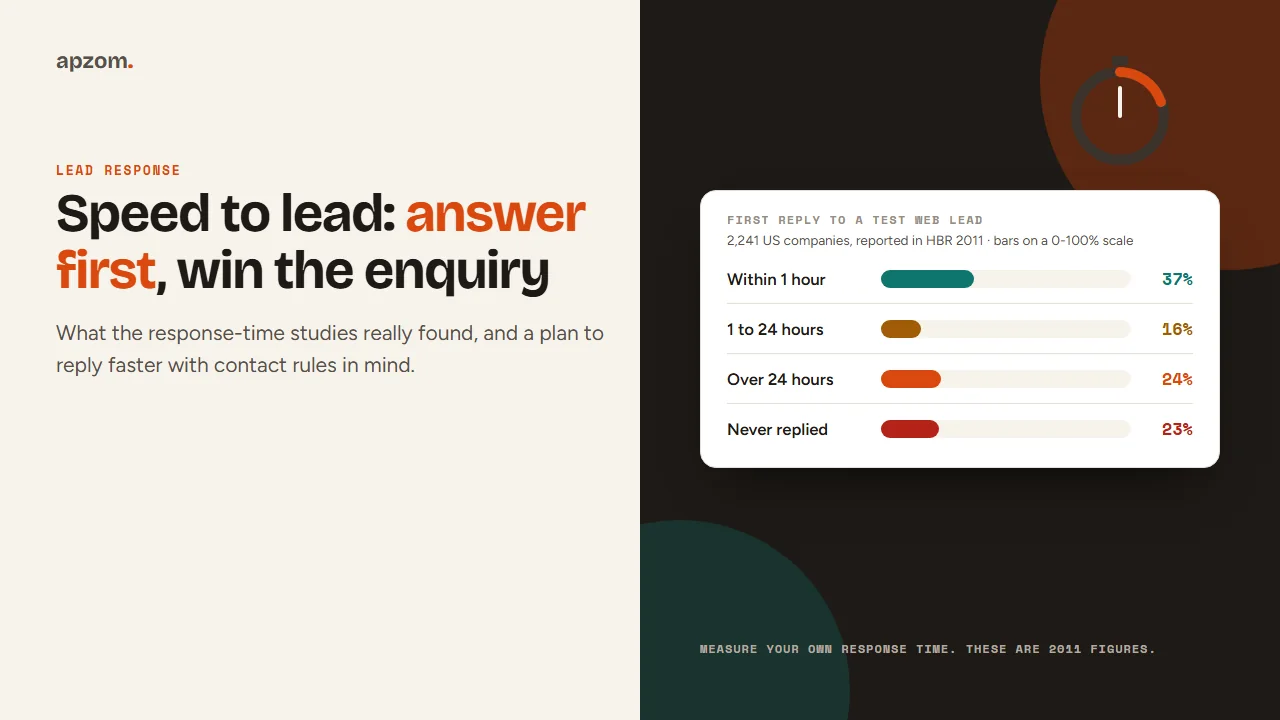
The short answer: Speed to lead is how quickly your business makes its first real response after someone enquires. It matters because enquiries go cold fast, and many businesses are slow. In an audit of 2,241 US companies reported in Harvard Business Review in 2011, only 37% replied to a test web lead within an hour, and 23% never replied at all. You don’t need a dramatic statistic to act on it: set a written response target for each type of lead, route every enquiry to a named person automatically, plan honestly for evenings and weekends, and measure your own response times against your own outcomes.
This guide is for owners, sales managers and marketers at service businesses anywhere in the world who pay for enquiries through ads, a website or listings and want more of them to turn into conversations. We explain what the well-known studies really found (several famous figures are miscited), give you a response plan you can set up this week, and list the contact rules that limit how you call or message a new lead in the US, UK, EU, Australia, Canada, the UAE and India.
Why response time decides who wins the enquiry
Someone who fills in a form may be asking other businesses too, and the one that answers while the question is still on their mind is better placed to get the first proper conversation. Every hour after that, the enquiry competes with their work, their family and your competitors’ replies.
Slow follow-up also makes your marketing look worse than it is. If half your leads are never reached, your ads, landing pages and cost per lead are judged on enquiries nobody worked. Before you change your targeting, check what happens after the form. Our guide to reducing your cost per lead and our article on low-quality Meta leads both start with the same check: how fast and how well you respond.
What the research actually says (and what it doesn’t)
Response-time statistics are some of the most miscited numbers in marketing. Here is what the original sources say, as we checked them on 16 November 2026.
Harvard Business Review, 2011
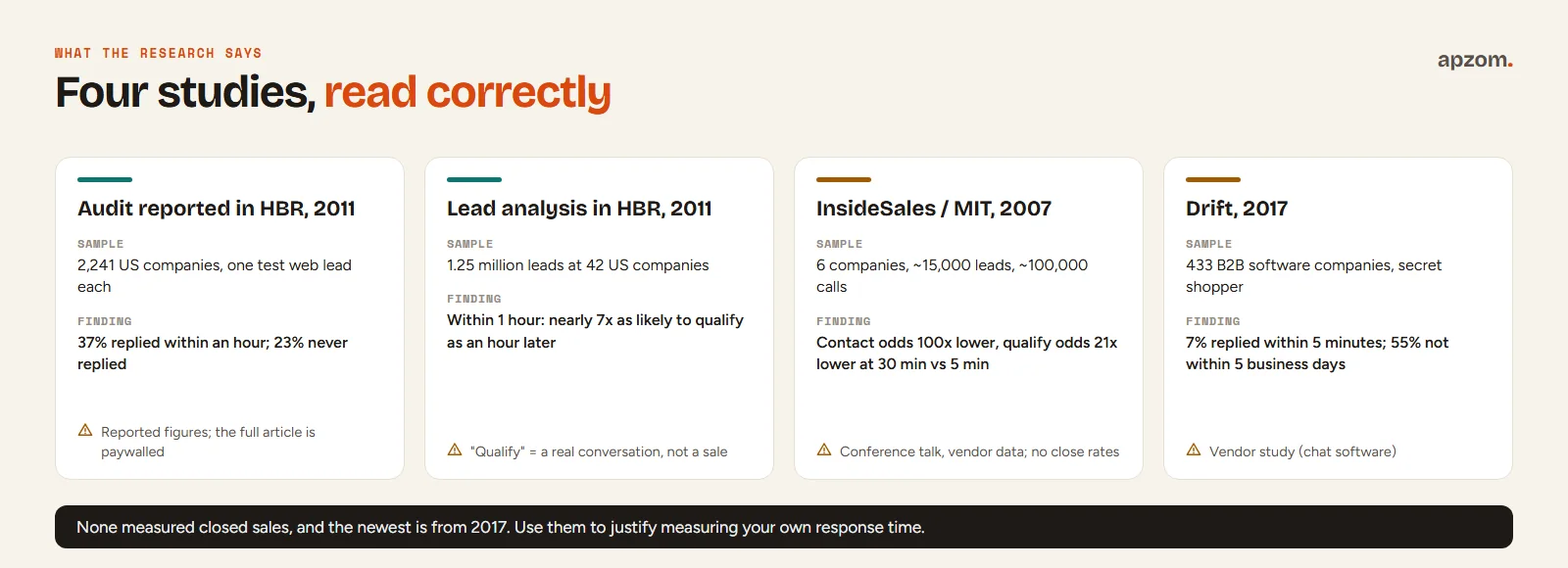
“The Short Life of Online Sales Leads” by James B. Oldroyd, Kristina McElheran and David Elkington (Harvard Business Review, March 2011) reported two separate pieces of research. The full article is behind HBR’s paywall, so the figures below come from contemporaneous reports of it:
- An audit of 2,241 US companies, each sent a test web lead. 37% replied within an hour, 16% within one to 24 hours, 24% took longer than 24 hours, and 23% never replied. Among the companies that replied within 30 days, the average response time was 42 hours.
- An analysis of 1.25 million leads at 42 US companies. Firms that tried to contact a lead within an hour were nearly seven times as likely to qualify it as firms that tried an hour later, and more than 60 times as likely as firms that waited 24 hours or more.
Two cautions. “Qualify” meant having a meaningful conversation with a key decision-maker, not closing a sale. And one of the authors, David Elkington, was chief executive of InsideSales.com, a sales software company, so the research is partly vendor-linked.
The “5 minutes” study, 2007
The famous “100 times” figure does not come from Harvard. It comes from the Lead Response Management Study, presented by Dave Elkington of InsideSales.com and James Oldroyd (then at MIT Sloan) at a MarketingSherpa summit on 16 October 2007. It used data from 6 companies, about 15,000 web leads and about 100,000 call attempts. It found that the odds of contacting a lead fell 100 times, and the odds of qualifying one fell 21 times, when the first call came at 30 minutes rather than within 5 minutes.
It was a conference presentation using one vendor’s data, not a peer-reviewed paper. It compared 5 minutes with 30 minutes, not with an hour, and it states that it did not look at close rates.
Later vendor studies
Later studies are vendor research, so treat them as signals, not benchmarks. Drift, a chat software company, ran a secret-shopper test on 433 B2B software companies in 2017: 7% responded within five minutes, and 55% had not responded within five business days. Velocify, a sales software company, reported large gains from calling within one minute in a 2012 study of about 3.5 million leads, mostly in mortgage, insurance and education, but its published deck does not state the baseline it compared against.
What to take from it
Every study points the same way: quick responses reach and qualify more leads, and most businesses respond more slowly than they think. None of them tells you the right number for your business, and the figures are 9 to 19 years old. Use them to justify measuring your own response time, not as a promise of what faster replies will earn.
Test your own response time first
Before you set targets, find out where you stand. A simple mystery-shop test takes about a week:
- Submit 5 to 10 test enquiries through every route a customer uses: website forms, ad lead forms, phone, WhatsApp, email and any listing sites. Use different days and times, including one evening and one weekend.
- Use real contact details you can monitor, and a believable request. Tell the sales manager in advance if you don’t want to surprise the team, or keep it quiet if you want to see the normal process.
- Record four things for each: when the enquiry was sent, when the first human response came, through which channel, and whether the reply answered the question or just said “we’ll be in touch”.
- Keep tests out of your data. Mark test enquiries clearly and exclude them from conversion tracking, so they don’t distort your ad optimisation and reports. Testing through live ads costs clicks, so keep those tests few and clearly marked.
- Check the plumbing. Did the form notification arrive? Did it go to a person, or a shared inbox nobody owns? Did an ad lead form reach your CRM, or does someone download a file once a week?
The last step often finds the biggest problem. Leads from Google Ads lead forms and Meta Lead Ads stay in the platform unless you connect them. Google’s help says Google Ads leads expire after 60 days, and Meta says its lead data is available for 90 days. Both offer webhook and CRM integrations that send each lead through as it arrives. If yours are downloaded by hand, that delay is part of your response time.
Set a response target for each type of lead
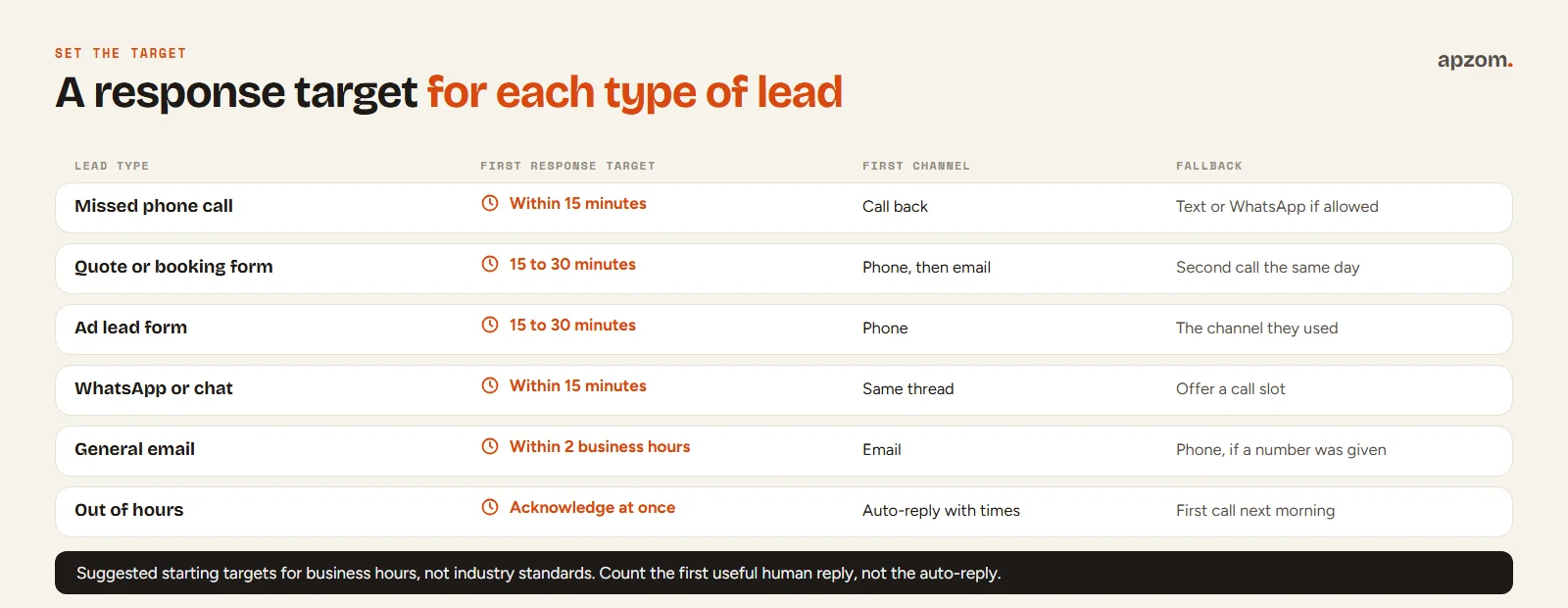
“As fast as possible” is not a target anyone can manage. Write down a response target, which sales teams call a service level agreement (SLA), for each type of enquiry, and agree it between sales and marketing. Here is a starting point to adapt. These targets are our suggestions, not industry standards:
| Lead type | First response target (business hours) | First channel | Fallback if no answer |
|---|---|---|---|
| Phone call missed | Call back within 15 minutes | Phone | Text or WhatsApp if allowed, then email |
| Quote or booking form | Within 15 to 30 minutes | Phone, then email | Second call later the same day |
| Ad lead form (Google or Meta) | Within 15 to 30 minutes | Phone | Message through the channel they used |
| WhatsApp or chat message | Within 15 minutes | Same thread | Offer a call slot |
| General email enquiry | Within 2 business hours | Phone if a number was given | |
| Out of hours, any type | Acknowledge at once; human reply at the start of the next working day | Automatic acknowledgement | First call of the morning |
A few rules make the targets work:
- Respond in the channel they chose, first. Someone who sent a WhatsApp message wants a reply there, not a call out of the blue.
- A useful first reply beats a fast empty one. “Thanks, we’ll be in touch” doesn’t count. Count the first response that moves the enquiry on: an answer, a question that qualifies them, or a booked call.
- Name an owner for every lead. Shared inboxes and “whoever is free” are a common reason leads wait. Route each enquiry to one person, with a back-up when that person is away.
- Write the first messages in advance. For example (illustrative): an acknowledgement such as “Thanks for your enquiry about a quote. Priya from our team will call you before 11:30 today, or reply here with a better time.” and a first-call opener such as “You asked about a quote for an office fit-out. Have I caught you at a good moment for five minutes?”
- Plan the follow-up, not just the first call. If you can’t reach someone, try again on a planned schedule over the next few days, using the channels they gave you. Velocify’s vendor study reported that 93% of the leads it saw convert had been reached by the sixth call attempt. Treat that as a direction, and stop as soon as someone asks you to.
Not sure what happens to your leads after the form? Ask for a Free Growth Audit. We review your forms, ad lead form connections, alerts and routing, and tell you where enquiries are likely to wait and what to fix first.
Route leads so nobody has to remember
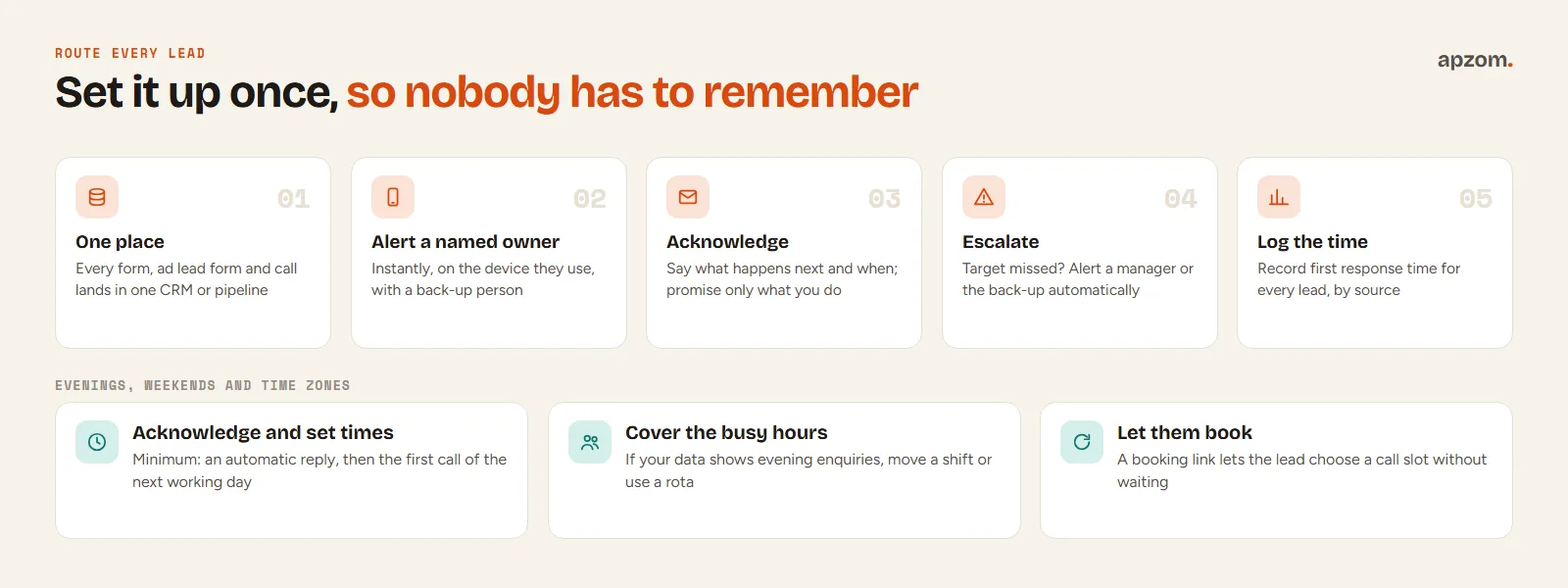
Slow responses are often not about effort. Leads arrive somewhere nobody is looking. Set up routing once, and it works every day:
- Send every enquiry to one place. A CRM, a shared pipeline or, for a small team, a single sheet with alerts. Connect ad lead forms with the platform’s webhook or a CRM integration rather than downloading files.
- Alert a named person instantly, on the device they actually use: a push notification, a text or a team chat message.
- Send an automatic acknowledgement that tells the person what happens next and when (“We’ll call you within 30 minutes during office hours, 9am to 6pm”). Promise only what you will deliver.
- Escalate when the target is missed. If no one has responded within the target, alert a manager or a back-up person automatically.
- Log the first response time for every lead, so you can measure it. Many CRMs can record this if the response is logged in them.
For phone leads, make sure calls from ads and your website can be traced. Our guide to tracking phone calls from Google Ads explains how. Note that Google Business Profile no longer offers chat or call history: Google discontinued both on 31 July 2024, so you can’t rely on the profile to show you missed calls.
Evenings, weekends and time zones
An enquiry at 9pm on a Saturday is still an enquiry. You have three honest options:
- Acknowledge and set expectations. An automatic reply that says when you will respond, and then a call first thing on the next working day. This is the minimum.
- Cover the busiest hours. If your own data shows many enquiries in the evening, move a shift or use a rota for those hours instead of staffing all night.
- Let people book themselves. A booking link in the acknowledgement lets the lead choose a call slot without waiting for you.
If you sell across time zones, set targets in the customer’s local business hours, and check calling-hour rules in their country (below). A fast call at 7am their time is not good service.
Contact rules that limit how fast you can call or message
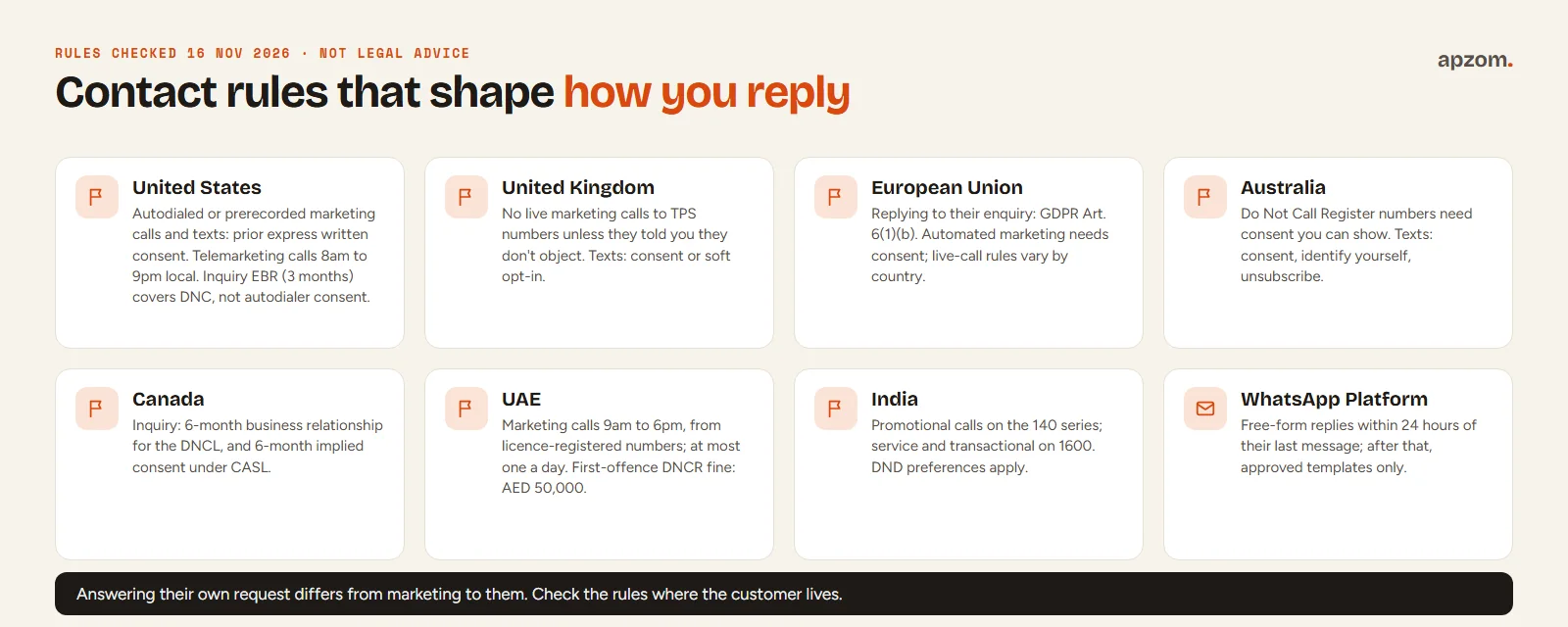
Answering someone’s own enquiry is generally treated differently from unsolicited marketing, but the rules still shape how you respond. This is a summary of what we checked on 16 November 2026, not legal advice, and several of these rules changed in 2025 and 2026. Check the rules where your customer lives, and ask a lawyer if you call or message at scale.
- United States. Under the Telephone Consumer Protection Act rules (47 CFR 64.1200), marketing calls or texts to a mobile number made with an autodialer or a prerecorded or artificial voice need prior express written consent. Telephone solicitations are not allowed before 8am or after 9pm in the called person’s local time. An inquiry creates an established business relationship for 3 months under the FCC rules (90 days under the FTC’s Telemarketing Sales Rule), which can allow telemarketing calls to a number on the National Do Not Call Registry. It does not replace consent for autodialed or prerecorded calls and texts to mobiles. If someone tells you to stop, by any reasonable method, honour it promptly: the FCC rule allows no more than 10 business days. Updated FCC rules on revoking consent take effect on 25 November 2026. Some states have stricter rules of their own. The FCC’s “one-to-one consent” rule was struck down by the 11th Circuit Court of Appeals in January 2025 and never took effect.
- United Kingdom. Under the Privacy and Electronic Communications Regulations (PECR), you must not make live marketing calls to numbers registered with the Telephone Preference Service unless that person has told you they don’t object to your calls. Automated marketing calls need specific consent. Marketing texts and emails need consent or the “soft opt-in”. The ICO’s guidance treats a message as solicited when the person specifically asked for it, so sending the quote they requested is different from adding them to your marketing. Since 5 February 2026, PECR fines can reach £17.5 million or 4% of global annual turnover, whichever is higher.
- European Union. The GDPR allows you to process someone’s details to take steps they asked for before a contract (Article 6(1)(b)), which covers replying to their enquiry. Automated calls, texts and emails for marketing generally need prior consent under the ePrivacy Directive (with a soft opt-in for email to existing customers), and each member state sets its own rules for live marketing calls.
- Australia. Telemarketing calls to numbers on the Do Not Call Register need the person’s consent, which you must be able to show. Under the Spam Act 2003, commercial texts and emails need consent, must identify you and must include a working unsubscribe option. The ACMA says express consent is preferable to relying on inferred consent.
- Canada. An inquiry creates an existing business relationship for 6 months under the CRTC’s National Do Not Call List rules, and implied consent for 6 months under Canada’s Anti-Spam Legislation (CASL), which covers texts and emails.
- United Arab Emirates. Cabinet Resolution No. 56 of 2024, enforced by the TDRA since 27 August 2024, limits marketing calls to 9am to 6pm, to one call a day and two a week if unanswered, and to local numbers registered under the company’s trade licence. Calling a number on the Do Not Call Register can be fined AED 50,000 for a first offence.
- India. Under TRAI’s telecom commercial communication rules, businesses must send promotional calls and texts through TRAI’s registered headers and number series (the 140 series for promotional calls), and customers’ DND preferences apply. TRAI has also allocated the 1600 series for service and transactional calls, now mandatory for banks, other financial firms and government senders. Record the customer’s consent, and check your telecom provider’s DLT and number-series requirements before calling or texting at scale.
WhatsApp: the 24-hour window
If you use the WhatsApp Business Platform (the API used through providers), Meta’s rules shape your response plan. Meta’s developer documentation says that when a customer messages you, a 24-hour customer service window opens, and it resets with each new message from them. Inside it you can send free-form replies, not only templates. Outside it you can only send pre-approved template messages, and only to people who have opted in. For a lead who messages you on a Friday evening, a Monday reply may need a template. Meta now charges per message, and its pricing rules changed again on 1 October 2026, so check Meta’s pricing page before you budget. If your leads come from Click-to-WhatsApp ads, Meta’s pricing page says a free entry point window can open that “may remain open for up to 7 days”. The free WhatsApp Business app is simpler; the window, template and pricing rules above apply to the Platform.
Measure response time against your own results
You can’t manage what you don’t measure. Track these each week:
- Median time to first response, overall and by lead source. The median is fairer than the average, which a few forgotten leads can distort.
- Share of leads answered within target, by person and by channel.
- Contact rate: the share of leads you actually spoke to or exchanged messages with.
- Qualified rate by response-time band, for example under 15 minutes, 15 to 60 minutes, 1 to 24 hours and over 24 hours. After a few months, this tells you what speed is worth in your own business, which no published study can.
- Leads with no response at all. This number should be zero. If it isn’t, fix routing before anything else.
Record where each lead came from in your CRM, so you can compare sources fairly. Our guides to creating UTM links and measuring marketing ROI show how to connect leads back to campaigns.
Common mistakes
- Quoting the wrong study. “Harvard says 21 times more likely to close” mixes up two studies and two measures. If you use a figure in a sales meeting, use it correctly.
- Counting the auto-reply as a response. It sets expectations; it doesn’t answer anyone.
- Speed without substance. A call in two minutes from someone who can’t answer basic questions can do more harm than a well-prepared call in twenty.
- Calling when they asked for a message. Use the channel the person chose first.
- One target for every lead. A missed call and a general email enquiry need different targets.
- Treating every lead as fair game for marketing. Replying to an enquiry is not permission to add someone to your marketing lists. Follow the rules for the country they live in.
- Fixing ads before follow-up. If leads wait a day, better targeting just sends more people into the same queue. Our guide to improving Google Ads lead quality shows how to tell a targeting problem from a follow-up problem.
How Apzom can help
Our performance marketing work covers what happens after the click as well as before it: we can connect your ad lead forms and website forms to one place, set up alerts, routing and acknowledgements, and report response time and lead outcomes by source, on top of the conversion tracking we set up first. We set this up alongside our Google Ads management and Meta ads management, and our conversion rate optimization work covers the forms themselves.
Our published lead-generation results are monthly Meta lead volumes for two property businesses: HillTown Group, with 600+ leads every month from Meta ads, for 12 months running, and Kingston Flats, with 560+ Meta leads every month since June 2025. We have not published response-time data for any client, so we won’t quote a figure we can’t show you.
We work with clients worldwide, remotely, from our base in Ahmedabad, India.
Get your Free Growth Audit and Quote. We review your lead journey from the ad or search result to the first reply: forms, lead form connections, alerts and routing, after-hours handling, and how response time is reported. You get a prioritised list of fixes, and a quote if you want us to set them up.
No obligation and no guaranteed results. Prefer to talk first? Contact us or see our performance marketing services.
Frequently asked questions
What is a good lead response time?
There is no universal number. Studies of web leads found that responses within the first hour, and especially within minutes, reached and qualified more leads, but those studies are from 2007 to 2017. Set a target per lead type, such as 15 to 30 minutes for quote requests in business hours, and test what speed is worth in your own data.
Is the “respond in 5 minutes” statistic real?
It comes from a 2007 conference presentation by InsideSales.com and an MIT Sloan researcher, using 6 companies’ data. It found the odds of contacting a lead fell 100 times, and of qualifying it 21 times, when the first call came at 30 minutes rather than within 5. It did not measure closed sales, and it was not a Harvard study.
Does an automatic reply count as responding?
It helps, because it tells the person their enquiry arrived and when to expect a reply. But it doesn’t qualify or help them. Measure the first useful human response separately.
Can I call a lead straight away if they filled in a form?
Usually you can respond to their own enquiry, but rules still apply: calling hours, do-not-call registers, consent for automated calls and texts, and country-specific rules in places such as the UAE and India. Check the rules where the customer lives. This isn’t legal advice.
How many times should we try to reach a new lead?
Plan several attempts over a few days, across the channels the person gave you, and stop when they ask you to. A vendor study by Velocify found most of the leads that converted had been reached by the sixth call attempt, but your own contact rate is the better guide.
Should we answer leads at night and on weekends?
At least acknowledge them automatically, say when you’ll reply, and call first thing on the next working day. If your data shows many evening enquiries, cover those hours with a rota or offer a booking link.