
The short answer: a digital marketing agency for accounting firms should help you win the clients you actually want, inside the rules of your professional body. That means being easy to find when a business owner or individual searches for help, proving on your website that qualified people will handle their work safely, and planning marketing around the filing calendar so new clients arrive when you have capacity to serve them.
This guide is for partners and practice managers at CPA firms, chartered accountancy firms, CA firms, tax practices and bookkeeping firms. It explains why accounting marketing works differently, which rules apply in the US, India and the UK, how to choose a client niche, what your website has to show, which channels fit which kind of firm, and how to measure marketing in signed engagements and recurring fees. If you run a smaller practice and want the wider basics first, our guide to digital marketing for small businesses is a good place to start.
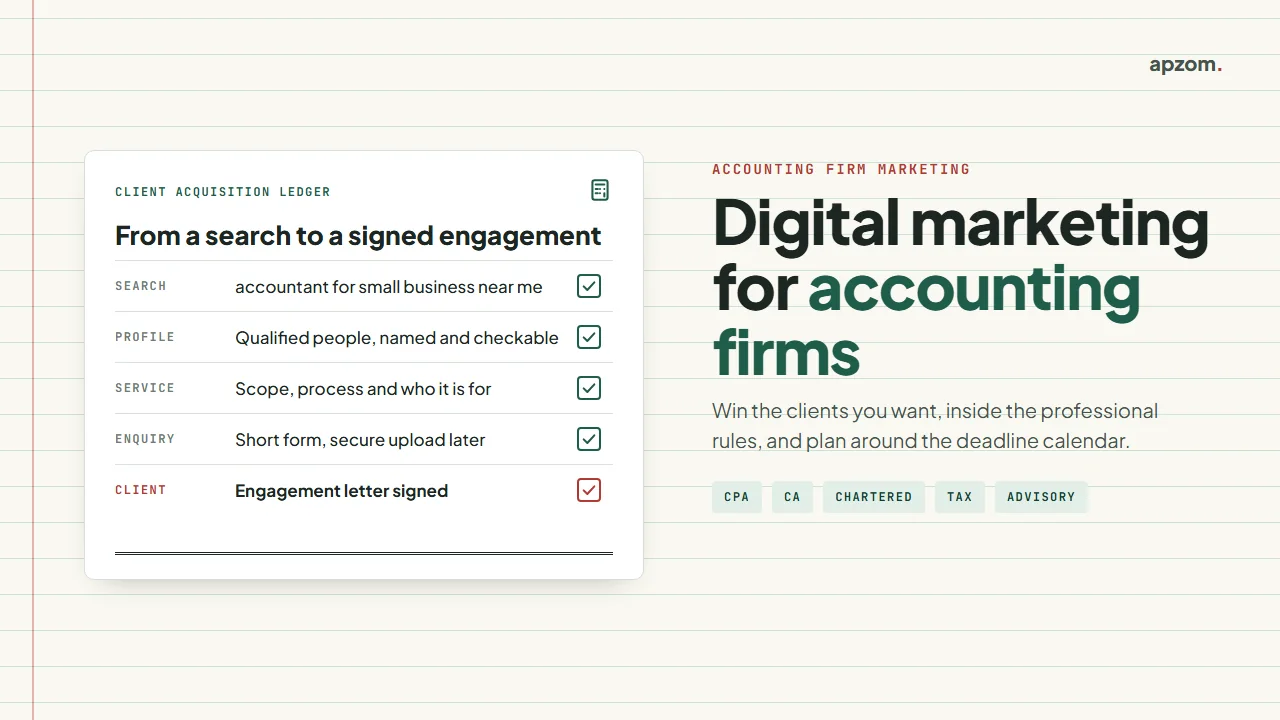
Why accounting firm marketing is different
Most marketing advice is written for businesses that sell something once. An accounting firm sells a long relationship, built on trust, regulated by a professional body and squeezed by deadlines. Five things set it apart.
- Clients hand over their most private information. Income, tax records, bank details, business accounts. Before anything else, a prospective client wants to know that you are qualified and that their information is safe.
- Advertising is regulated. Accountants answer to professional bodies and, in some cases, tax authorities. What you can say, and in some countries whether you can advertise at all, is set by rules, not by your agency.
- Demand follows the filing calendar. Searches for tax help rise before deadlines, exactly when your team has the least time to take on new work.
- The value is in the years, not the first job. A client who stays for many years and adds bookkeeping, payroll or advisory work is worth far more than their first tax return.
- Referrals still matter most. But a referred prospect almost always searches for you before calling. Your website and profile decide whether the referral turns into a conversation.
First, which kind of firm are you?
“Accounting firm” covers very different businesses. A practice preparing individual tax returns and a firm offering outsourced finance to growing companies need different marketing. We use a simple firm model map to decide where to start.
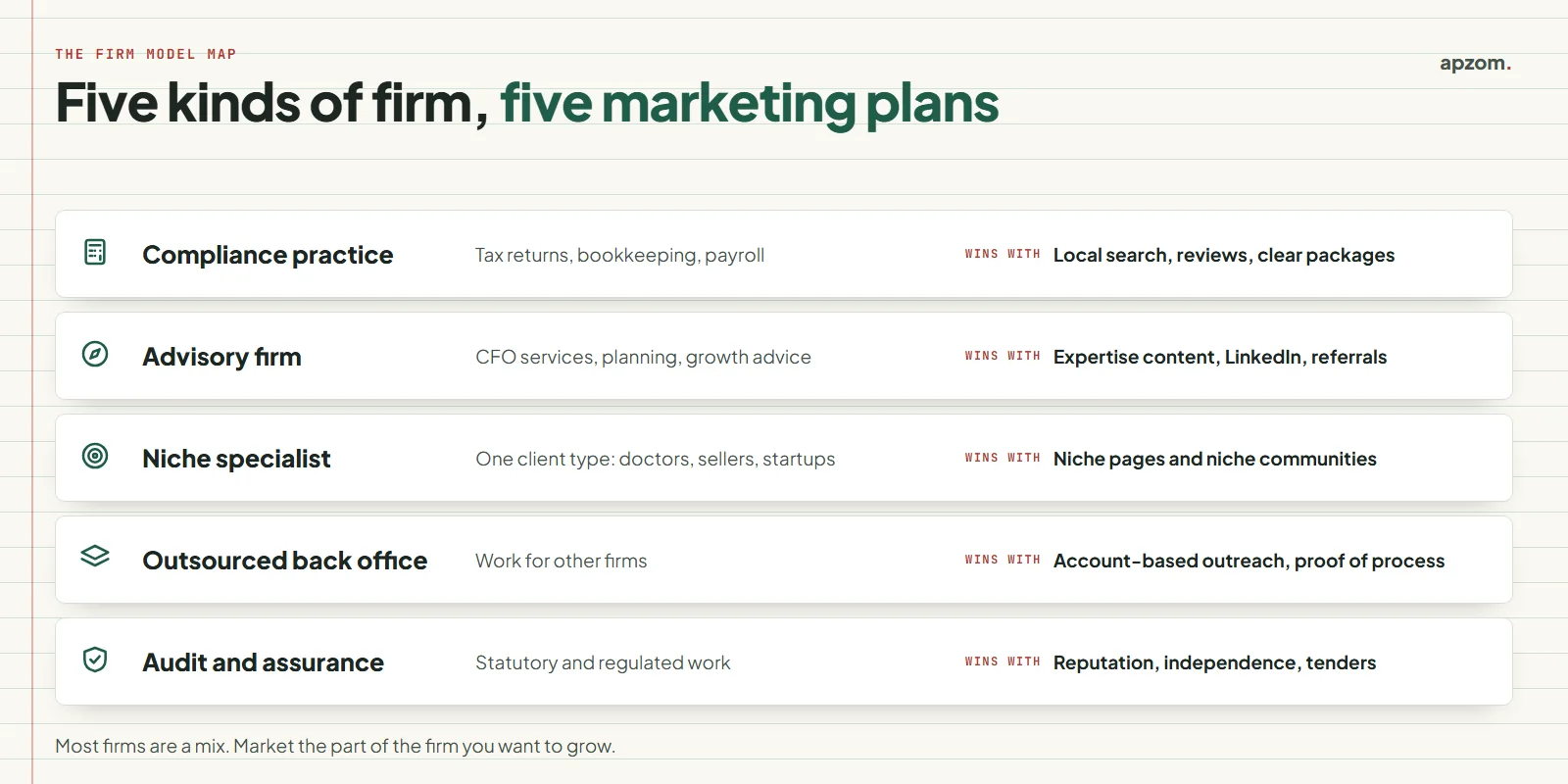
| Firm model | Typical work | What wins clients | Main marketing risk |
|---|---|---|---|
| Compliance practice | Tax returns, bookkeeping, payroll, statutory filings | Local search, reviews, clear packages and start dates | Competing on price alone |
| Advisory firm | Fractional CFO work, planning, forecasting, growth advice | Expertise content, LinkedIn, referral partners | Vague promises that sound like every other firm |
| Niche specialist | One client type, such as doctors, online sellers, startups or non-resident clients | Pages and content that show deep knowledge of that niche | Claiming a niche without real clients in it |
| Outsourced back office | Work for other accounting firms | Direct outreach, proof of process, data security | Confidentiality and quality questions |
| Audit and assurance | Statutory audits, regulated assurance work | Reputation, independence, tender responses | Independence rules limit what you can offer |
Most firms are a mix. The useful question is: which part of the firm do you want to grow? Market that part, and let the rest keep coming through referrals.
The rules come first
Before an agency writes a single advert for you, it should know which rules apply. They differ by country and by professional body, and some are much stricter than most marketers expect. What follows is a summary of the main rules we check, not legal advice. Your professional body’s current guidance is the final word.
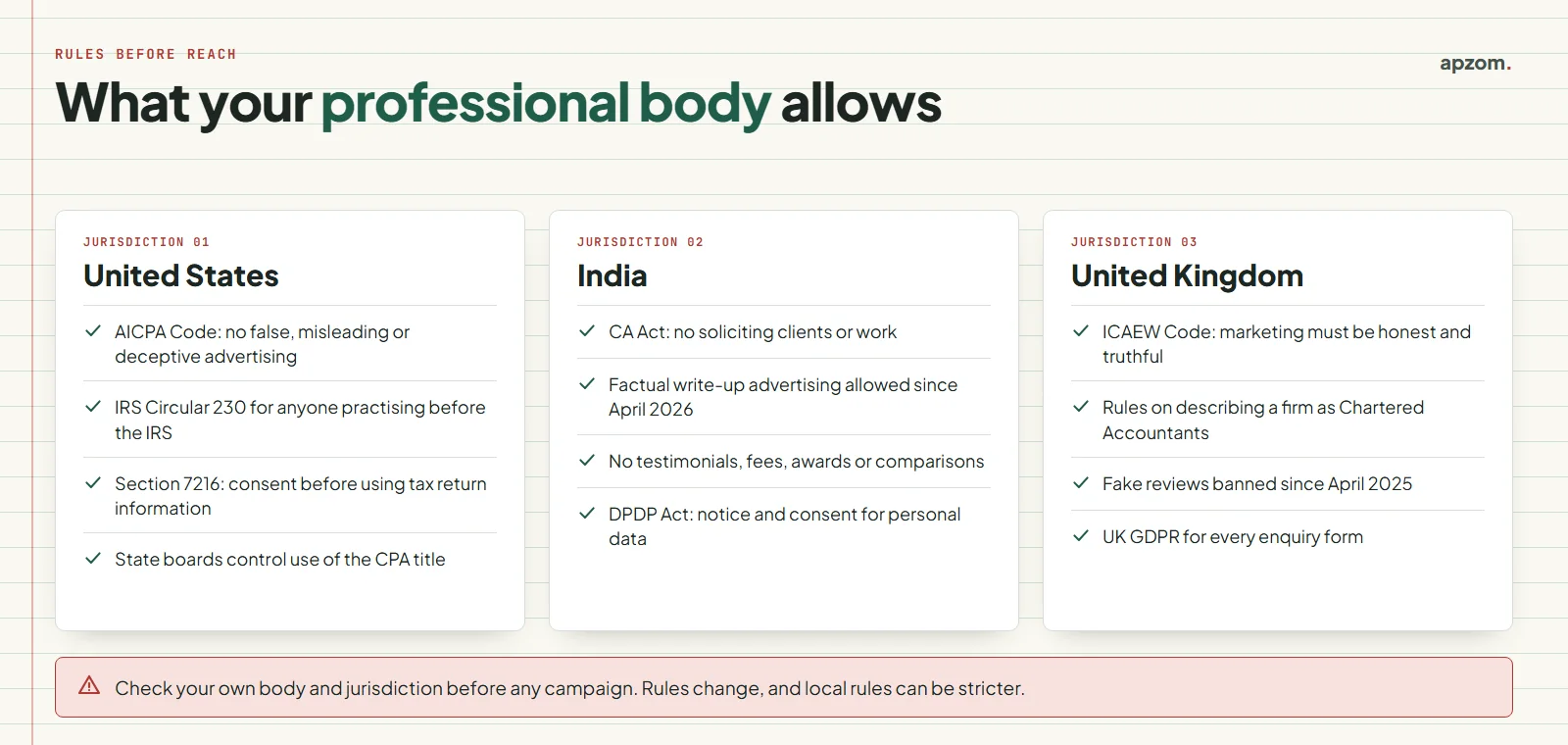
United States: CPA firms and tax practices
- The AICPA Code of Professional Conduct (section 1.600.001) says a member in public practice shall not seek clients through advertising or other solicitation that is false, misleading or deceptive, and bans solicitation through coercion, over-reaching or harassing conduct. Advertising itself is allowed. The Code also says members must not do through others what they cannot do themselves, so your agency’s work counts as yours.
- State boards of accountancy license CPAs and CPA firms and decide who can use the CPA title and “CPA” in a firm name. Check your state board’s rules before a campaign, especially if you work across states.
- IRS Circular 230 covers anyone who practises before the IRS, including CPAs and enrolled agents. Section 10.30 bans false, fraudulent, coercive, misleading or deceptive claims. It allows published fixed fees, hourly rates and fee ranges, as long as you honour them for at least 30 days. Enrolled agents must not call themselves “certified”. Preparers in the IRS Annual Filing Season Program may mention their Record of Completion, but may not describe it as “certified”, “enrolled” or “licensed”.
- Section 7216 of the Internal Revenue Code restricts how tax return preparers use and disclose tax return information. Without written consent, you can use basic client contact details to send tax and general educational information or to offer more tax return preparation. Marketing bookkeeping, advisory or anything else using that information needs a written consent that names each service, obtained before the return is presented for signature. This matters for every email campaign and cross-sell.
- The FTC Safeguards Rule treats tax preparation firms, and many accounting firms, as financial institutions that need a written information security programme. Since 13 May 2024 they must also notify the FTC of a breach involving unencrypted information of 500 or more consumers. Your website forms, email and client portal are part of that programme.
India: chartered accountants and CA firms
The rules for chartered accountants in India changed this year, and much of the advice online is now out of date.
- The Chartered Accountants Act, 1949 still treats soliciting clients or professional work, directly or indirectly, as professional misconduct, with limited exceptions such as responding to tenders and enquiries.
- Since 1 April 2026, under the 13th edition of the ICAI Code of Ethics, a CA firm may advertise through a factual “write-up” of its services and firm particulars, in print, on websites and on social media, subject to the ICAI Council’s guidelines. The ICAI describes the revision as including a relaxation in advertisement norms.
- What the write-up must not contain: exaggerated claims, disparaging references or unsubstantiated comparisons with other firms, testimonials or endorsements, fees charged, awards (other than those from the Central or a State Government or a regulator) or accreditations. Firm logos and monograms remain prohibited. Client names are now allowed, but only with the client’s permission.
- Services reserved for chartered accountants, such as audit and attestation, may only be shown to people who come looking for them (the ICAI calls this the “pull” model). Firms also must not advertise in a way that solicits people to visit their website or like their social pages.
- Paid search ads are not expressly addressed in the 2026 Code. Before running Google Ads or sponsored listings, check with the ICAI’s Ethical Standards Board.
- The Digital Personal Data Protection Act, 2023 applies to personal data you collect through forms and portals. Its Rules were notified on 13 November 2025, and most obligations on businesses, including notices, security safeguards and breach reporting, apply from 13 May 2027.
United Kingdom: chartered accountants
- The ICAEW Code of Ethics (section 115 of the 2026 edition) requires marketing to be honest and truthful, with no exaggerated claims and no disparaging references or unsubstantiated comparisons to the work of others. Other bodies, such as ICAS and ACCA, have their own codes.
- Describing your firm as “Chartered Accountants” is controlled by ICAEW’s regulations. For a partnership or LLP, for example, chartered accountants must hold more than half of the voting rights. Check the rules before using the description on your website or Business Profile.
- Fake reviews and concealed incentivised reviews have been banned practices under the Digital Markets, Competition and Consumers Act 2024 since April 2025.
- UK GDPR applies to every enquiry form and newsletter.
The practical result: a good accounting marketing agency builds the rules into the plan from day one, rather than finding out about them after a complaint.
Choose a niche you can prove
The fastest way for an accounting firm to stand out is to be the obvious choice for one kind of client. “Accountants for dentists”, “tax for non-resident Indians”, “bookkeeping for online sellers” and “outsourced finance for SaaS startups” are all easier to market than “full-service accounting”.
But a niche has to be real. Before committing to one, test it.
- Do we already have several clients like this? You need real experience, not a target market.
- Do we know things about them that a general firm does not? Their tax rules, their software, their cash flow patterns, their common mistakes.
- Can we reach them? Through search, associations, events, communities or referral partners who serve them.
- Can they pay a fee that works for us? A niche of clients who only want the cheapest return will not build the firm.
A niche does not mean turning other clients away. It means your marketing has one clear story, and your website shows real depth for that client type.
The deadline calendar: market ahead of the rush
Accounting demand is seasonal in a way most marketing plans ignore. In the US, individual federal returns are normally due on 15 April. In the UK, online Self Assessment returns are due by 31 January. In India, the due date for most individuals is 31 July, with later dates for some business and audit cases, and the new Income-tax Act, 2025 has applied since 1 April 2026. Searches for tax help rise as these dates approach, which is exactly when your team is busiest.
So we plan marketing around the calendar, not against it. We call this deadline-calendar marketing.
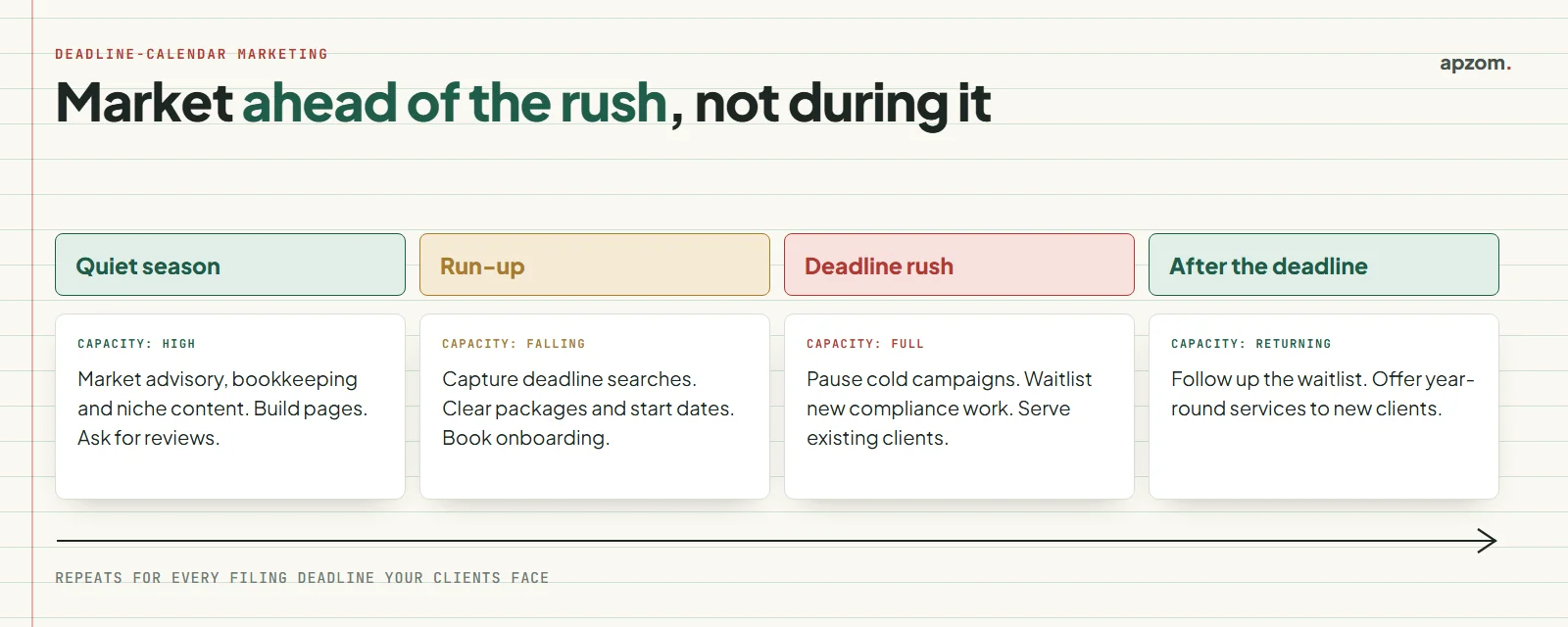
| Season | What to do |
|---|---|
| Quiet season | Market advisory, bookkeeping and niche services. Publish and update pages. Ask happy clients for reviews. Build referral partnerships. |
| Run-up to a deadline | Capture people searching for help. Be clear about packages, document lists and the last date you can take on new work. Book onboarding calls. |
| Deadline rush | Stop campaigns for new compliance work if you are full. Offer a waitlist. Look after existing clients first. |
| After the deadline | Follow up the waitlist and late filers. Offer year-round services, so new clients stay beyond one return. |
The most expensive mistake is paying for adverts in the busiest weeks, then taking on clients you cannot serve well. Unhappy first-year clients do not stay, and they do not refer.
What your website has to prove
Your website is where referrals and searchers decide whether to contact you. For an accounting firm it has to answer five questions. We call this the trust ledger.
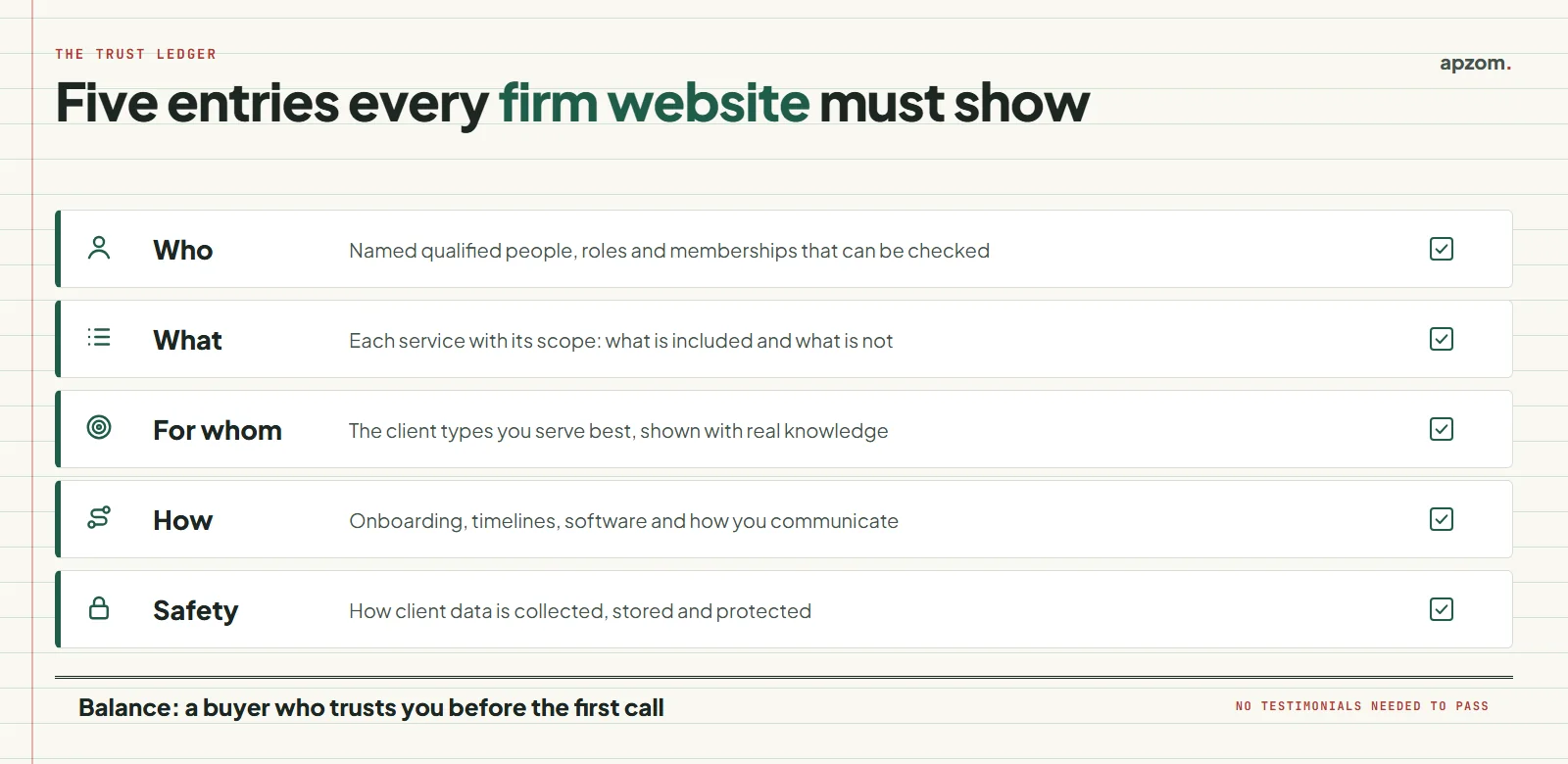
| Entry | What to show |
|---|---|
| Who | Named partners and team members, their qualifications and memberships, and their roles |
| What | Each service on its own page, with its scope: what is included, what is not and what the client needs to provide |
| For whom | The client types you serve best, shown through specific knowledge, not a list of industries |
| How | How onboarding works, typical timelines, the software you use and how clients reach you |
| Safety | How you collect, store and protect client information, in plain language |
Service pages
Give each main service its own page: individual tax returns, business tax, bookkeeping, payroll, advisory, audit or whatever you want more of. Each page should explain who it is for, what is included, the process, what the client needs to provide and how to start. If your professional rules allow it, say how you price the work, whether fixed packages, ranges or a quote after a call. Clear pricing language filters out poor-fit enquiries. In the US, Circular 230 allows published fees if you honour them; in India, the ICAI guidelines do not allow fees to be shown.
Team pages
People choose accountants, not logos. A page for each partner and senior adviser, with qualifications, areas of focus and a real photo, does more for trust than any slogan. Only state qualifications and memberships that are current, and use the exact title your professional body allows.
Content that shows expertise
The best content for an accounting firm answers questions your clients actually ask: what records to keep, how a rule change affects them, what to do before a deadline. Tax content is “your money” content, so it needs extra care.
- Name the jurisdiction and tax year in every guide. A tax rule without a country is not useful and may be wrong.
- Date it and review it when rules change.
- Have a qualified person write or review it, and say so on the page.
- Do not promise outcomes such as savings or refunds you cannot guarantee.
The enquiry path: protect data from the first click
An accounting enquiry form should collect just enough to qualify the lead and book a call. It should not ask for tax identification numbers, bank details or documents.
| Ask on the form | Why |
|---|---|
| Individual or business, and business type | Routes the enquiry to the right person |
| Services needed | Filters out work you do not do |
| Rough size, such as turnover band or number of employees | Helps you judge fit and fee level |
| Any deadline they are facing | Tells you if you can realistically help |
| Current accountant, if any | Shows whether it is a switch or a new client |
| How they heard about you | Your best source of marketing data |
Collect documents and identity details later, through a secure client portal, after an engagement letter is in place. This protects the client, keeps your firm on the right side of data protection law, and looks more professional.
Respond quickly. A prospect contacting an accountant often contacts more than one, and the first firm to book a proper conversation usually has the advantage.
Getting enquiries, but not the clients you want? An Accounting Firm Growth Audit checks your service and team pages, Business Profile, enquiry form and campaigns against the rules that apply to your firm, and shows where good clients are slipping away. Free, with no obligation.
Channels: what fits which firm
| Channel | Best job | Fits best | Watch out for |
|---|---|---|---|
| Google Business Profile | Local discovery and reviews | Compliance practices and local firms | Using a name or category that breaks profile or professional rules |
| SEO | Being found for services, niches and questions | Every firm, especially niche specialists | Thin tax content with no jurisdiction or date |
| Google Ads | Capturing high-intent searches before deadlines | Compliance practices with spare capacity | Paying for clicks in weeks you cannot take clients, and any professional body limits on paid ads |
| Credibility with business owners and finance leaders | Advisory firms and outsourced services | Posting without a point of view | |
| Referral partners | Steady, high-trust introductions | Every firm | Professional rules on referral fees and commissions |
| Email newsletter | Staying useful to clients and contacts | Every firm | Consent and, in the US, Section 7216 limits on using tax return information |
| Webinars and talks | Showing expertise to a niche | Advisory firms and niche specialists | Turning education into a sales pitch |
Google Business Profile and local search
For firms that serve local clients, the Business Profile is often the first thing a searcher sees. Use your real business name, choose the most specific primary category Google offers for your main work (such as an accountant, tax preparation or bookkeeping category), add secondary categories only for services you really offer, list your services, keep hours accurate through deadline season, and add real photos of your office. Our local SEO services cover this in detail.
SEO
SEO for an accounting firm is about service pages, niche pages and helpful guides that answer real questions for a named jurisdiction. It builds slowly and lasts. Our SEO services start with the pages that bring enquiries, not with a blog calendar.
Google Ads
Paid search works best for specific services with clear intent, such as “small business bookkeeping” or “tax return for rental income”, in your area, at times you have capacity. Use negative keywords to filter out job seekers, students and people looking for free software. Our Google Ads management team builds campaigns around the calendar described above. Google Ads has no policy aimed specifically at accounting or tax ads, but CA firms in India should check with the ICAI first, because the 2026 Code does not expressly cover paid search.
LinkedIn and referral partners
For advisory and business-focused firms, LinkedIn is where buyers check you out. Partners who post useful, specific commentary on rules and business finance build credibility over time. Referral partners such as lawyers, bankers, financial planners and business advisers can be the best source of good clients, but follow your professional rules on referral fees and commissions, and disclose them where the rules require it.
Reviews and testimonials: rules first
Reviews help clients choose, but accounting firms face two extra constraints: professional rules on testimonials and strict confidentiality.
- Check whether your professional body allows testimonials on your own website. In India, the ICAI guidelines do not allow testimonials or endorsements in a CA firm’s write-up. Rules differ by country and body.
- Ask every client the same way. Google’s review policy says businesses must not discourage negative reviews or selectively ask only happy clients, and must not offer incentives for reviews.
- Never fake or buy reviews. In the US, the FTC’s rule on consumer reviews and testimonials has banned fake reviews and incentives tied to positive or negative reviews since 21 October 2024, and the FTC has said that asking only happy customers could still break the wider FTC Act. In the UK, fake reviews have been banned practices since April 2025.
- Never confirm someone is a client in a review reply. Even a polite reply can reveal confidential information. A short, general response that invites the reviewer to contact the firm directly is safer.
AI search and answer engines
People now ask AI assistants questions like “do I need an accountant for my side business?” or “which accounting firms in my area help startups?” These tools draw on the same web pages as search engines. What helps is what builds trust anyway: clear service and niche pages, named qualified authors, dated guides tied to a jurisdiction, and consistent business details across your website, profile and directories. Our AEO services and GEO services explain how we approach this.
Measure marketing in engagements and recurring fees
The right question is not “how many leads did we get?” but “which channels brought clients we want to keep?” We use a client value scorecard.
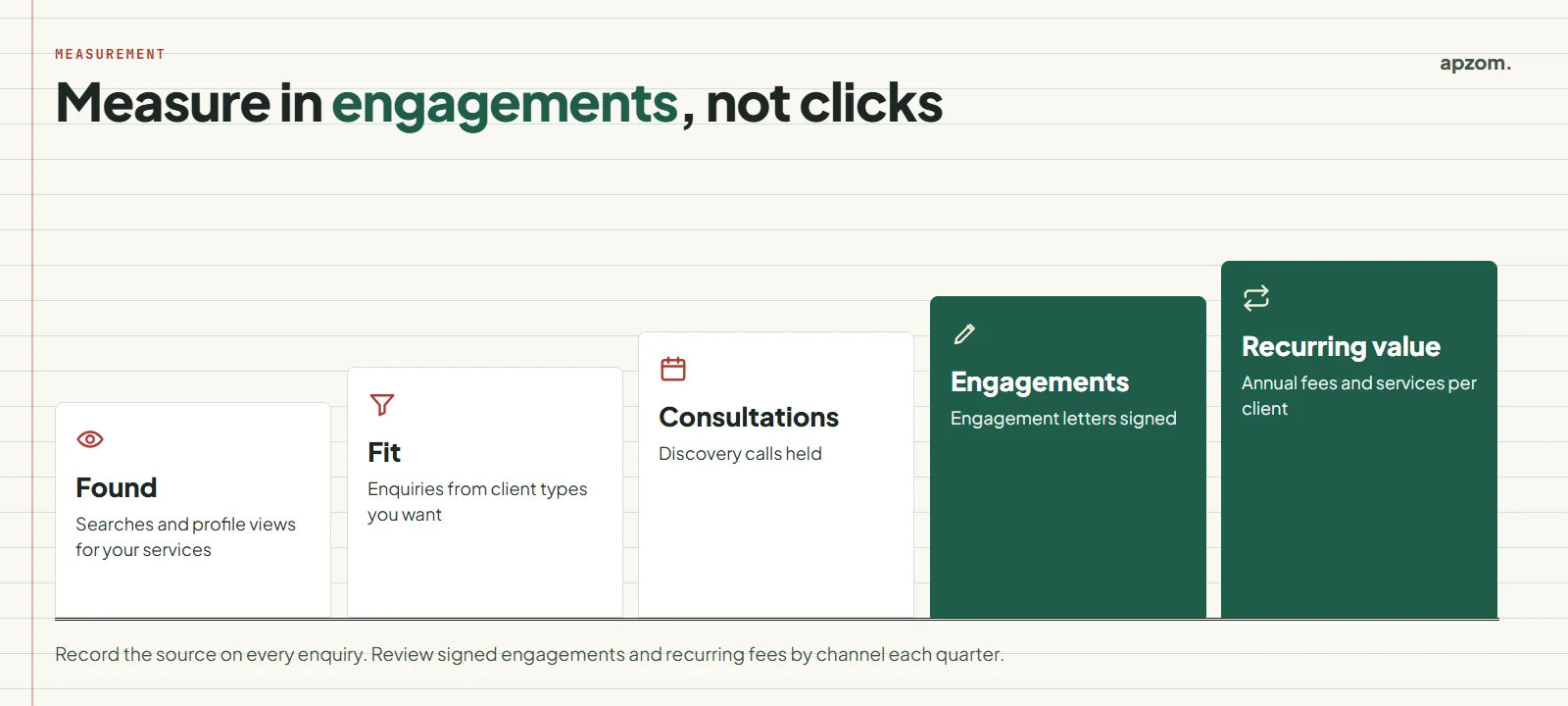
| Stage | What to track |
|---|---|
| Found | Search impressions, profile views and website visits for your main services |
| Fit | Share of enquiries from the client types and services you want |
| Consultations | Discovery calls or meetings held |
| Engagements | Engagement letters signed, by source |
| Recurring value | Annual fees per client and number of services per client, by source |
Ask “how did you hear about us?” on every enquiry and record it against the client. After a year, you will know which channels bring clients who stay and grow, which is the only number that really matters for an accounting firm.
A 90-day starting plan
Days 1 to 30: foundations
- Check the advertising and data rules that apply to your firm, and write them down for your team and agency.
- Choose the part of the firm to grow and test your niche.
- Fix your Business Profile, team pages and contact details. Set up tracking and the “how did you hear about us?” question.
Days 31 to 60: build the money pages
- Write one full page for each main service and for your niche.
- Rebuild the enquiry form to collect less, and set up secure document collection after engagement.
- Start a consistent review request process, if your rules allow it.
Days 61 to 90: build authority and plan the calendar
- Publish two or three dated guides that answer your clients’ most common questions.
- Plan campaigns around your next filing deadline: when to start, when to stop, when to reopen.
- Agree a simple referral partner routine with two or three trusted firms.
What an accounting marketing agency should actually do
Questions to ask
- Do you know the advertising rules for our professional body and country?
- How will you protect client data in forms, tracking and email?
- Will our partners review every piece of content before it is published?
- How will you measure engagements and recurring fees, not just leads?
- Who owns the website, ad accounts and Business Profile?
Red flags
- Promises of guaranteed rankings or a set number of new clients.
- Fake reviews, paid reviews or “review management” that filters out unhappy clients.
- Generic tax content with no jurisdiction, date or qualified reviewer.
- Forms that ask for tax IDs or documents before engagement.
- Campaigns that run at full spend through your busiest weeks.
How Apzom can help
Apzom Digital helps accounting firms grow the part of the practice they want to grow. We start with the rules that apply to you, then work on your niche, website, Business Profile, content and paid campaigns, planned around your filing calendar. Our team covers SEO, Google Ads, website development and conversion rate optimisation, and you can see how we work in our case studies.
We will not promise rankings or a number of new clients. We will tell you plainly where your best clients are likely to come from and what to fix first.
Request an Accounting Firm Growth Audit. We review which part of your firm to grow, the advertising and data rules that apply, your website against the trust ledger, your Business Profile and reviews, your enquiry path, and how your campaigns fit the filing calendar. You get a prioritised list of what to fix first, matched to your capacity.
The audit is free, with no obligation and no guaranteed rankings. Prefer to talk it through? Contact us or see all our services.
Frequently asked questions
What does a digital marketing agency for accounting firms do?
It helps an accounting firm attract and convert the clients it wants, through search, local listings, website content, paid campaigns and referral support, while following the advertising and data rules that apply to accountants.
Can accountants advertise?
In the US and the UK, yes, as long as advertising is not false, misleading or deceptive and follows your professional body’s rules. In India, since 1 April 2026, CA firms may advertise through a factual write-up of their services, online and in print, but without testimonials, fees, exaggerated claims or comparisons, and soliciting work is still prohibited.
Is SEO worth it for accounting firms?
Usually, yes. Clients search for specific services, niches and questions, and referred prospects check you out online. SEO builds lasting visibility, though it takes months rather than weeks.
Should accounting firms use Google Ads?
Where the rules allow it (CA firms in India should check with the ICAI first), Google Ads can work well for specific, high-intent services, especially in the run-up to filing deadlines. Plan spend around your capacity, and stop campaigns when you cannot take on new clients.
How can an accounting firm get more reviews?
Ask every client in the same way after their work is done, with a direct link. Do not ask only happy clients, do not offer incentives, and check whether your professional body allows testimonials on your own website.
What should an accounting firm’s enquiry form ask?
Only what you need to qualify the enquiry and book a call: client type, services needed, rough size, any deadline, current accountant and how they heard about you. Collect documents and identity details later through a secure portal.
How long does marketing take to work for an accounting firm?
Business Profile and website fixes can help within weeks. SEO and referral partnerships usually take several months. Judge results over a full year, because accounting demand is seasonal.
How do we choose a marketing agency for our accounting firm?
Look for one that understands your professional rules, protects client data, involves your partners in content, and measures signed engagements and recurring fees rather than clicks.