
Most property businesses in Singapore do not need more marketing activity. They need marketing that does three jobs properly. It has to get the agency or salesperson found. It has to build enough trust that a buyer, seller, landlord or tenant is willing to make contact. And it has to turn that contact into something real: a viewing, a seller appointment, a listing, a tenancy or a sale.
Weakness in any one of those jobs wastes the other two. A well-ranked page that looks untrustworthy does not get the enquiry. A trusted salesperson nobody can find does not get the chance. And a steady stream of enquiries that nobody qualifies or follows up properly just becomes a longer contact list.
This playbook is organised around those jobs, plus two more that decide whether the effort pays off: qualifying the enquiries you get, and measuring the outcomes that matter. It is written for agency leaders, marketing heads, team leaders and individual salespersons, and it treats the Council for Estate Agencies (CEA) rules and the Personal Data Protection Act (PDPA) as part of the strategy rather than an afterthought, because in Singapore they shape what good property marketing looks like.
The short answer
What does a real estate digital marketing agency in Singapore actually do? It builds and runs the system that gets an estate agency or salesperson discovered on Google, Maps, the property portals, social media and AI search; makes their profiles, listings and content trustworthy and compliant with CEA advertising rules; converts attention into enquiries through pages, calls, WhatsApp and booking; and tracks each enquiry through to viewings, seller appointments and transactions. A good one works within the PDPA and Do Not Call rules, not around them.
The measure of the work is not traffic or followers. It is qualified conversations, and what those conversations become.
First, get the words right
CEA uses two formal terms that everyday search language blurs.
An estate agent (EA) is the licensed business: the agency. A real estate salesperson (RES) is the registered individual who works under that agency. Consumers search for “property agent”, “real estate agent” or “property agency” without caring about the distinction, and your marketing should meet them in that language. But your compliance, your advertisements and your profiles have to use the formal identity correctly, because CEA requires both the agency and the salesperson to be clearly identified.
The distinction matters for marketing in another way too. An agency markets a brand, a team and a portfolio. A salesperson markets a personal reputation within that agency. A new-launch marketing team markets specific projects. They share channels, but their funnels are different, and so is what they should measure.
Chapter 1: Get found
How property search actually works in Singapore
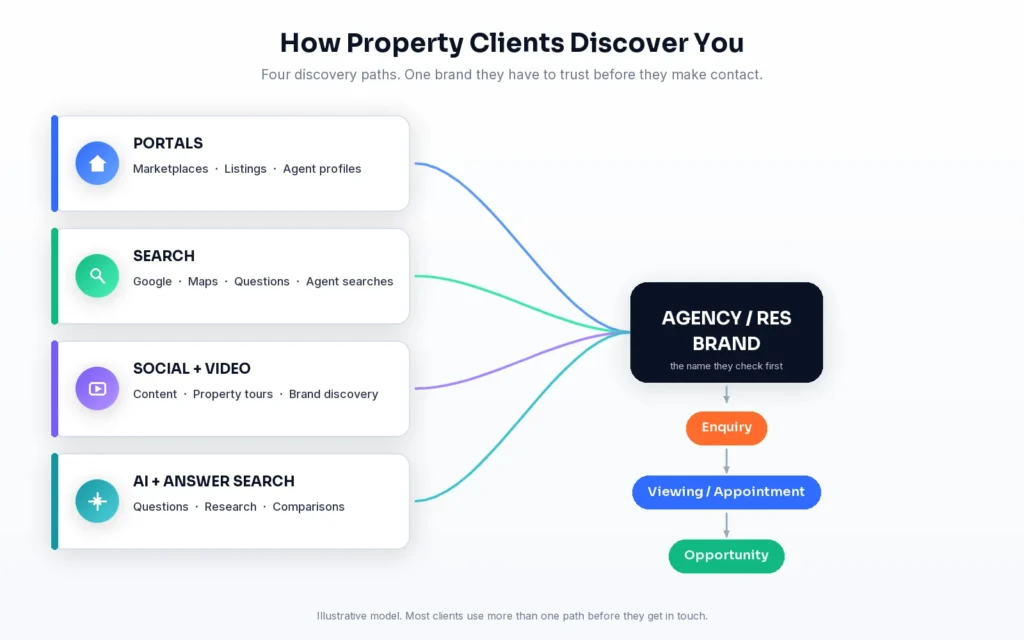
Singapore is one city, so the “city page” logic that works in larger countries does not apply. Property search here narrows by segment and place instead:
Singapore → property segment → project, HDB town, district or MRT station → property type → what the person wants to do
A buyer might go from “condo” to a particular MRT line, to a named development, to three-bedroom units, to asking prices. An HDB owner in Tampines who is thinking of selling searches very differently: how to sell an HDB flat, what similar flats nearby have sold for, which agents know the area. The vocabulary is local too. People search by project name, by town, by district number, by “near MRT”, by “ready to move in”, by “freehold”, by “resale” or “new launch”.
That is why one generic “property agent” page rarely wins much. Visibility comes from being present across the specific searches that match the segments and places you actually serve.
The four types of property demand
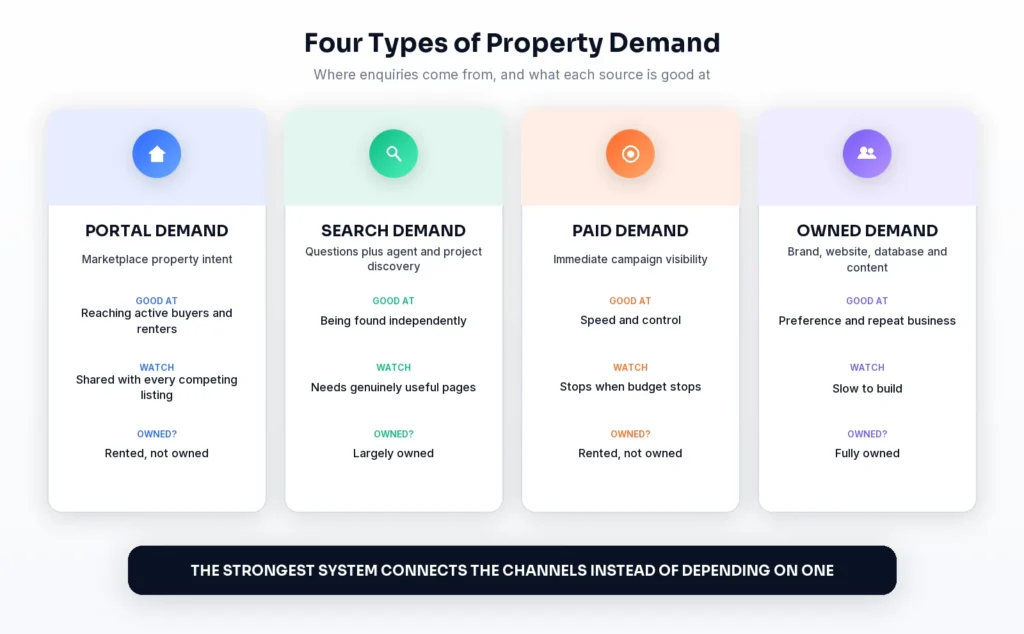
It helps to separate where enquiries come from, because each source behaves differently.
Portal demand comes from people already browsing property marketplaces: listings, projects and agent profiles. It is large and immediate, but you share it with every competing listing on the same page.
Search demand comes from people asking Google or Bing: agent searches, project research, HDB and condo questions, seller questions, area research. It rewards owned pages and content that answer those questions well.
Paid demand is traffic you create or capture with Google Ads, Meta and paid video. It is fast and controllable, and it stops the day the budget stops.
Owned and brand demand is what you build: your website, content, email list, organic social following, reviews and the people who search for you by name. It is slower to build and the only one of the four that keeps working when campaigns end or portal pricing changes.
Most successful property businesses use a mix. The question is not which one to choose but how dependent you are on each, and whether that dependence is a choice.
Portals are part of the plan, not the enemy
PropertyGuru is the dominant property marketplace in Singapore by its own account. Its agent site says it is chosen by 85% of property seekers and gets 6.6 times more visits than its closest competitor, with 38.3 million visits a year, citing SimilarWeb engagement data for June 2024 to July 2025. Those are the company’s own marketing figures, so treat them as directional, but nobody serious disputes that the portals are where a large share of active property searching happens. 99.co is the other substantial platform many agents use.
Telling an agency to “stop relying on portals and do SEO” misses how buyers and renters actually behave. Portals are very good at marketplace discovery: putting a listing in front of people who are already looking.
What portals do not give you is ownership. The relationship starts on someone else’s platform, next to someone else’s listings, under someone else’s rules and pricing. Your profile there is valuable, but it is not your brand.
So the useful approach is layered. Portals create discovery. Search creates independent discovery, where people find you rather than a listing. Brand creates preference, so people choose you when they have options. A CRM turns all of that attention into opportunities you can actually follow up. PropertyGuru itself puts the seller side well in its agent material: before sellers contact you, they look you up. Where they land when they do is the part you control.
Search and Google Maps
For search, the pages that tend to earn visibility are the ones that answer a specific question for a specific segment: a seller guide for HDB owners in the towns you work in, an honest explainer on a development you know well, a page on what a salesperson actually does for a landlord. More on how to build those without creating thin pages in the SEO section below.
For Maps, a Google Business Profile helps people who search for your agency’s name, or for property agencies nearby, find a real office with a phone number, directions and reviews. Google’s own rules decide eligibility. A business needs a real location where it meets customers during its stated hours; a virtual office or a mailing address you do not work from is not eligible; the business name must be the real name, without added keywords; and properties for sale are not themselves eligible for profiles. Google’s guidelines also treat real estate agents as individual practitioners, who can have their own profile if they are public-facing and can be reached at the verified location during stated hours. Check the current rules before a salesperson creates one, and make sure the name, number and details match what is registered with CEA.
Fake offices, duplicate listings and purchased reviews break Google’s rules and can get profiles suspended. They also undermine the trust the next chapter is about.
Paid search and paid social
Google Ads captures people searching right now: for an agency by name, for a salesperson, for “sell my HDB flat” style seller intent, for a development, for commercial space. The value comes from intent-specific campaigns, sensible negative keywords (rental searches in a seller campaign, jobs, “agent salary”, “DIY”), landing pages that match the search, and tracking that goes beyond the form fill to appointments and viewings.
One clarification that trips up advice copied from elsewhere: Google’s restricted targeting rules for housing ads, which block targeting by age, gender, marital or parental status and by postal code, apply in the United States and Canada. Google’s policy does not extend them to Singapore. Singapore campaigns still have to follow Google’s general advertising policies and Singapore law, including CEA’s advertising rules, which apply to online ads in full.
Meta is where most property creative runs: short videos, walkthroughs, new-launch awareness, seller education and remarketing. Meta’s housing special ad category, with its limited targeting, has been applied in the United States, Canada and parts of Europe rather than Singapore, but check what Ads Manager asks you to declare, because Meta enforces these categories automatically and changes them. And make sure every ad carries the identification details CEA requires.
Social media and video
Property is visual, and video does a lot of trust work before anyone makes contact: a walkthrough, a neighbourhood explainer, an honest take on a new launch, a seller explaining what the process was like, a salesperson answering the questions they hear every week.
The feed that does not work is the endless loop of “new listing, sold, new listing, sold”. It says nothing about how you think, and CEA’s rules put limits on it anyway: transaction details of a specific property, such as the price and the parties, cannot be advertised without the written consent of all parties to the transaction. Content that explains the market, the process and the area builds more preference than a scoreboard.
CEA also requires any social media account used for estate agency work to show the agency’s licence number and the salesperson’s registration number in its profile. That applies to Instagram, Facebook, TikTok and anything else you use for work.
AI search
People increasingly ask AI tools how to choose a property agent, how to sell an HDB flat or what to look for in a development. You cannot buy your way into those answers, and nobody can guarantee a mention. What helps is covered later in this guide: clear, consistent information about who you are, accurate content, and being a useful source on the questions your clients actually ask.
Chapter 2: Get trusted
A property decision is expensive and personal, and people check before they call. In Singapore they have better tools to check with than in most markets, which raises the bar for everyone.
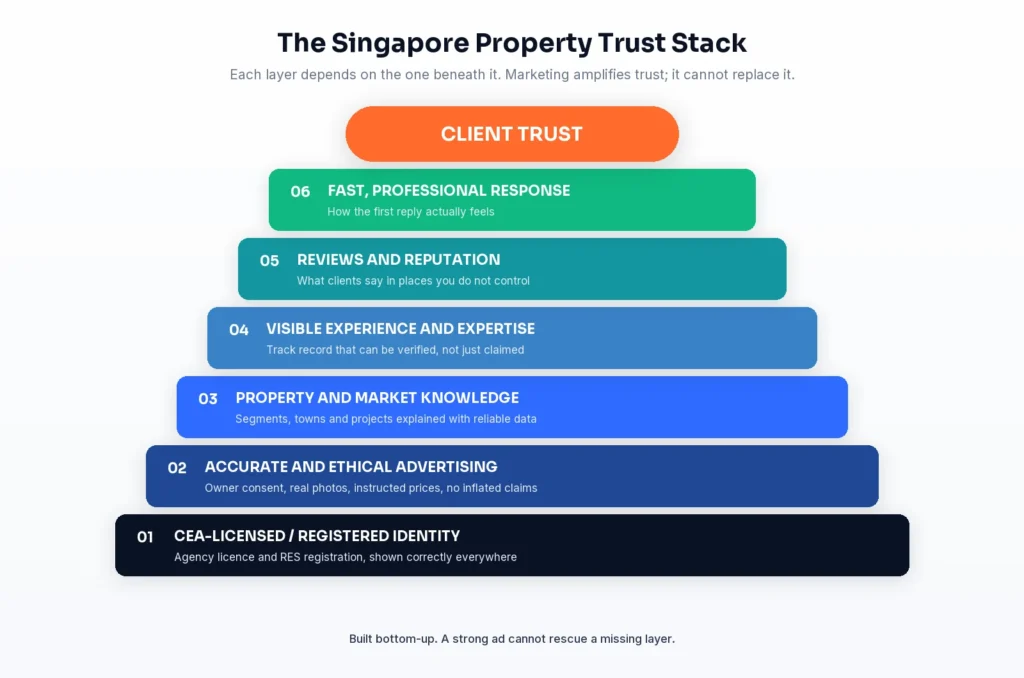
The Singapore property trust stack
Trust builds in layers, and each one depends on the one beneath it:
- Licensed and registered identity. The agency’s licence and the salesperson’s registration, shown correctly everywhere.
- Accurate and ethical advertising. Listings and ads that describe the property as it is.
- Property and market knowledge. Evidence that you understand the segment, the area and the process.
- Visible experience and expertise. Track record that can be verified, not claimed.
- Reviews and reputation. What clients say, in places you do not control.
- Fast, professional response. How the first contact actually feels.
Client trust sits on top of all of them. Digital marketing can amplify each layer. It cannot replace a missing one. A beautiful website does not fix an inaccurate listing, and a strong ad does not rescue a slow, careless reply.
Prospects can check you on the public register
CEA’s public register lets anyone check whether a salesperson is registered, which agency they are with, their recent residential transactions and which parties they represented, and any disciplinary record. Since June 2026 the register also shows enforcement actions against agencies and salespersons in more detail. CEA also tells consumers to search the register using the phone number in an advertisement, because scammers copy real names and registration numbers.
For marketing, that means consistency is a trust signal. The name, registration number and contact number on your website, portal profiles, social accounts, business cards and ads should all match what CEA has on record. A prospect who checks and finds a mismatch will usually just move on.
What CEA’s advertising rules mean in practice
CEA’s Practice Guidelines on Ethical Advertising, read with the Code of Ethics and Professional Client Care, set out what property advertising must and must not do. The guidelines state plainly that all advertising rules apply equally to the internet: websites, portals, email, SMS, social media and online advertising. This is not legal advice, and agencies should read the current CEA documents themselves, but the practical points for a marketing team are these.
Identify correctly. Advertisements must show the salesperson’s name as registered, their registration number, the agency’s name and licence number, and the salesperson’s registered contact number. Classified ads and SMS have a shorter requirement, but websites, portals and online ads need the full set.
Get consent before advertising. A property can only be advertised with the prior consent of the owner, or all the owners where there is more than one, in writing, by SMS or another verifiable form. If two salespersons advertise the same property, each needs the owner’s consent. Copied advertisements and “dummy” ads for properties that are not really available are not allowed. In workflow terms, the owner’s instruction and consent come first, and listing publication comes after, never the other way round.
Describe the property as it is. Photos must not be altered to misrepresent the property. Interior photos must be of the actual unit, and view photos must be taken from the unit’s own viewpoint, not from a higher floor. The price must be the one the client instructed. Guarantees of “cash over valuation” are prohibited.
Do not overclaim. Claims of expertise, specialisation or success rate must be backed by verifiable facts and records, and the guidelines specifically call out labels such as “King of” an area, “Specialist” and “Expert”. Claims about market trends must be supported by reliable statistics, such as a government agency’s reports. Rental yields or capital gains, if mentioned, need their basis, source, definitions and time period.
Keep it current. Advertisements must come down when a property is no longer available or the agency agreement ends, and listings must be updated when details change.
Vet before publishing. Agencies must vet their salespersons’ advertising before it goes out, and key executive officers must approve advertisements or run a structured approval process. That applies to online content too, which means an agency’s marketing workflow needs a real review step, not just a shared folder.
Mind the data you use. Specific floor levels or unit numbers of transacted properties must not be disclosed in advertisements, detailed unit-level data bought from URA’s REALIS or portals is meant for research rather than marketing, and the source of any public data you use should be stated.
For new developments, CEA’s circulars add two points worth knowing: a development project should not be marketed before the relevant authorities have approved it for sale, and floor area information has to be presented properly to consumers. Anyone marketing new launches should check the current circulars and the developer’s own obligations before a campaign goes live.
The underlying principle is simple: a property advertisement has to be useful and accurate before it can be persuasive. The agencies that build that into their systems tend to find that accuracy is also good marketing.
Content that proves knowledge
Singapore has unusually good public property data, and it is a real content advantage for agencies willing to use it properly.
URA publishes private residential price indices, transaction and rental information, developer sales and pipeline supply. HDB publishes resale information and the resale price index, and HDB resale transaction data is available on data.gov.sg. Even CEA’s salesperson transaction records are published as an open dataset.
That makes it possible to publish things buyers and sellers actually find useful: a plain-English explanation of what the latest quarterly figures mean for a particular segment, a guide to how resale prices have moved for a flat type in a town you work in, or a comparison of what is coming up in an area. It is far more persuasive than another “5 reasons to buy a condo” post, and it is exactly the kind of substantiated market commentary CEA expects.
Two cautions. Do not dress up data as investment advice, and do not publish unit-level transaction details that CEA’s guidelines say should not appear in advertising. Explain the market; do not expose individual transactions.
The strongest content stack pairs official data with first-hand experience: URA and HDB for the numbers, CEA for the rules, and your team’s genuine knowledge of the segments and areas you serve for the explanation.
Chapter 3: Get the enquiry
Attention becomes an enquiry at a handful of points: a listing, a search result, a landing page, a profile, a social post. Each one has to make the next step obvious and low-friction.
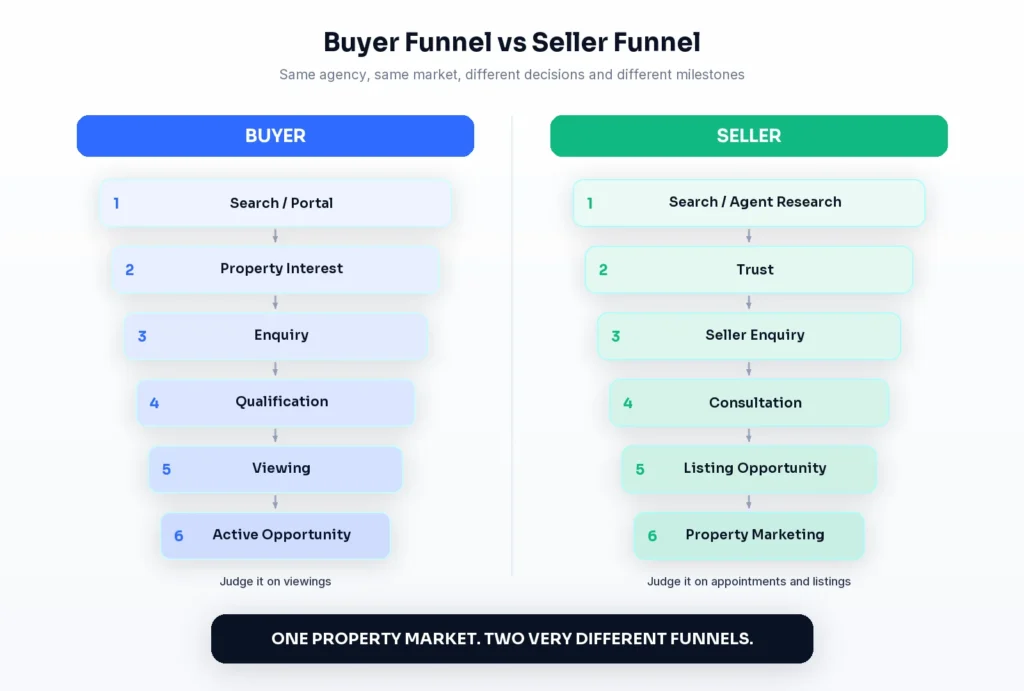
Buyers and sellers need different front doors
This is the most common mistake on property websites: one generic “Contact us” form for everybody.
A buyer usually arrives interested in a property or a type of property. The natural next step is an enquiry about that listing or project, a WhatsApp message or a viewing request.
A seller is doing something different. They are choosing who to trust with one of the largest assets they own, and they often research agents quietly for weeks. The natural next step is a conversation about their property, not a “free valuation” gimmick. That means seller pages that show relevant experience in their segment and area, explain the selling process and fees honestly, and make it easy to book a consultation.
Landlords and tenants are different again, and so are new-launch buyers, who often want project details and a showflat or consultation appointment.
Making contact easy
Singapore buyers and sellers expect to reach a salesperson quickly, and WhatsApp is often the channel they choose. Useful practice:
- Offer the channels people actually use: WhatsApp, a call and a short form, with the registered number consistent everywhere.
- Keep forms short and relevant to the intent. A seller form might ask for the property type, the area and a preferred contact time. A buyer form might ask about budget range and timing.
- Offer appointment booking for consultations and showflat visits where it suits the funnel.
- Make the first reply specific. Knowing which listing, project or page the person came from turns a generic “Hi, how can I help?” into a useful answer.
The PDPA at the enquiry form
Every enquiry collects personal data: names, phone numbers, emails, sometimes budgets and addresses. The PDPA sets obligations for how that is handled. In plain terms:
- Tell people what you are collecting and why, at the point of collection.
- Get consent for those purposes, and use the data only for purposes a reasonable person would expect.
- Keep marketing consent separate and honest. Replying to someone’s enquiry is not the same as adding them to a marketing list. If you want to send them future marketing, ask for that clearly. Do not use pre-ticked boxes.
- Let people withdraw consent, and make sure withdrawal actually stops the messages.
- Protect the data and do not keep it longer than needed.
The same thinking applies to uploading customer lists to Meta or Google for remarketing or lookalike audiences: check that your notices and consents cover that use before you do it. None of this is legal advice, and agencies with large databases should take proper advice. But getting it right at the form stage is much easier than fixing it later.
Chapter 4: Qualify and convert
An enquiry is not an outcome. What happens in the next few days decides whether any of the marketing was worth it.
Different intents, different paths
| Intent | First conversion | Middle of the funnel | Commercial outcome |
|---|---|---|---|
| Buyer | Enquiry about a property or type | Viewing | Offer and purchase |
| Seller | Seller enquiry or consultation request | Appointment at the property | Listing, then sale |
| Tenant | Rental enquiry | Viewing | Tenancy |
| Landlord | Landlord enquiry | Consultation | Listing, then lease |
| New-launch buyer | Project enquiry or registration | Showflat visit or consultation | Purchase opportunity |
Not every transaction follows these steps exactly, but the table makes one thing clear: the milestone that proves a campaign is working is different for each intent. A seller campaign should be judged on appointments and listings, not on how many buyers it attracted.
One market, several segments
HDB resale, private condominium resale, new launches, executive condominiums, landed property, rentals and commercial property attract different people asking different questions. An HDB seller wants to understand the resale process and realistic prices in their town. A condo buyer compares developments, unit types and locations. A new-launch buyer wants accurate project information and a showflat visit. A commercial client has different decision-makers and a longer cycle.
The practical consequence is that one funnel, one landing page or one ad campaign cannot serve all of them well. Pick the segments you genuinely serve and build for those.
A lead ladder worth using
- Raw enquiry: someone submitted contact details.
- Relevant lead: the enquiry fits the market you serve.
- Qualified lead: intent, timing and property need are plausible.
- Viewing or seller appointment: the first real-world milestone.
- Active opportunity: genuine transaction potential.
- Client and transaction: the commercial outcome.
A cheap lead can be very expensive if nobody ever converts it. Measuring only the first rung rewards campaigns that produce volume, not business.
Routing and follow-up
A workable workflow looks like this: source → lead type → property and intent → qualification → assigned salesperson or team → contact → viewing or appointment → opportunity → outcome. Record the source on every lead, assign an owner straight away, and ask salespersons to update the outcome honestly. Collect only the data you need to serve the enquiry.
Calls, SMS and WhatsApp follow-up: the Do Not Call rules
Singapore’s Do Not Call (DNC) rules under the PDPA specifically cover marketing messages that advertise or promote land or an interest in land. That puts property marketing squarely inside them.
In plain language, based on the PDPC’s advisory guidelines:
- Before sending a marketing call or message to a Singapore number, check it against the DNC Registry. A check is valid for 21 days before the message is sent. (Some older guidance mentions 30 days; the PDPC’s current guidelines say 21.)
- The rules apply to voice calls, SMS and messaging apps that use a Singapore phone number, including WhatsApp, iMessage and Viber.
- If someone has given clear and unambiguous consent, evidenced in writing or another form you can refer back to, you can message them even if they are on the registry.
- Every marketing message must identify the sender and how to contact them, and marketing calls must not hide the caller’s number.
- Generating numbers automatically or harvesting them from the internet is prohibited, even if you then check them against the registry.
CEA’s own guidelines add property-specific rules: stop immediately when someone asks not to be contacted, do not send SMS advertising or make cold calls between 10pm and 9am, include an unsubscribe number in SMS advertising, and label advertising emails as required under the Spam Control Act.
The practical conclusion is to build consent and DNC checks into the CRM, not rely on memory. And to stay away from bought databases and mass cold outreach entirely. Beyond the legal risk, it is not how trusted salespersons get their business.
Chapter 5: Measure what actually matters
The property growth scorecard
| Layer | What to track | Why it matters |
|---|---|---|
| Discovery | Organic visibility for your segments, portal listing and profile views, paid impressions on the right searches, brand searches for the agency and salespersons | Whether the right people can find you |
| Engagement | Listing and page engagement, content consumption, calls, WhatsApp messages, form starts | Whether attention is turning into interest |
| Pipeline | Qualified enquiries, seller appointments, viewings, active buyer and landlord opportunities | Whether marketing is creating real conversations |
| Business | Listings won, transactions, and revenue attribution where the data is reliable | Whether any of it is paying off |
Most reporting stops at the first two layers because they are easy to measure. The pipeline layer is where marketing and sales have to share data, and it is the layer that changes budget decisions. A weekly look at which sources produced appointments and viewings, not just enquiries, is worth more than any dashboard.
Attribution in property will never be perfect. People see a listing, search your name, watch a video, ask a friend and message you weeks later. The aim is attribution good enough to stop funding what does not produce appointments.
What it costs, and what you are paying for
There is no honest single price for real estate digital marketing in Singapore, because the scope varies so much: one salesperson or a team of fifty, one segment or several, a new launch or ongoing seller acquisition, video production or none.
What helps is separating the four kinds of cost, which are often bundled together in proposals:
- Agency fee for strategy, SEO, content, campaign management and reporting
- Media spend paid directly to Google, Meta and the portals
- Software such as a CRM, booking tools and analytics
- Production for photography, video, design and copy
A proposal that blurs these makes it hard to judge value. A useful one tells you what each part is for and how it will be measured.
SEO, AEO and GEO for Singapore property
The decisions that matter in SEO
Technical foundations. Many agency sites are slow on mobile, duplicate listing pages, leave expired listings live (which also clashes with CEA’s rule on removing unavailable listings) or block useful pages from search by accident. Fixing these is unglamorous and raises the ceiling on everything else.
Commercial pages. Pages for what you actually do: selling for HDB owners, selling private property, leasing for landlords, the salespersons and teams, and the segments and areas you serve.
Project and area pages, with restraint. A page about a development or an HDB town earns its place when it has real substance: official data, transport, context, the questions buyers and sellers actually ask, and genuine knowledge from your team. Hundreds of near-identical pages for every MRT station, condo or district are what Google’s spam policies call doorway pages and scaled content abuse, and they rarely help. It is better to have twenty pages you would be proud to send a client to than two hundred templates.
Content. Answers to the real questions buyers, sellers, landlords and tenants ask, grounded in official data where possible.
Entity clarity. Make the relationships obvious: which agency, which salespersons, which segments, which areas, which projects. The more consistently this appears across your website, portal profiles, social accounts, Google Business Profile and the CEA register, the easier it is for both people and machines to understand who you are.
Our SEO services and SEO methodology explain how we approach this work, and our local SEO services cover Google Business Profile and local visibility.
AEO and GEO in plain language
Answer Engine Optimisation (AEO) means organising useful information so that search and answer systems can understand it and answer common questions clearly. For property: a direct answer to “how do I choose a property agent in Singapore?”, “what is the difference between an estate agent and a salesperson?” or “should I use an agent to sell my HDB flat?”, followed by the explanation and the caveats.
Generative Engine Optimisation (GEO) is about how AI assistants such as ChatGPT, Gemini and Google’s AI features describe and recommend businesses. Nobody can guarantee inclusion. What helps is being a clear, consistent and credible source: accurate business and registration details that match across the web, original content grounded in official data, genuine reviews and mentions, and pages that answer questions directly.
Google’s own guidance says there is no special optimisation or markup needed to appear in AI Overviews or AI Mode; the same search fundamentals apply. Anyone selling a secret AI ranking trick is selling something else. More on this in our guide to answer engine optimisation for real estate, and our AEO services and GEO services.
A useful way to picture the entity relationships AI systems and search engines try to understand: estate agency → licence → salespersons → property segments → projects, towns and districts → buyers, sellers, landlords and tenants → content → enquiry → viewing or appointment → transaction. The goal is for those relationships to be obvious from genuinely useful content, not stuffed into it.
Signal, system, scale
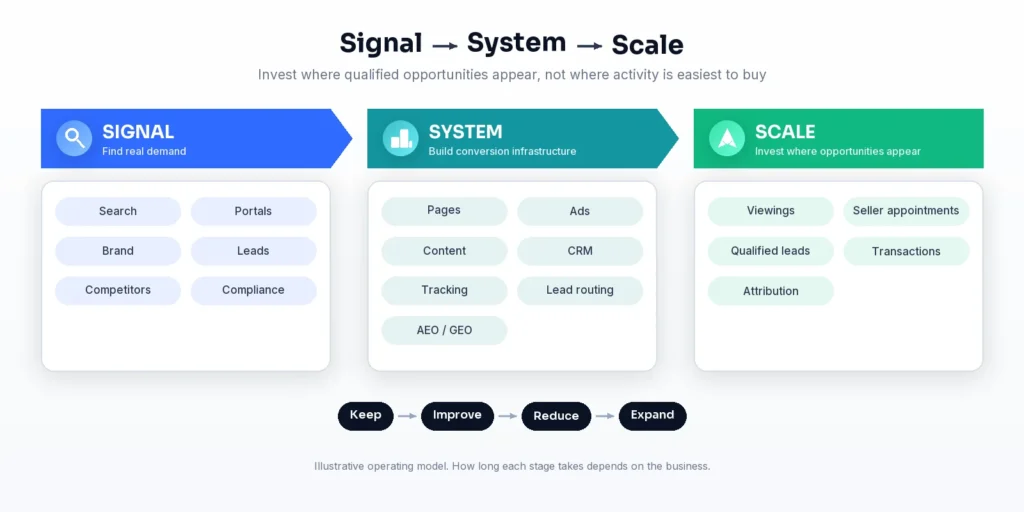
Rather than a fixed calendar, we think about the work in three stages. How long each takes depends on the business.
Signal: find where real demand is. Audit search visibility, portal presence and dependence, brand search, salesperson profiles, listings, the website, paid campaigns, content, reviews and lead sources. Check the advertising workflow against CEA’s requirements, and the enquiry and follow-up process against the PDPA and DNC rules. The question: where are qualified enquiries, appointments and budget being lost?
System: build the machinery that converts. Improve the priority pages, build separate buyer and seller funnels, fix landing pages and tracking, restructure campaigns around intent, produce video and content that shows real knowledge, set up CRM routing and qualification, and tighten entity consistency for search and AI discovery.
Scale: invest where qualified opportunities appear. Look at qualified enquiries, seller appointments, viewings, search queries, portal performance, ad performance and CRM outcomes. Then keep what works, improve what nearly works, reduce what does not and expand where the evidence is strong.
Choosing a marketing partner
Some questions that separate agencies that understand Singapore property from those that do not:
- How will you measure success beyond leads and cost per lead?
- Will you report on appointments, viewings and listings, and work with our CRM to do it?
- How do you make sure ads, profiles and content meet CEA’s identification and advertising rules?
- How do you handle consent, the PDPA and DNC checks in lead generation and follow-up?
- What would you do in the first month, and what would you deliberately not do?
Red flags include guaranteed lead volumes or rankings, promises of AI citations, advice to build hundreds of template location pages, bought phone databases, ads that describe salespersons as “specialists” or “experts” without verifiable records, and reluctance to give you ownership of your ad accounts, website and data.
How Apzom Digital works with property businesses
Apzom Digital is a digital marketing agency based in Ahmedabad, India. We work with clients internationally, including remotely with businesses in Singapore, and we do not have a Singapore office. Our property work so far includes websites, social media and performance marketing for property developers and a real estate project; none of these clients is in Singapore, and we do not publish their numbers until they have signed them off.
For estate agencies, salespersons and property marketing teams, our work covers SEO, local SEO, AEO and GEO, Google Ads, Meta ads, social media, content, website development, conversion rate optimisation, tracking and lead-funnel strategy. We do not give legal advice on CEA, PDPA or DNC matters, and we ask your key executive officer or compliance team to approve advertising before it goes live, as CEA requires.
Request a Real Estate Digital Growth Audit
If you want a clear view of where discovery, trust or conversion is breaking down, start with a diagnostic rather than a proposal. For a Singapore agency or salesperson, a useful audit covers search visibility and agent discovery, portal dependence, the seller and buyer funnels, website conversion, paid campaigns, lead quality, CRM and follow-up, the PDPA and DNC workflow, AEO and GEO readiness, and tracking.
Request a Real Estate Digital Growth Audit and tell us about your agency, your segments and your current results. If you would rather talk first, contact us.
Frequently asked questions
What does a real estate digital marketing agency in Singapore do?
It helps estate agencies, salespersons and property marketing teams get found on search, Maps, portals, social media and AI search, builds trustworthy and CEA-compliant profiles, listings and content, turns attention into enquiries, and tracks those enquiries through to appointments, viewings and transactions.
How can property agents generate leads online in Singapore?
By combining portal visibility with owned search visibility, a consistent and verifiable profile, content that shows real knowledge of their segments and areas, separate buyer and seller funnels, fast follow-up and a CRM. Lead generation that ignores consent, DNC checks or CEA advertising rules creates risk rather than business.
Is SEO worth it for property agents?
Usually, for agencies and salespersons who focus on particular segments and areas. SEO takes months and depends on genuinely useful pages, but it builds discovery that does not depend on portal placement or ad budgets.
Is PropertyGuru enough for property marketing?
Portals are excellent for marketplace discovery, and most agents need them. They do not build your own brand, audience or search presence, which is why many agencies combine portals with a website, content, social media and a CRM.
What is the difference between an estate agent and a real estate salesperson?
In CEA’s terms, an estate agent is the licensed agency, and a real estate salesperson is the registered individual who works for it. Both must be identified correctly in advertising, and anyone can check a salesperson’s registration and records on CEA’s public register.
How can property agents generate seller leads?
Sellers research agents before they make contact, so seller leads come from visible, verifiable expertise in their segment and area, useful seller content grounded in official data, genuine reviews, a clear seller page and an easy way to book a consultation.
Do Singapore property agents need to follow the PDPA and DNC rules?
Yes. Property marketing messages are covered by the Do Not Call provisions, including calls, SMS and WhatsApp messages to Singapore numbers. Numbers must be checked against the DNC Registry within 21 days before sending unless there is clear and unambiguous consent, and enquiry data must be handled under the PDPA.
Google Ads or Meta Ads: which is better for property marketing?
They do different jobs. Google Ads captures people already searching, such as sellers looking for an agent or buyers researching a development. Meta builds awareness and familiarity through video and creative. Many agencies use both and judge them on appointments and viewings rather than cost per lead.
How should a property agency measure digital marketing?
Track the full chain: discovery, engagement, qualified enquiries, seller appointments, viewings, listings and transactions, broken down by source. The pipeline layer, which needs marketing and sales to share data, is where budget decisions should be made.