
Most law firms that are unhappy with their marketing are not short of clicks. They are short of the right matters. The phone rings with people the firm cannot help, enquiries arrive about practice areas it does not handle, a promising caller waits two days for a reply, and the monthly report still celebrates “leads up 40%”.
This guide is for managing partners, solo lawyers, legal marketing directors and intake managers who want marketing judged by a better standard: does it help the right person find the right lawyer, understand why the firm is credible, contact it safely, and become a signed matter the firm actually wants?
That last part is what makes legal marketing different. Lawyers work under professional conduct rules on advertising, solicitation, confidentiality and conflicts that most businesses never meet. Good law firm marketing is built around those rules rather than retrofitted to them.

The short answer
What does a digital marketing agency for law firms do? It builds the system that helps people with a legal need find the firm, trust its lawyers and contact it, then helps the firm turn suitable enquiries into consultations and signed matters. That usually means local and organic search, paid search, attorney profiles, practice-area content, reviews, website conversion and intake reporting. A good one works within the advertising, solicitation and confidentiality rules of the firm’s jurisdiction, and measures success in qualified consultations and signed matters, not traffic.
Key points from this guide
- Authority comes before visibility. Search can send people to a firm; it cannot make a thin attorney profile or a vague practice page trustworthy.
- A website enquiry can create duties to a prospective client. Intake forms, chat and AI tools should collect only what is needed at each stage.
- Case results, testimonials, “specialist” claims and review replies are governed by professional rules, not just marketing taste.
- Cheap leads become expensive when they are the wrong matters. Report on consultations and signed matters, wherever the firm can track them.
- Rules depend on where the lawyer is licensed. Check the actual rules of your jurisdiction before acting on any example here.
The Legal Client Acquisition and Authority System
Law firm growth follows a chain. Each link depends on the one before it.
Legal need → discovery → authority → trust → safe enquiry → consultation → engagement → signed matter → reputation and referral
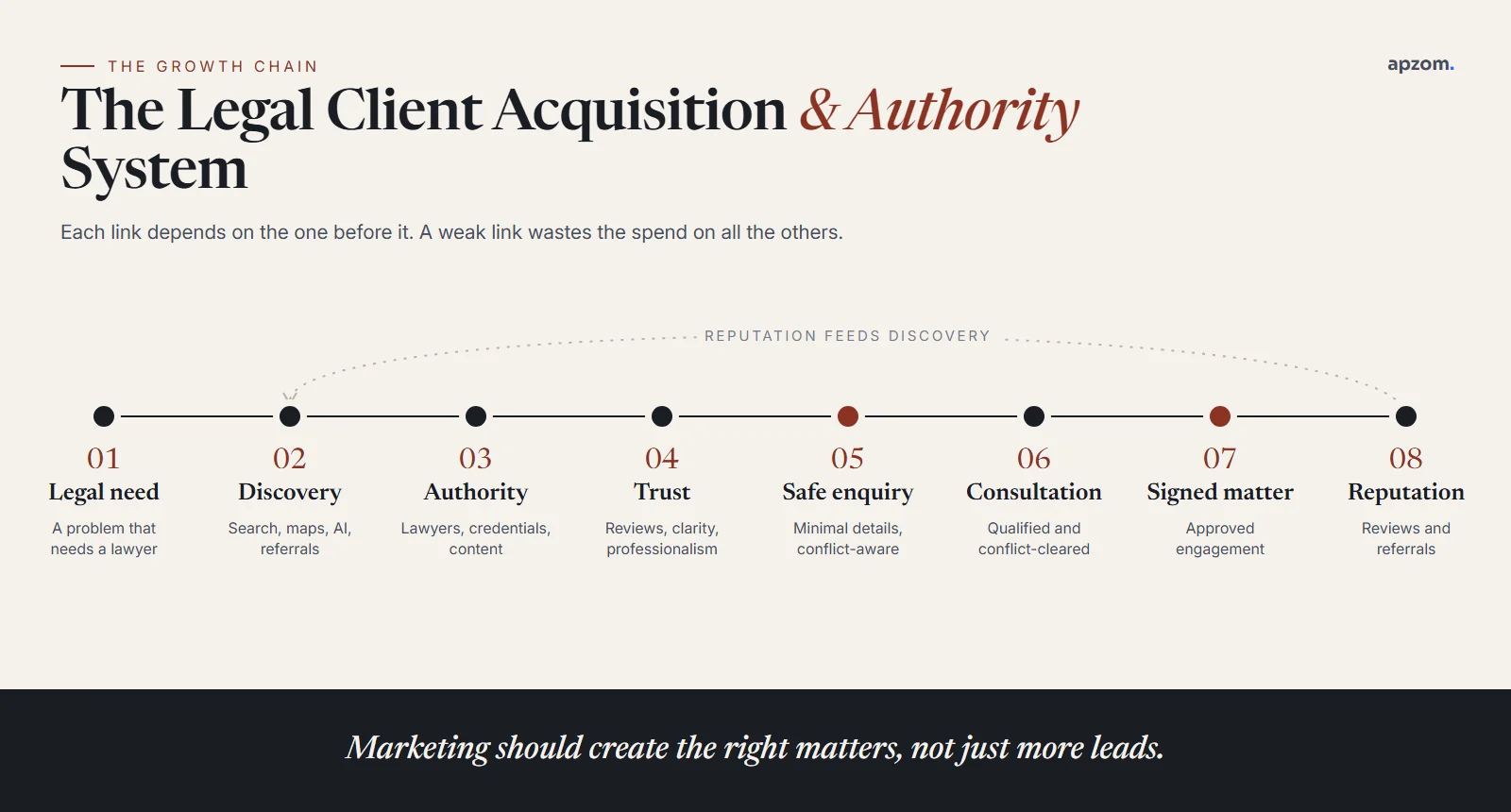
Someone has a legal problem. They search, ask an AI assistant, check a directory or get a referral and then look the firm up. What they find either convinces them the firm is credible or it does not. If it does, they contact the firm, and that first contact has to be handled in a way that protects them and the firm. A consultation follows if the matter is a fit and there is no conflict. Engagement turns it into a matter. Good work and good service turn the matter into reviews and referrals, which feed the next search.
The rest of this guide follows that chain in six parts: build authority, get discovered, earn trust, create safe enquiries, turn enquiries into qualified matters, and measure signed matters rather than clicks.
First: whose rules apply?
Every example in this guide should be checked against the rules where the lawyer is licensed. A few illustrations show how much they differ.
| Jurisdiction | Who sets the rules | What it means for marketing |
|---|---|---|
| United States | Each state’s highest court and bar, usually based on the ABA Model Rules of Professional Conduct, plus the FTC | The ABA Model Rules are a model, not law; each state adopts its own version, sometimes with significant changes. Rules 7.1 to 7.3 cover advertising and solicitation; Rule 1.18 covers prospective clients |
| England and Wales | Solicitors Regulation Authority | Solicitors may advertise, but the SRA Code of Conduct prohibits unsolicited approaches to members of the public, other than current or former clients, to advertise legal services |
| India | Bar Council of India | Rule 36 of the BCI Rules prohibits advocates from soliciting work or advertising, directly or indirectly. A 2008 amendment allows limited website information. The government confirmed in August 2024 that the prohibition remains in force |
The Indian position matters for anyone reading this from India: most of the paid and promotional tactics in this guide are not available to advocates there. What remains is accurate, permitted website information. This guide is written mainly for markets where lawyer advertising is allowed, and uses US examples where a specific rule helps, labelled as such.
None of this is legal advice. A firm’s lawyers, or its ethics counsel, should approve anything that touches the rules.
Part 1: Build authority before chasing visibility
The Law Firm Authority Stack
Authority is built in layers, and each layer rests on the one below it.
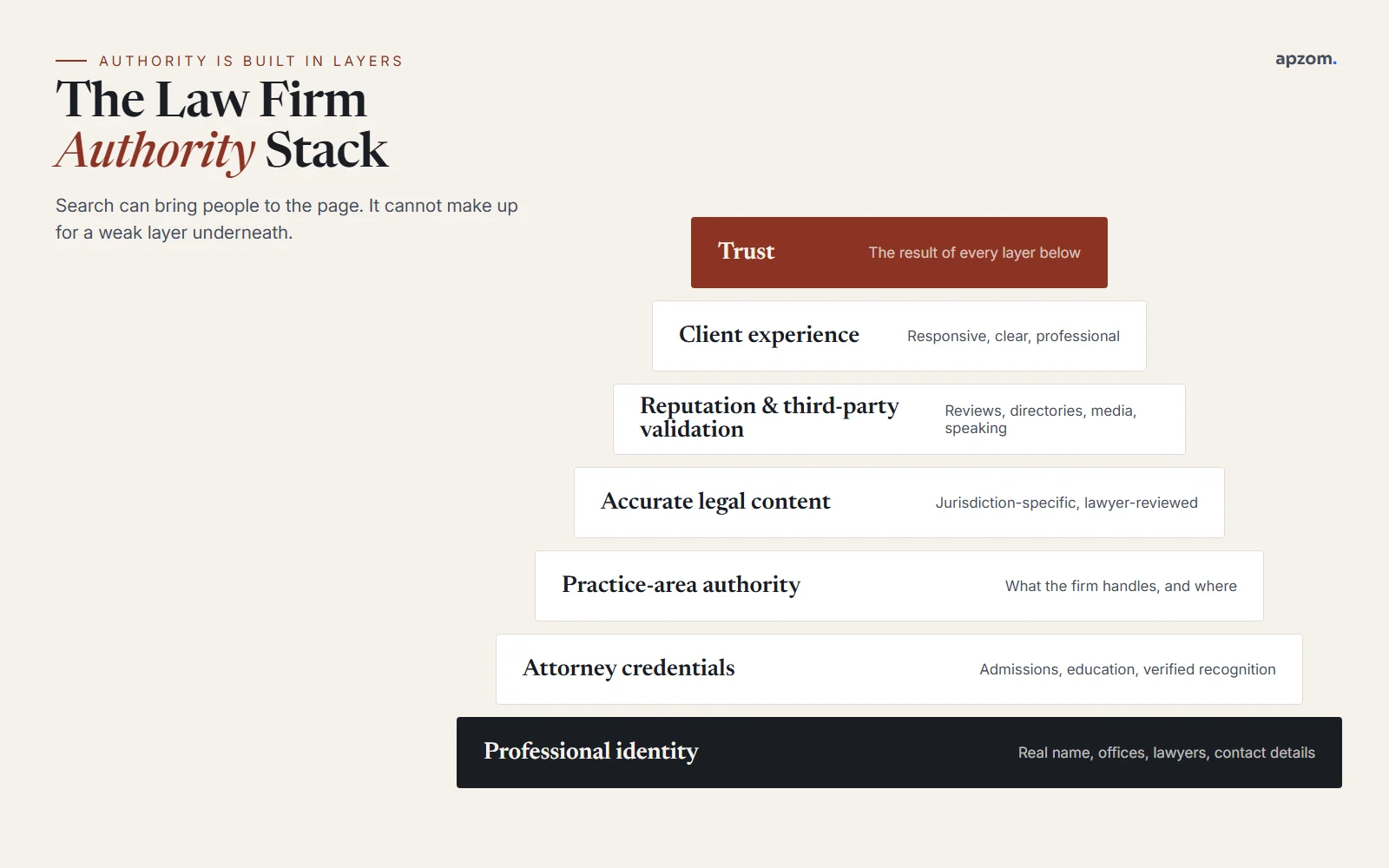
- Professional identity. The firm’s real name, offices, lawyers and contact details, consistent everywhere.
- Attorney credentials. Bar admissions, education, genuine certifications and memberships, each one verifiable.
- Practice-area authority. Clear evidence of what the firm actually handles, and where.
- Accurate legal content. Explanations that are correct for the jurisdiction, reviewed by a lawyer.
- Reputation and third-party validation. Reviews, legitimate directory profiles, media commentary, speaking and publications.
- Client experience. Responsiveness, clarity and professionalism from the first contact.
On top of all six sits trust. Search can bring people to the page. It cannot make up for a weak layer underneath, and any gain from trying usually does not last.
Attorney profiles are not staff pages
For many firms, attorney profiles are the most visited pages after the home page, and the most underused. A prospective client choosing a lawyer wants to know who they will actually deal with.
A strong profile includes, where accurate and verifiable:
- A professional photo and the lawyer’s full name.
- Bar admissions, by jurisdiction and court where relevant.
- Education.
- The practice areas the lawyer genuinely handles.
- Legitimate certifications, memberships, publications and speaking.
- Languages spoken.
- Representative experience, where client confidentiality and the applicable rules allow it.
- Direct contact details or a clear route to contact them.
Profiles help in several ways at once: they build trust, they answer branded searches for the lawyer’s name, they give search engines and AI systems a clear picture of who works at the firm, and they give practice pages someone to link to. Every fact on them needs checking. An invented award or an overstated admission is not a marketing problem; it is a conduct problem.
“Specialist”, “expert” and awards
Words that imply special status are regulated in many places. US example: ABA Model Rule 7.2(c) says a lawyer should not state or imply certification as a specialist unless certified by an organisation approved by an appropriate state authority or accredited by the ABA, and the certifying organisation is clearly named. States vary, so check the local rule before using “specialist”, and treat “expert” with similar care.
Awards and rankings need the same scrutiny. Use only genuine recognition, name who gave it, and do not present a paid listing as an independent honour.
Directories: know what you are paying for
“Legal directories” covers four very different things, and mixing them up leads to wasted money or misleading claims:
| Type | What it is | How to treat it |
|---|---|---|
| Citation | A basic business listing with name, address and phone | Keep accurate on the few that matter; ignore low-quality ones |
| Attorney directory | A profile on a lawyer-focused platform | Worth having where prospective clients in your practice area actually look |
| Editorial ranking | Independent research-based recognition | Earned, not bought; cite accurately |
| Paid listing | Visibility bought from a platform | Can be useful, but never describe it as an award or independent recognition |
Digital PR: earn authority, do not buy links
Search engines and AI systems treat a firm as an authority when credible sources treat it as one. That comes from real activity: lawyers commenting for journalists on legal developments, articles in trade publications, original research or data analysis, podcasts, speaking at professional events, and genuine community involvement.
Avoid private blog networks, paid link schemes, mass directory submissions and generic guest-post campaigns. They break search guidelines, and for a law firm they also risk looking exactly like the kind of manipulation clients distrust.
Part 2: Get discovered
The Legal Search Intent Map
People do not search for “legal marketing”. They search from a situation, and the situation decides what page, call to action and intake path they need.
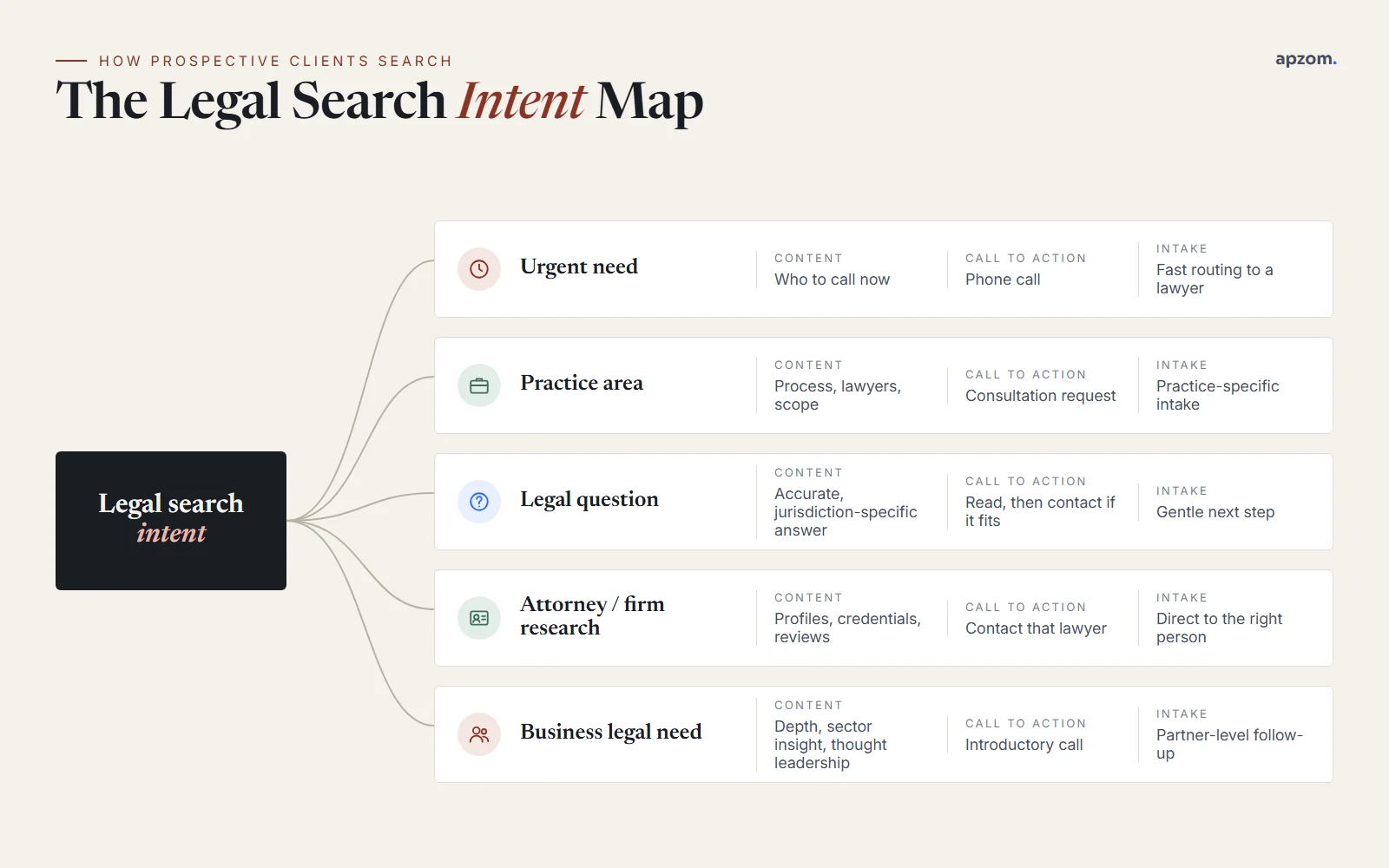
| Intent | Example | What they need to see | Best next step |
|---|---|---|---|
| Urgent need | “criminal defence lawyer near me”, “arrested what to do” | Who to call now, availability, location | Phone call to a person who can help |
| Practice-area need | “divorce attorney”, “immigration lawyer”, “personal injury lawyer [city]” | What the firm handles, who handles it, the general process | Consultation request |
| Legal question | “how long does probate take”, “can my employer do this” | An accurate, jurisdiction-specific explanation | Read more, then contact if their situation fits |
| Attorney or firm research | the lawyer’s name, the firm’s name, “[firm] reviews” | Profiles, credentials, reviews, office details | Contact the specific lawyer |
| Business legal need | “commercial litigation firm”, “employment counsel for startups” | Depth of expertise, sector experience, thought leadership | Introductory call, often after several visits |
The mistake most firm websites make is giving every one of these people the same page and the same “free case evaluation” button. A business owner researching outside counsel and someone who has just been arrested need completely different things.
Practice-area pages
“We fight aggressively for you” tells a prospective client nothing. A useful practice page explains what the firm handles in that area and where, the types of matters it takes and does not take, what the process generally involves, which lawyers do the work, any important limitations, and how to get in touch.
Substantive legal explanation on these pages should be reviewed by a lawyer licensed in the relevant jurisdiction, dated, and updated when the law changes. Avoid creating several near-identical pages for the same practice area with small keyword changes; one strong, accurate page is better for clients and for search.
Local search and Google Business Profile
Many legal searches are local, so the firm’s Google Business Profile, Maps presence and office pages are central to local SEO for a law firm.
The basics: the firm’s real name without added keywords, a genuine office address (Google does not allow virtual offices), accurate hours and phone numbers, the fewest categories that describe the practice, real photos of the office and lawyers, and reviews.
Google treats lawyers as “individual practitioners”, who may be eligible for their own profile separate from the firm. Under Google’s current guidelines, a solo lawyer practising under a firm brand should usually share one profile with the firm, named “[Firm]: [Lawyer name]”. At an office with several lawyers, the firm can have its own profile and eligible public-facing lawyers can have their own, using only their name. A practitioner should not have separate profiles for different practice areas. Creating a profile for every lawyer by default often splits reviews and creates duplicates, so decide case by case.
Multiple offices
Each genuine office deserves a page with real local information: the address and how to get there, parking or transit, the lawyers based there, opening hours, the practice areas actually handled from that office, photos, and local court or jurisdiction context where accurate. Near-identical city pages for places where the firm has no office are doorway pages, and they mislead people about where the firm can help.
Google Ads: buy matters, not clicks
Paid search works best for urgent and high-intent searches, new practice areas, and markets where organic visibility takes time. Build it around matter quality:
- Separate campaigns by practice area and intent, each sending people to the matching page.
- Target the geography where the firm’s lawyers are licensed and can actually take matters.
- Use negative keywords to block searches the firm cannot help with: free legal aid, jobs, law school, other practice areas.
- Write accurate ads. The same rules on misleading communications apply to a 90-character ad as to a website.
- Track calls and consultation requests, then feed back which of them became qualified consultations and signed matters.
Legal search terms are often expensive, and costs vary widely by practice area and city. Any agency quoting a typical cost per lead without knowing your market and practice is guessing.
Local Services Ads (US-specific)
Google’s Local Services Ads appear above other results for some searches and charge per lead rather than per click. In the US they currently support a range of lawyer categories, including bankruptcy, business, criminal, DUI, estate, family, immigration, personal injury, real estate, tax and traffic. Google’s screening for lawyers includes checking state bar licences for each lawyer in the firm, identity verification and professional liability insurance.
Availability depends on the category and the market, so check eligibility for your exact practice and location. Google’s screening is a platform requirement, not a legal certification or endorsement, and should not be presented as one.
Paying for leads
Many firms buy leads from third parties. US example: the comment to ABA Model Rule 7.2 says a lawyer may pay for leads as long as the lead generator does not recommend the lawyer, the payment is consistent with the fee-sharing and independence rules, and the lead generator does not create the impression that it is recommending the lawyer, referring without payment or analysing the person’s legal problem. Check your state’s version before using any lead service.
Local SEO, organic SEO, Google Ads and Local Services Ads
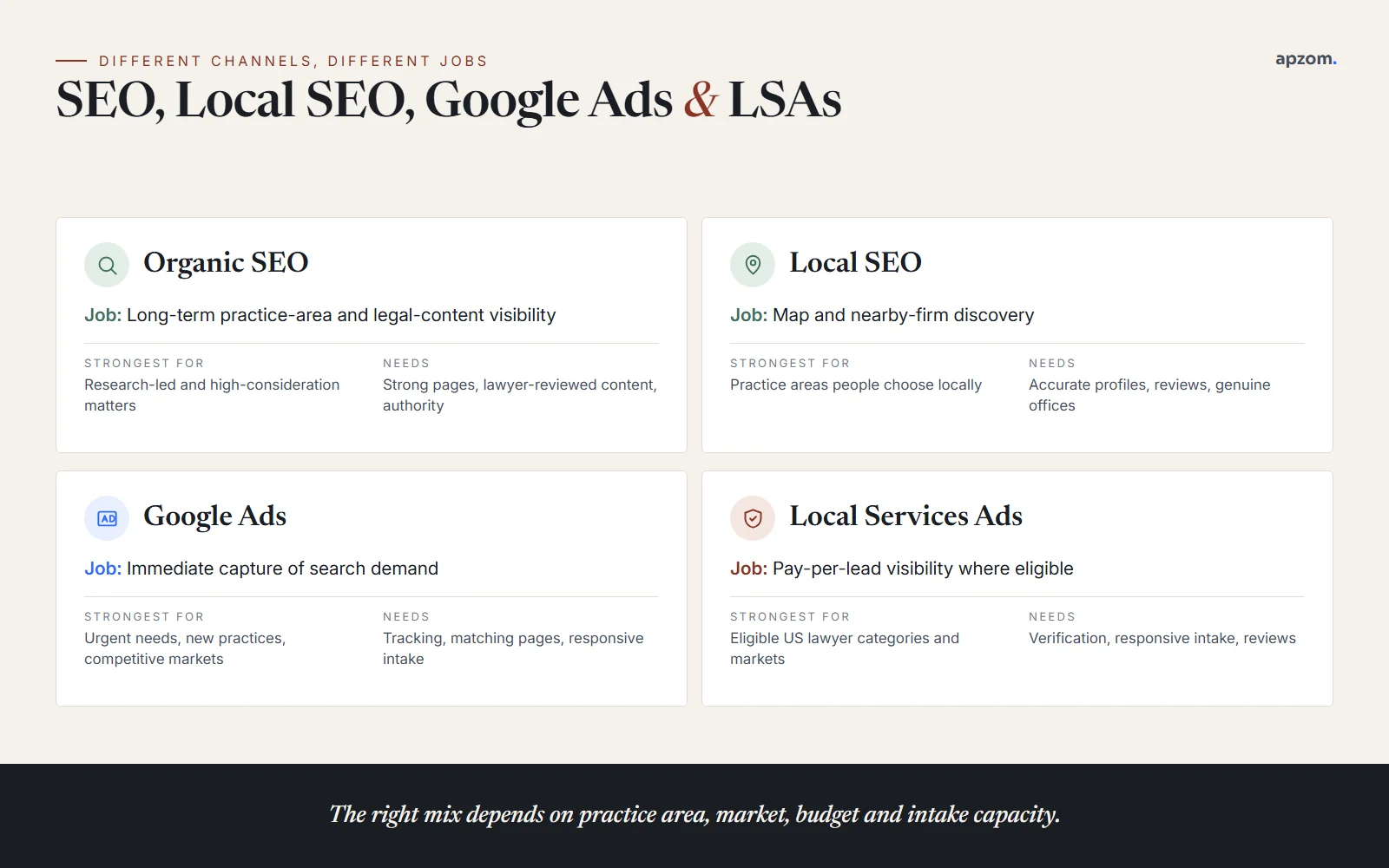
| Channel | Its job | Strongest for | What it needs |
|---|---|---|---|
| Local SEO | Map and nearby-firm discovery | Practice areas people choose locally | Accurate profiles, reviews, genuine offices |
| Organic SEO | Practice-area and legal-question visibility | Research-driven and high-consideration matters | Strong pages, lawyer-reviewed content, authority |
| Google Ads | Immediate capture of search demand | Urgent needs, new practices, competitive markets | Tracking, matching pages, intake that can respond |
| Local Services Ads | Pay-per-lead visibility where eligible | Eligible US categories and markets | Verification, responsive intake, reviews |
None of these is universally best. The right mix depends on the practice area, the market, how urgent the need is, competition, budget, the firm’s existing authority, and how much intake can handle. A channel that produces more enquiries than intake can answer is wasting money.
Social media and video
Gavels, motivational quotes and courthouse photos do not build trust. Useful social content shows the lawyers and how they think: short explanations of common questions, commentary on legal developments, what to expect in a process, firm culture, speaking and community work. Legal information in posts needs the same review as on the website, and nothing should ever reveal a client’s confidences.
AI search and answer engines
AEO, answer engine optimisation, means presenting accurate information clearly enough that search engines and answer systems can understand it and use it. GEO, generative engine optimisation, applies the same idea to AI assistants and AI-generated search answers.
Google says there are no additional requirements or special optimisations needed to appear in its AI Overviews or AI Mode; the same SEO fundamentals and people-first content apply. For a law firm, that means a clear identity for the firm and each lawyer, accurate credentials and admissions, the jurisdictions and practice areas served, content that cites primary legal sources, original commentary from the lawyers, and consistent details across the web. Nobody can guarantee a mention in ChatGPT, Gemini, Perplexity or AI Overviews, and an agency that promises one is overselling.
Part 3: Earn trust
Case results
Prospective clients want to see that the firm has handled matters like theirs. Rules on presenting results vary, so this is an area for care.
US example: the comment to ABA Model Rule 7.1 says truthful reports of results can still be misleading if they lead a reasonable person to expect the same outcome without regard to the facts of their own case. It adds that an appropriate disclaimer “may” prevent that, which is not the same as saying a disclaimer always will. Some states require specific wording or prohibit certain presentations. Client confidentiality and consent also apply.
Safer practice is to describe the type of matter and the work involved, avoid presenting the biggest numbers as typical, follow the state’s specific requirements, and never use language such as “guaranteed result” or “guaranteed settlement”.
Testimonials and reviews
Reviews influence which firm someone calls, and several rule sets apply at once:
- Platform rules. Google prohibits incentivised reviews and discouraging negative ones or selectively asking only satisfied clients.
- US law. The FTC’s Consumer Reviews and Testimonials Rule, in force since 21 October 2024, bans fake reviews, incentives conditioned on a positive review, undisclosed reviews by staff or insiders, and tactics to suppress negative reviews.
- Professional rules. States may restrict testimonials or require disclaimers. Check before featuring them.
Ask every client the same way at a natural point, never offer anything for a review, and never let staff, friends or AI write reviews.
Responding to reviews: confidentiality comes first
A negative review is not permission to disclose. US example: ABA Formal Opinion 496 (2021) concludes that a negative online review alone does not justify revealing information about the client’s representation, and that a response disclosing such information would go beyond what the rules allow. It suggests not responding as a sensible default, or replying with an invitation to discuss the matter privately, or stating that professional considerations prevent a response.
The working principle is simple: protect confidentiality before protecting reputation. A reply such as “Our professional obligations prevent us from discussing any client matter. If you would like to talk, please contact our office directly” protects both.
The Legal Content Trust Model
Legal content can affect someone’s liberty, family, immigration status, money or business. It deserves a higher standard than ordinary marketing copy.
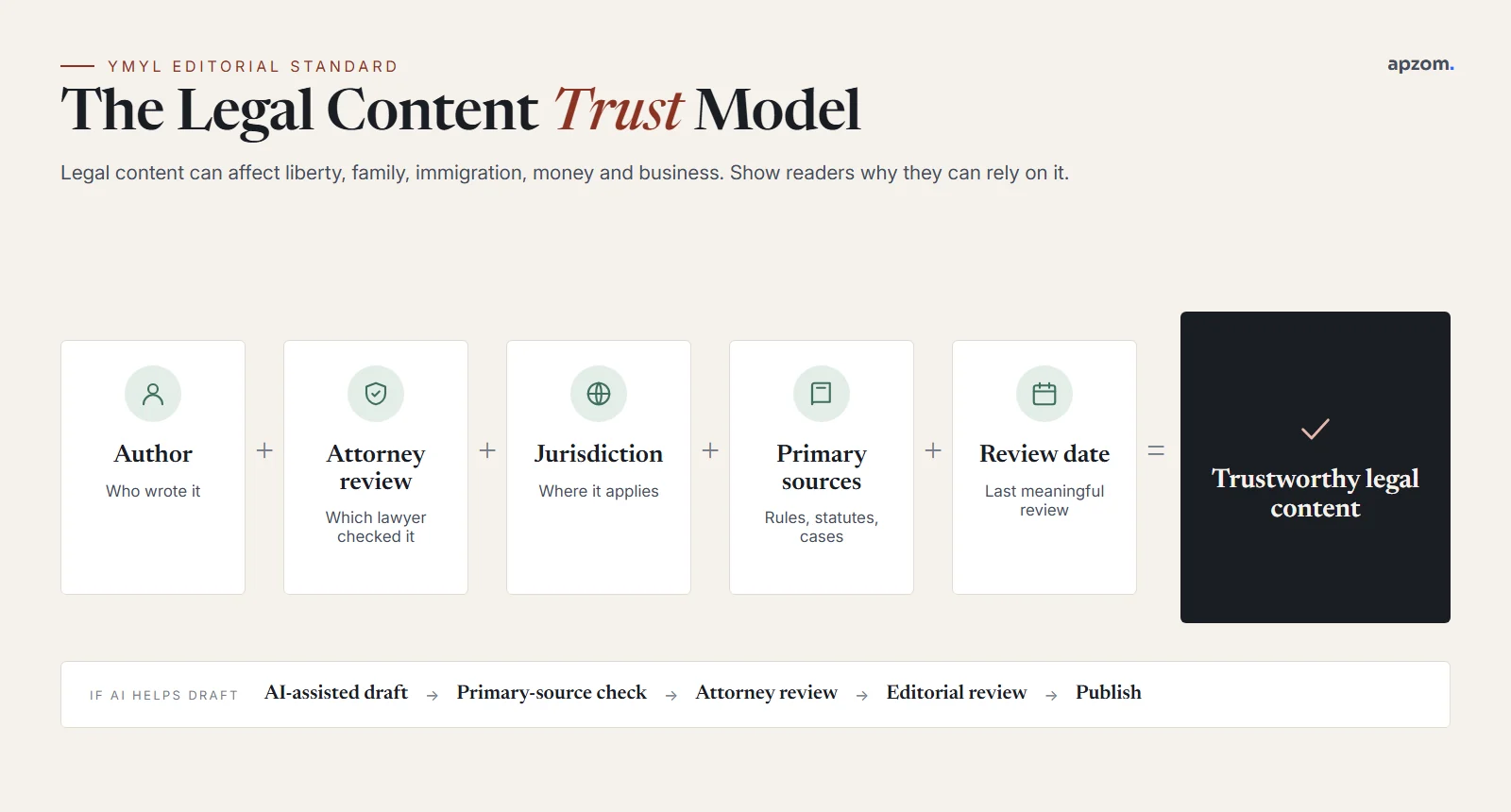
Make five things visible on every substantial legal page: who wrote it, which lawyer reviewed it, which jurisdiction it covers, the primary sources it relies on, and when it was last meaningfully reviewed. Do not change dates just to look fresh.
If AI helps with drafting, the workflow should be: AI-assisted draft, then verification of every case, statute, rule and quote against the primary source, then review by a lawyer, then editorial review, then publication. Raw AI legal content should never be published; invented citations are a well-known failure of these tools.
Part 4: Create safe enquiries
This is where law firm marketing most often goes wrong, because ordinary lead-generation habits clash with professional duties.
A website enquiry can create a prospective client
US example: ABA Model Rule 1.18 says a person who consults a lawyer about possibly forming a lawyer-client relationship is a prospective client. Even if the firm never takes the matter, it generally cannot use or reveal what it learned, and receiving information that could significantly harm that person can disqualify the lawyer, and potentially the firm, from acting against them in the same or a substantially related matter.
ABA Formal Opinion 10-457 (2010) notes that websites inviting enquiries may create prospective-client relationships, and that disclaimers work only if they are clear, properly placed and not contradicted by the firm’s conduct. Formal Opinion 510 (2024) adds that a lawyer trying to limit disqualification risk should obtain from a prospective client only the information reasonably necessary to decide whether the firm can and will take the matter.
For marketing, the implication is direct: a law firm contact form is not an ecommerce lead form. “Tell us everything about your case” invites exactly the information that creates risk.
The Conflict-Safe Legal Intake
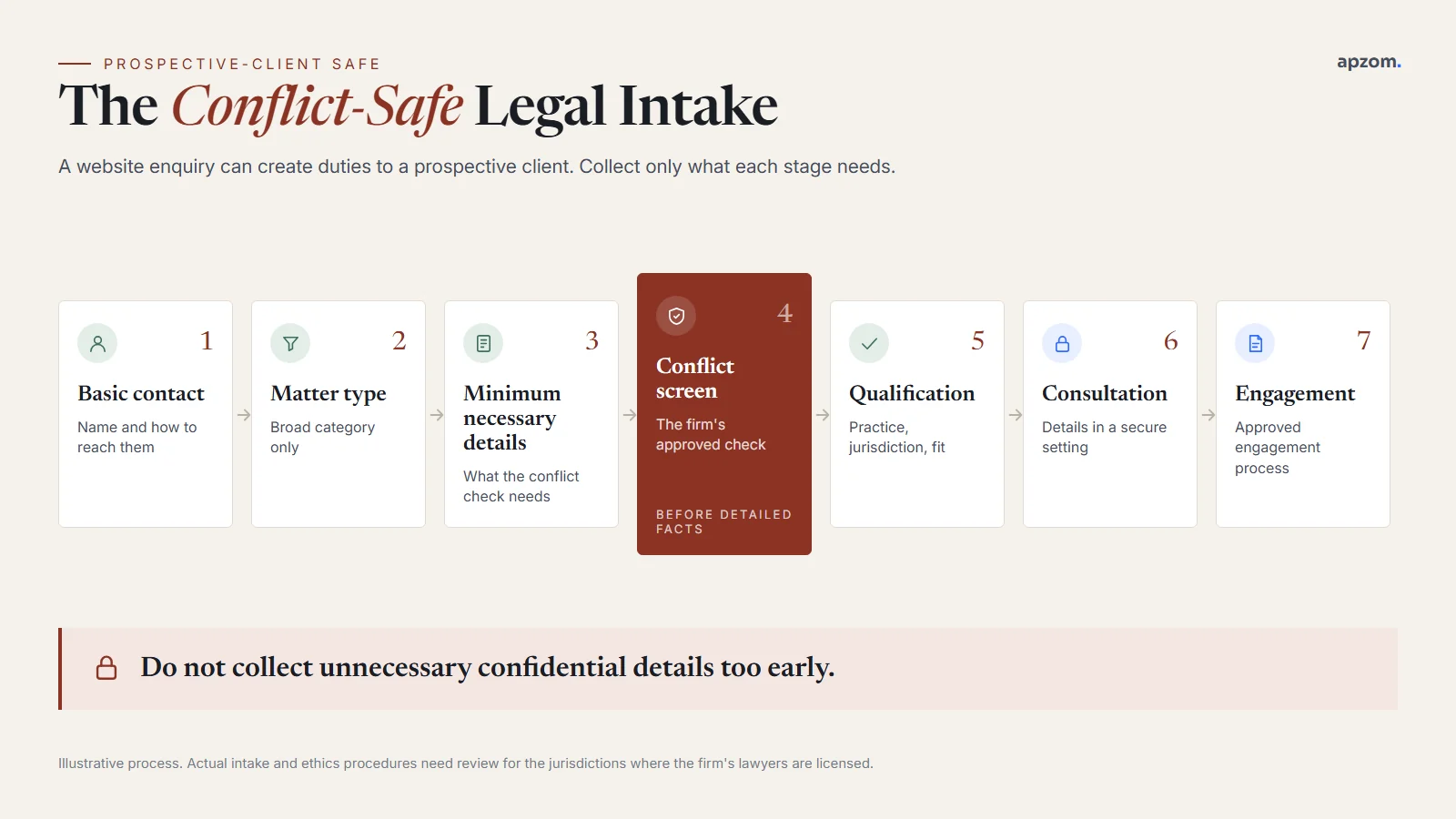
An illustrative model, to be adapted and approved by the firm’s lawyers or ethics counsel:
- Basic routing. Name, contact details and the broad type of matter.
- Minimum necessary information. Only what the firm needs to check conflicts and decide whether it handles this kind of matter, such as the names of the other parties.
- Conflict screen. The firm’s approved conflict check, before detailed facts are discussed.
- Qualification. Is this a matter the firm handles, in a jurisdiction where it practises, at a stage it can help?
- Consultation. Detailed facts are discussed in an appropriate, secure setting.
- Engagement. Representation begins only through the firm’s approved engagement process.
This is an illustrative operational model, not legal advice.
Forms, chat and AI chatbots
Review each contact channel with the same questions: who sees the information, where it is stored, which vendors can access it, whether people can submit confidential details, and how it reaches the conflict process.
- Contact forms. Short, with a clear and readable note about what not to include yet and that submitting does not create a lawyer-client relationship. Store submissions securely and route them to a person.
- Live chat. Outsourced chat operators are not the firm’s lawyers. Script them to collect basic routing information only and never assess the legal issue.
- AI chatbots. Highest risk. A chatbot can invent law or deadlines, appear to give legal advice, collect confidential details and send them to a vendor, or leave someone believing they have a lawyer. If used at all, it should say clearly that it is automated, avoid substantive legal questions, collect minimal information and be supervised by lawyers.
- Call tracking and recording. Useful for attribution, but recordings can capture confidential information, and recording consent laws vary. Review the vendor’s terms and tell callers when calls are recorded.
AI tools and confidentiality
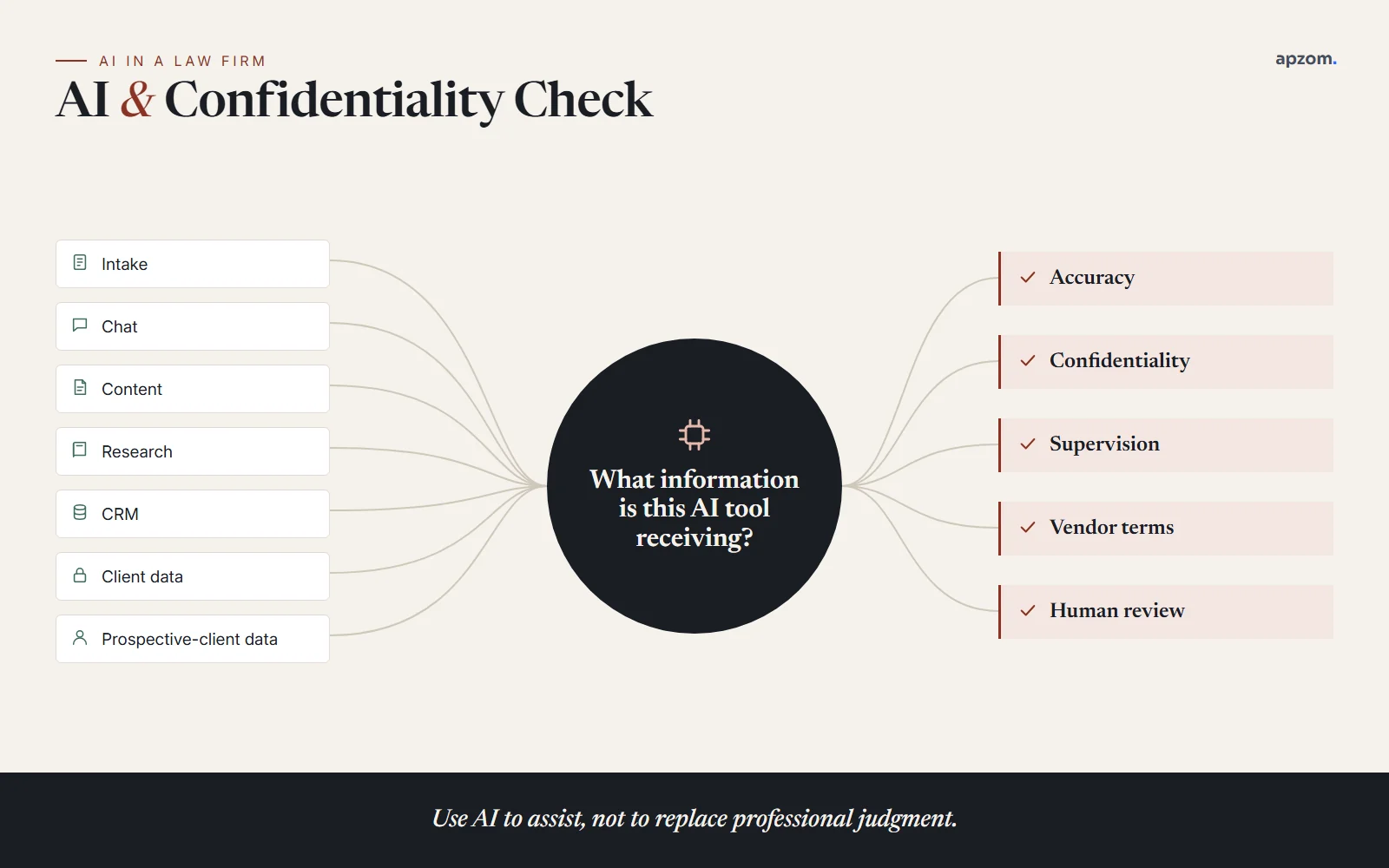
US example: ABA Formal Opinion 512 (July 2024) addresses lawyers’ use of generative AI under the duties of competence, confidentiality, communication, supervision, candour and reasonable fees. Among other points, it advises informed client consent before putting client confidences into many AI tools, and says boilerplate consent in an engagement letter is not enough.
For marketing and intake, the practical question for every AI tool is: what information is this tool receiving? Then check its accuracy, the confidentiality of the data, who supervises it, the vendor’s terms on storage and training, and where a human reviews the output. Use AI to assist people, not to replace professional judgment.
Part 5: Turn enquiries into qualified matters
Intake is part of marketing
A high-intent enquiry loses value if nobody responds properly. That is not a reason to promise an unrealistic response time; it is a reason to design intake on purpose:
- Routing. Enquiries reach someone who can act on that practice area.
- Coverage. Someone answers during the hours the firm advertises, and there is a plan for evenings and weekends where urgent matters are promoted.
- Scripts. Intake staff know what each practice handles, what to ask and what not to ask before a conflict check.
- Scheduling. Consultations are easy to book.
- Follow-up. Enquirers who do not book get an appropriate follow-up, consistent with the rules on contacting people.
- Tracking. Every enquiry has a status in the CRM or practice management system, from first contact to signed or declined.
Following up with someone who contacted the firm is different from solicitation. US example: ABA Model Rule 7.3 defines solicitation as a communication initiated by or for a lawyer, directed at a specific person known to need legal services in a particular matter, and restricts live person-to-person solicitation for financial gain. It also prohibits solicitation involving coercion, duress or harassment, or of someone who has said they do not want it. Targeting people because they are known to have just suffered an accident, or using automated outreach to get around these rules, should never be part of a marketing plan.
The Matter Quality Ladder
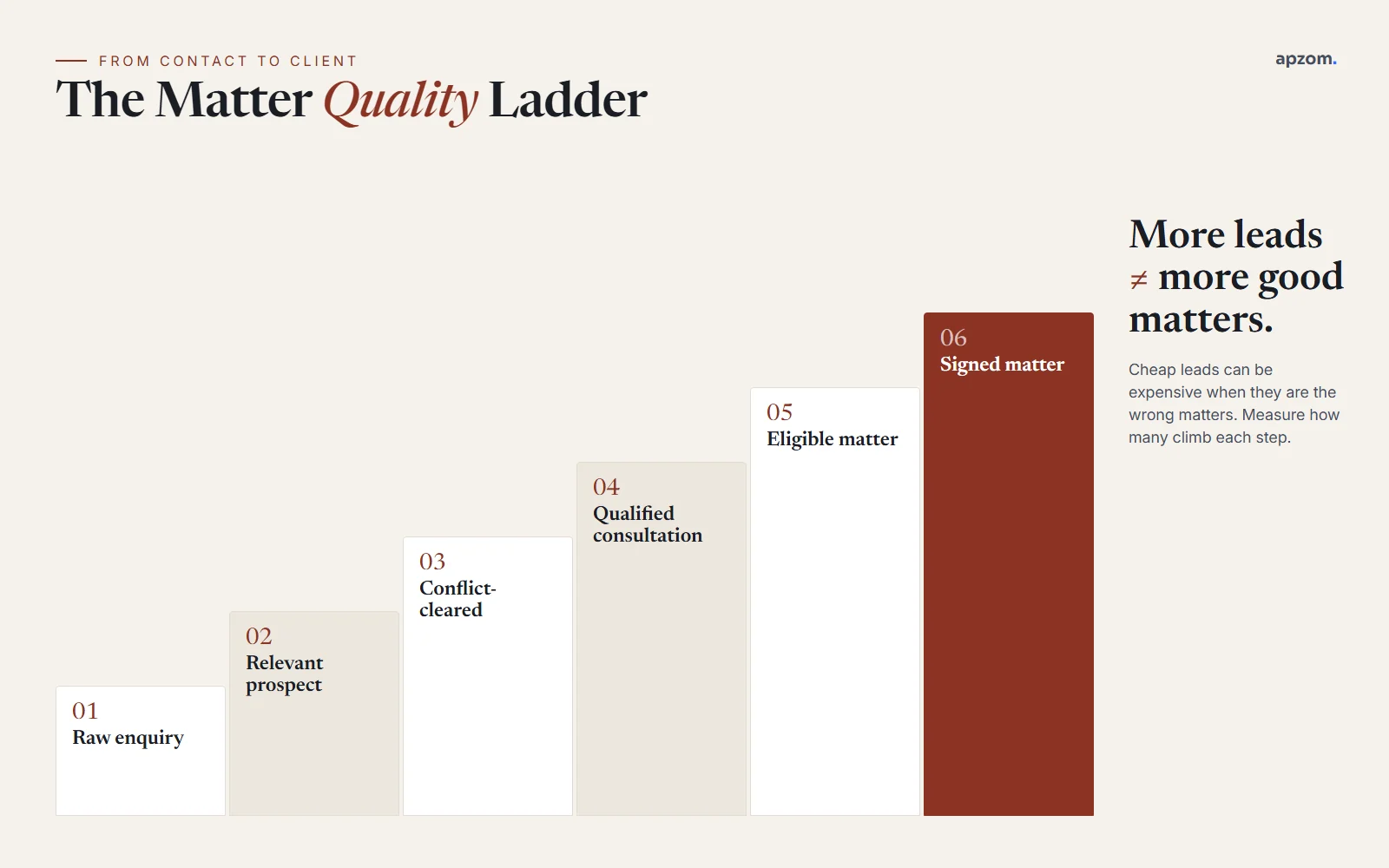
Not every contact is a client, and calling every enquiry a “client” hides where the system is failing.
Raw enquiry → relevant prospect → conflict-cleared prospect → qualified consultation → eligible matter → signed matter → client and matter value
Cheap leads can be expensive when they are the wrong matters. A campaign producing many low-cost enquiries in practice areas the firm does not handle uses intake time, crowds out the right calls and makes reporting look better than it is. A smaller number of well-targeted enquiries that become signed matters is usually worth far more.
Part 6: Measure signed matters, not clicks
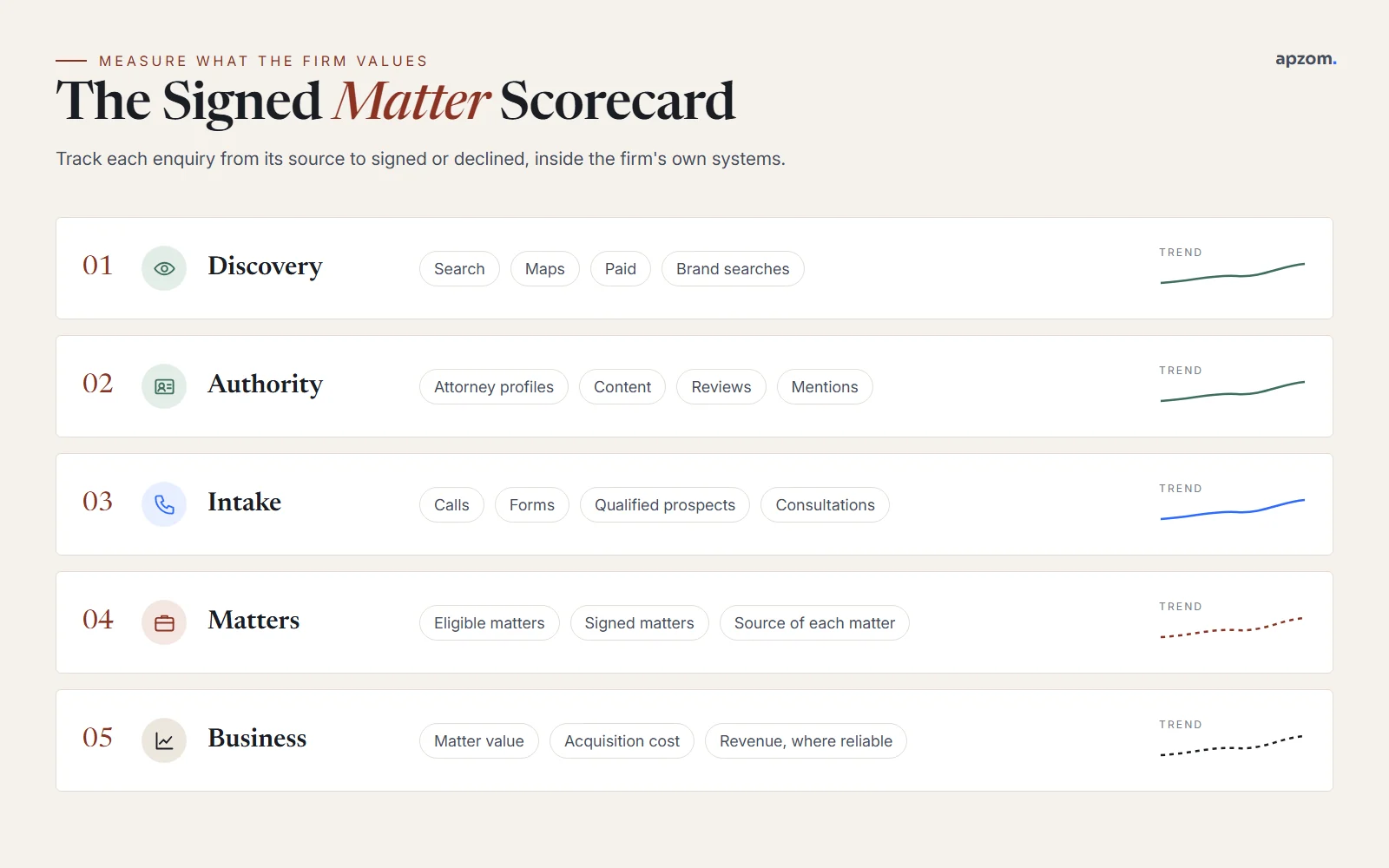
The Signed Matter Scorecard
| Layer | What to measure |
|---|---|
| Discovery | Organic and Maps visibility, paid search impressions, searches for the firm’s and lawyers’ names |
| Authority | Attorney profile and practice page engagement, content performance, reviews, media mentions |
| Intake | Calls, forms, qualified prospects, consultations booked and held |
| Matters | Eligible matters, signed matters, source of each signed matter |
| Business | Matter value, acquisition cost, revenue attributable to marketing where it can be measured reliably |
The single most useful change most firms can make is to record the marketing source of every enquiry and follow it through to signed or declined. That turns “which channel gets the most leads?” into “which channel produces the matters we want?”. It can be done inside the firm’s own systems without sending client details to advertising platforms.
Marketing differs by practice area
| Practice area | Typical intent | Urgency | Content priority | Primary conversion |
|---|---|---|---|---|
| Personal injury | Local, matter-specific | Often high | Process, lawyer trust, what to expect | Call or consultation |
| Criminal defence | Immediate, local | High | Who to call, next steps, lawyer credentials | Call |
| Family law | Research and trust | Medium to high | Process, lawyer authority, sensitivity | Consultation |
| Immigration | Information-heavy | Varies | Clear process, jurisdiction, expertise | Consultation |
| Estate planning | Educational | Lower | Guides, services, fees where permitted | Consultation |
| Employment | Mixed: individuals and employers | Varies | Rights explained accurately, employer guidance | Consultation |
| Business and commercial | Authority-led | Lower | Expertise, sector insight, thought leadership | Introductory call |
These are general patterns, not rules. A firm’s own data should override them.
What the website has to get right
A law firm website does not need a courthouse, a gavel or navy and gold to look credible. It needs to make the important things easy: who the lawyers are, what the firm handles and where, how to get in touch, and what happens next.
Practical priorities:
- Clear navigation to practice areas, lawyers, offices and contact.
- Attorney profiles that are as strong as the practice pages.
- Calls to action that match intent: a phone number for urgent matters, a consultation request for considered ones, an introductory call for business clients.
- Contact forms designed for safe intake, as described above.
- Fast, readable pages on a phone, with good contrast, proper headings and accessible forms.
- No fake urgency, no oversized settlement numbers above the fold, and no badges that are not genuine.
Content worth publishing
Plan content around the decisions prospective clients are actually making:
- Practice information. What the firm handles, where, and how.
- Process questions. What typically happens next, how long things take, what to bring to a consultation.
- Legal education. Accurate explanations for a specific jurisdiction, reviewed by a lawyer.
- Attorney insight. Genuine commentary on cases, rules and trends.
- Business thought leadership. For corporate practices, analysis that in-house counsel and executives find useful.
- Current developments. Important statutes, regulations and judgments, explained promptly and accurately.
A few excellent, accurate pieces do more for a firm than hundreds of keyword-led articles nobody would cite.
How to choose a law firm marketing agency
Questions worth asking any agency, including us:
- How will you find out where our system is weakest before recommending services?
- Will you report signed matters by source, or stop at leads?
- Who writes legal content, and which lawyer reviews it?
- How do you handle testimonials, case results, reviews and “specialist” claims under our rules?
- What will our contact forms, chat and any AI tools collect, and where will that data go?
- Do you understand the difference between advertising and solicitation in our jurisdiction?
- Will we own our website, Business Profiles, ad accounts and data?
Red flags: guaranteed rankings or case numbers, “#1” claims without evidence, review schemes, link buying, lead services that present themselves as recommending you, and reports that never mention consultations or signed matters.
How Apzom can help
Apzom Digital is a digital marketing agency covering SEO, local SEO, Google Ads, content, social media, website development, conversion rate optimisation, and answer engine and generative engine optimisation. We are not a law firm. We do not give legal advice, ethics opinions or compliance certifications, and we recommend that your own lawyers or ethics counsel approve anything that touches professional rules.
Request a law firm digital growth audit
A growth audit from Apzom looks at:
- Your visibility in Google Search, Maps and AI search.
- Your Google Business Profiles and office pages.
- Your practice-area pages and attorney profiles.
- Your Google Ads, and whether Local Services Ads are available for your practice and market.
- Your reviews and how you respond to them.
- How easily a prospective client can contact you on a phone.
- Your intake path from first contact to consultation, including what your forms and chat collect.
- Your tracking, and whether you can see which sources produce signed matters.
- Content gaps and technical SEO issues.
You get a clear view of what to fix first, flagged for your lawyers where a professional rule is involved. Request your free growth audit, or read how we approach search in our SEO methodology.
Frequently asked questions
What does a digital marketing agency for law firms do?
It helps people with a legal need find the firm, trust its lawyers and contact it safely, then helps the firm turn suitable enquiries into consultations and signed matters. That typically covers local and organic SEO, paid search, attorney profiles, practice content, reviews, website conversion and intake reporting, within the professional rules of the firm’s jurisdiction.
Is SEO worth it for law firms?
Usually, yes. Many people start with a search, and visibility for practice-area and local searches keeps working after it has been built. It takes time, it depends on genuine authority and accurate content, and it works best alongside strong attorney profiles and intake.
How does local SEO help lawyers?
It puts the firm in Google Maps and local results when people search for a lawyer nearby. That depends on an accurate Business Profile for a genuine office, sensible practitioner profiles, reviews, and office pages with real local information.
Should law firms use Google Ads?
Often, for urgent or high-intent searches and competitive markets. It works when campaigns are organised by practice area, targeted to where the firm can take matters, sent to matching pages, and measured by consultations and signed matters rather than clicks.
Are Local Services Ads available for lawyers?
In the US, for a range of lawyer categories, subject to Google’s screening, which includes state bar licence checks. Availability depends on the category and market, so check your exact practice and location.
Can law firms use client testimonials and past case results?
Sometimes. Rules vary by jurisdiction. In the US, results must not create unjustified expectations, disclaimers do not automatically make a presentation acceptable, states may require specific wording, and fake or incentivised reviews are prohibited. Check your own rules and client consent first.
What should a law firm’s website contact form collect?
Only what the firm needs at that stage: contact details, the broad type of matter, and enough to run a conflict check. Detailed facts are better discussed after the conflict check, in an appropriate setting. The form should say clearly what not to include and that submitting it does not create a lawyer-client relationship.
Can a law firm use an AI chatbot for intake?
With great care, if at all. It should say it is automated, avoid answering legal questions, collect minimal information, send data only to vendors the firm has vetted, and be supervised by lawyers. In the US, ABA Formal Opinion 512 sets out the ethical duties involved.
How should a law firm measure marketing ROI?
Track every enquiry from its source to signed or declined, then compare channels by qualified consultations, signed matters and matter value rather than traffic or lead volume. Most of this can be done inside the firm’s own systems.
How do I choose a law firm marketing agency?
Look for one that diagnoses before it sells, understands advertising and confidentiality rules, has legal content reviewed by lawyers, reports on signed matters, and leaves you owning your accounts and data. Avoid guarantees and “#1” claims.
Sources
Professional rules and platform policies change and vary by jurisdiction. These are the primary sources behind the statements in this guide, checked in October 2026.
- American Bar Association, Model Rules of Professional Conduct: Rule 1.18 (Duties to Prospective Client), Rule 7.1 and Comment, Rule 7.2 and Comment (including Comment 5 on lead generators), Rule 7.3 (Solicitation of Clients).
- ABA Formal Opinion 10-457 (2010), Lawyer Websites; Formal Opinion 496 (2021), Responding to Online Criticism; Formal Opinion 510 (2024), Rule 1.18 and reasonable measures with prospective clients; Formal Opinion 512 (2024), Generative Artificial Intelligence Tools.
- US Federal Trade Commission: Consumer Reviews and Testimonials Rule, 16 CFR Part 465, effective 21 October 2024.
- Solicitors Regulation Authority: Code of Conduct for Solicitors, paragraph 8.9, and SRA guidance on unsolicited approaches.
- Bar Council of India Rules, Rule 36; Government of India, Press Information Bureau, 9 August 2024.
- Google Business Profile Help: Guidelines for representing your business on Google.
- Google Maps user-contributed content policy: Fake engagement.
- Google Local Services Help: Business screening and verification requirements (United States).
- Google Search Central: AI features and your website; Creating helpful, reliable, people-first content.