
For most Australian agents, digital marketing is not really a lead generation problem. It is a listings problem. Buyer enquiry tends to look after itself once a property is on the market. What decides the size of an agency is how many vendors think of you first, ask you for an appraisal, and then choose you over the agent down the road.
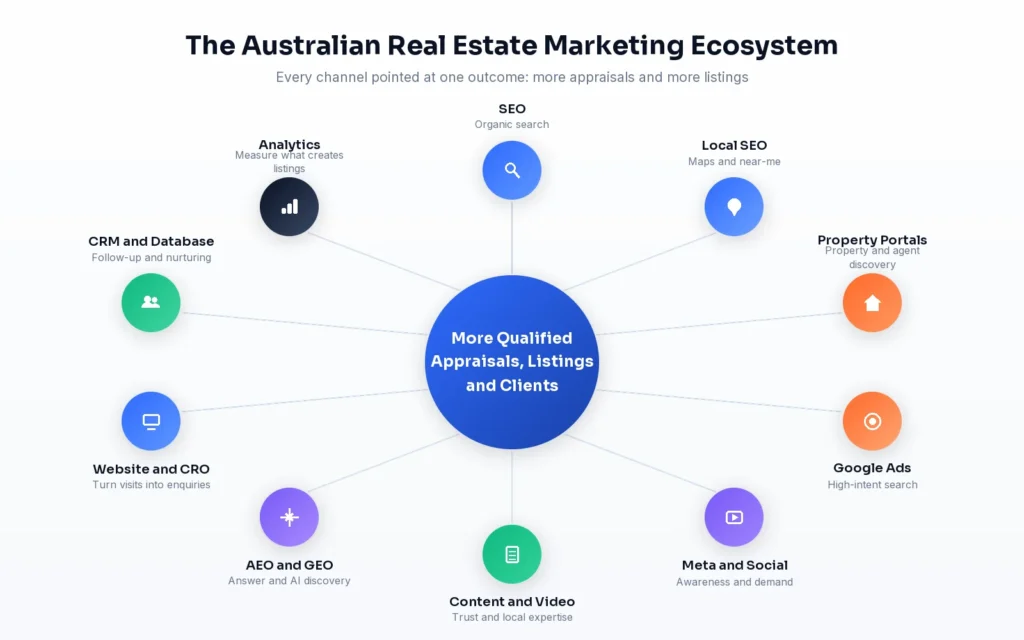
So this guide is built around that. It covers search visibility, local and suburb SEO, Google Business Profile, realestate.com.au and Domain, Google Ads, Meta, content, your database, and the compliance rules that actually apply here — all pointed at one outcome: more appraisals, and more of those appraisals turning into signed authorities.
A quick warning before we start. A lot of the real estate marketing advice you will find online was written for the American market and lightly reworded. Some of it is wrong here, and one of the biggest examples is in the Google Ads section further down.

Key Takeaways
- Appraisals are the metric that matters. Counting raw enquiries hides whether marketing is actually creating listing opportunities.
- realestate.com.au and Domain own the listing search. Your own site usually competes better on agent, agency, suburb and selling-related searches.
- Vendors research you before they call. Reviews, sold results, your profile and your suburb content are all part of the appraisal decision.
- Google’s housing ad targeting restrictions apply in the United States and Canada, not Australia. Advice that says otherwise has been copied from an overseas article.
- The Spam Act sets real rules for the database campaigns most agencies run every month.
- Property advertising sits under Australian Consumer Law federally, but agent conduct and price advertising are state and territory matters — and Victoria’s rules change on 1 October 2026.
- Speed of response decides more appraisals than budget does.
Leads Are Easy. Listings Are the Hard Part.
Ask most agencies what they want from marketing and they will say more leads. Push a little and what they actually want is more stock.
The difference matters because the two are bought in completely different ways. Buyer enquiry arrives more or less automatically once a property is listed on a portal, and a good sales campaign generates plenty of it. Vendor attention does not work like that. Someone thinking about selling is not searching for a property. They are quietly working out what their home might be worth, who sells in their street, and whether the agent they keep seeing on those boards is any good.
That research happens months before anyone fills in a form. By the time a vendor requests an appraisal, they have usually shortlisted two or three agents already. Most of your marketing job happens before that moment, and almost none of it shows up in a leads report.
A useful way to think about it: buyer marketing sells the property, and vendor marketing sells the agent. They need different pages, different content, different calls to action and different measures of success.
Where Australian Vendors Actually Find You
Before deciding where to spend, it helps to map where attention comes from. For a typical suburban agency, it looks roughly like this:
- Google Search — suburb research, agent comparisons, selling questions, and searches for your agency by name.
- Google Maps and your Business Profile — someone searching for an agent near them, then reading your reviews.
- realestate.com.au and Domain — property browsing, sold-price research, and agent profiles.
- Signboards, letterbox drops and word of mouth — still working, and still sending people straight to Google to check you out.
- Social and video — familiarity, recent sales, and a sense of whether you know the area.
- Your database — past appraisals, past buyers, open home attendees.
Notice how many of those end with someone typing your name into Google. That is the moment most agencies lose vendors without ever knowing it happened. If the first page for your agency name shows a thin profile, three old reviews and nothing else, the board and the letterbox drop have just paid for a competitor’s appraisal.
Portal Demand, Paid Demand and Owned Demand
Australian agency marketing pulls on three different kinds of demand. Getting them confused is expensive.
Portal demand is realestate.com.au and Domain. The scale is genuinely hard to replicate. REA Group reported that realestate.com.au averaged 146.4 million visits a month in FY26, up 11%, and around 12.7 million monthly unique visitors — which REA put at 104.5 million more monthly visits than its nearest competitor. Domain, reporting separately, said it drew 7.7 million visitors in June 2026. Read those side by side carefully: each company reports its own numbers on its own basis, so they are useful for a sense of scale rather than a clean head-to-head.
What portals give you is an audience already in property mode. What they do not give you is ownership. Your listing sits beside your competitor’s, your profile sits beside theirs, and the relationship with that buyer or vendor belongs to the platform.
Paid demand is Google Ads and Meta. Fast, controllable, and gone the moment you stop paying.
Owned demand is the slow stuff: your rankings for suburb and agent searches, your Google Business Profile and reviews, your database, your brand. It takes eighteen months to feel like it is working and then it quietly lowers what every listing costs you to win.
The mistake is treating these as competitors. Portals are where you meet people already looking. Paid media fills gaps and covers campaigns. Owned demand is the only one that still exists if you cut the budget next quarter. A sensible agency runs all three and measures them separately, because blending them into one enquiry number hides which part is actually improving.
Choosing Search Battles You Can Win
Here is something most SEO proposals will not tell you. You are probably not going to outrank realestate.com.au for “houses for sale in [suburb]”. The portals have spent two decades and enormous budgets owning those searches, and a single agency site is not going to displace them on listing queries.
That is fine, because those are not the searches that win you listings anyway.
The queries where an individual agency can realistically compete look different:
- Agent and agency searches — your name, competitor names, “real estate agent [suburb]”, “best agent in [suburb]”.
- Vendor intent — “what is my house worth”, “sell my house [suburb]”, “property appraisal [suburb]”.
- Selling advice — auction versus private sale, preparing a home for sale, choosing an agent, agent fees.
- Suburb knowledge — market updates, recent sales analysis, what is actually happening in the streets you work.
- Property management, if that is part of your business.
These have lower search volumes and much higher commercial value. A page ranking for one appraisal-intent search in your core suburb is worth more than a page chasing a high-volume listing query you will never win.
Buyer Marketing and Vendor Marketing Are Different Jobs
| What differs | Buyer acquisition | Vendor acquisition |
|---|---|---|
| What they search | Suburbs, property types, price ranges, inspection times | What is my property worth, agent comparisons, recent sales, selling advice |
| Where they look | Portals first, then your listing | Google, reviews, sold results, then your profile |
| What they want to see | Photos, floor plan, inspection times, price guide | Evidence you sell in their street and get results |
| The conversion | Property enquiry, inspection registration | Appraisal request, or a phone call |
| Timeframe | Weeks | Often months of quiet research |
| Commercial value | Useful, and largely a by-product of listings | Creates the stock the whole business runs on |
One practical consequence: a single generic contact form serving both audiences serves neither. A vendor who lands on a page full of listings sees nothing that speaks to them, and leaves.
The Appraisal-to-Listing Funnel
The funnel most agencies measure stops far too early. Here is the whole thing:
Local visibility → agent discovery → research and trust → appraisal request → qualification → appraisal appointment → listing presentation → signed authority → sales campaign → sale.
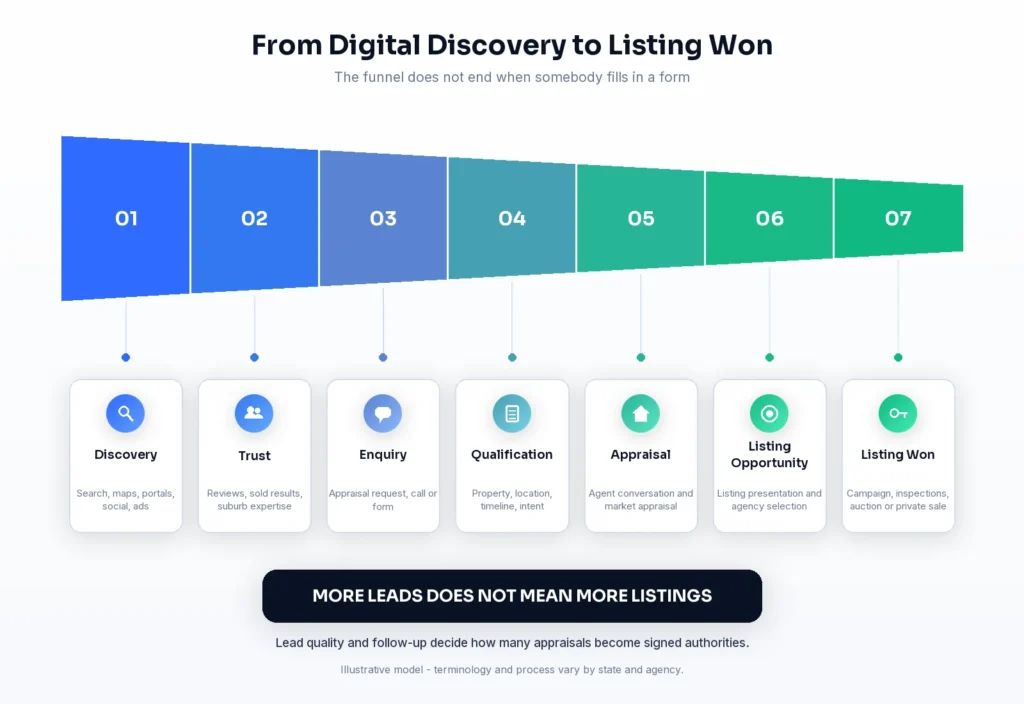
Marketing usually claims credit at step four and stops paying attention. But an appraisal request that never converts to an appointment is not a win, and an appointment that never converts to a signed authority is an expensive afternoon.
More leads does not mean more listings. If your appraisal-to-listing conversion is weak, spending more on ads just buys you more unconverted appraisals. Fixing the conversation, the follow-up and the listing presentation will often produce more stock than doubling the ad budget.
Terminology varies a little between states and agencies — what gets signed at the end might be called an agency agreement, a sales authority or an exclusive authority depending on where you are. The sequence is what matters.
Local and Suburb Search
Agency selection is intensely local. Someone selling in Coburg wants an agent who sells in Coburg, and they will judge that in about fifteen seconds from a search result.
Australian property search narrows in a fairly predictable way: state, then city, then a broader region like the inner west or the eastern suburbs, then a specific suburb, then a property type, then an intent like buying or selling. The further down that ladder someone goes, the closer they are to acting.
Suburb pages, done properly
Suburb content is the backbone of local visibility, and it is also where most agencies do real damage. The temptation is to generate a page for every suburb within fifty kilometres, swap the name, and call it coverage. Those are doorway pages. They read as hollow to a vendor and they do not hold rankings.
A good test: could someone who has lived in that suburb for ten years read your page and learn something? If it just lists the median price and a few generic lines about lifestyle, the answer is no.
Ten genuinely researched suburb pages covering the areas you actually sell in will beat two hundred templated ones. Write about what is selling and what is not, which streets hold value, what buyers in that pocket are actually looking for, how auction results have been tracking. That is the sort of thing a vendor reads and thinks, this person knows my area.
Google Business Profile
For most agencies this is the highest-return work available and the most neglected. A complete profile with real photos, correct hours, a genuine address and a steady flow of reviews will outperform a better-looking website attached to a neglected profile.
Reviews do double duty here. They influence whether you appear, and they influence whether someone calls. A vendor comparing three agents will read reviews before they read anything else you have published.
What not to do: create profiles for suburbs where you have no office, stuff keywords into your business name, or buy reviews. All three breach Google’s guidelines, competitors report them, and the cleanup costs more than the shortcut saved. Our local SEO services page covers the mechanics.
Agent Profiles and Reputation
Vendors do not choose agencies. They choose agents. That is why your individual agent pages often matter more than your home page.
When someone is deciding, they typically look at four things in quick succession: your reviews, your recent sales in their area, your portal profile, and whatever comes up when they search your name. Those four need to tell a consistent story. An agent with strong portal results, a thin agency bio and no Google presence looks less credible than the same agent with all three aligned.
Practical version: give every sales agent a proper profile page with their sold results, their suburbs, their reviews and a way to book an appraisal directly. Keep it current. An agent profile that still lists sales from three years ago suggests a quiet year.
SEO for Australian Agencies
Three distinct jobs get lumped under this heading.
The technical layer
Agency sites break in predictable ways. Listing feeds create hundreds of thin pages that all disappear when the property sells. Filters spawn endless URL variations. Sold listings either vanish and leave dead links, or pile up as low-value pages. Somebody needs to decide what gets indexed, what happens to a listing after settlement, and which version of a filtered page is the real one — that last decision is what a canonical tag does.
Pages that earn appraisals
Your selling page, your appraisal page, your suburb pages and your agent profiles. These carry the commercial load. They should be written for a vendor making a decision, not stuffed with the phrase “real estate agent” a dozen times.
Making it obvious who you are
Search engines and AI systems need to work out what your agency is, where it operates, who works there and what you are known for. Consistent business details, real agent bios, a clear service area and a licence number where appropriate do more for durable visibility than most on-page tweaking. Our SEO methodology sets out how we sequence this, and the general framework sits on our SEO services page.
Showing Up in AI Answers
More property research now starts with a generated answer than a list of links. Google AI Overviews summarise at the top of the page. ChatGPT and similar tools answer directly and cite a few sources.
Two terms you will hear. Answer Engine Optimisation (AEO) just means writing so a specific question gets a clear, self-contained answer that a machine can quote without mangling it. Generative Engine Optimisation (GEO) is the broader work of being a source these systems understand well enough to reference.
Neither can be promised. Nobody controls which sources an AI picks, and any agency guaranteeing you a spot in ChatGPT is selling something that does not exist. What you can influence is whether your information is accurate, clearly written, consistently presented across the web, and specific enough to be worth citing. Local expertise helps here in a way it rarely does elsewhere — genuine suburb knowledge is hard to synthesise.
None of it replaces the fundamentals. If a page cannot be crawled or has no authority behind it, no amount of clever formatting rescues it. We go deeper in our guide to answer engine optimisation for real estate, and across our AEO and GEO services.
Google Ads — and a Correction Worth Reading
Start with the correction, because this one appears in a lot of Australian agency advice and it is simply imported.
Google restricts targeting for housing ads: no gender, age, parental status, marital status or postcode targeting. That policy applies to the United States and Canada. It does not apply to Australia. If a proposal tells you that Australian property campaigns cannot use age or postcode targeting because of Google’s housing rules, that proposal was written for another market and reworded.
This does not mean anything goes. Australian Consumer Law still applies to what you claim in an ad, and Google’s general advertising policies still apply. But the specific North American housing restrictions are not an Australian constraint, and building a campaign as though they were leaves performance on the table.
Where paid search earns its place here is vendor intent. Searches like “property appraisal [suburb]”, “sell my house [suburb]” and “real estate agent [suburb]” are small in volume and heavy in value. Those are worth bidding on. Buyer keywords are usually a harder argument, because the portals already have that audience and your listing is on them anyway.
Two things decide whether this works. First, where the click lands — sending an appraisal search to your home page wastes it. Second, measurement. Most appraisal enquiries come by phone, so if you only count form submissions you will undercount badly and cut the campaigns that are actually working. Our Google Ads management page covers structure in general terms.
Anyone quoting you a cost per lead before looking at your market, your suburbs and your conversion setup is guessing.
Meta, Social and the Just Listed Trap
Most agency social accounts follow the same pattern. Just listed. Just sold. Just listed. Just sold. Open home this Saturday. Just sold.
It is not useless — sold posts do signal activity, which is part of why vendors notice you. But an account that only does this gives a prospective vendor no reason to follow along, and no reason to think of you as anything other than someone who occasionally sells houses nearby.
The accounts that generate appraisals tend to mix in things a seller would actually want: what happened at the auction and why, what the market did this month in plain language, what a home needed doing before it sold well, how to prepare for a campaign, what a bad styling decision costs. Short video does the heavy lifting here, because vendors are partly assessing whether they want to spend six weeks dealing with you.
On targeting, Meta operates a Housing Special Ad Category with restricted targeting options. Its scope and rules have changed more than once, so confirm the current position for Australian advertisers in Meta’s own documentation rather than trusting an article, including this one. Our Meta Ads management page outlines the approach.
Where paid social genuinely pulls its weight in Australia is vendor awareness and campaign support — getting a listing in front of the neighbours most likely to know a buyer, and keeping your face familiar in the suburbs you want to dominate.
Content That Vendors Actually Read
You do not need a content calendar with forty ideas. You need about a dozen pieces that answer what sellers ask before they call anyone.
The reliable ones: how to choose an agent, what an appraisal involves and what it is not, auction versus private treaty in your market, what to fix before listing and what to leave, how agent fees and marketing costs work, when to sell, and an honest read on your local market updated regularly.
Buyer content is worth having too — suburb guides, inspection checklists, how auctions run — but be clear about its job. It builds visibility and audience. It rarely wins a listing on its own.
Steer clear of anything that strays into financial or legal advice. Explaining how a sales campaign works is your expertise. Advising someone on their mortgage structure or tax position is not, and getting it wrong is a real risk. Our content marketing page covers the production side.
Supporting an Auction Campaign Digitally
Where auction is the norm — and it varies a lot between markets and even between suburbs — the digital campaign has a specific shape.
Portal exposure and a good listing do the heavy lifting for reach. Search and social keep the property in front of the right local audience during the campaign. Email to your buyer database usually produces the earliest inspection registrations, because those people are already looking. Retargeting keeps the property in front of people who inspected the listing but did not enquire. And the whole thing needs a reporting line back to the vendor, because vendor confidence during a four-week campaign is part of what you are managing.
Do not assume auction suits every property or every market. In plenty of Australian markets private treaty is the norm and pushing auction because it produces better marketing content is not acting in the vendor’s interest.
Your Database Is Probably Your Best Asset
Most agencies are sitting on a list of past buyers, past vendors, appraisal enquiries, open home attendees and landlords — and using it twice a year.
A well-segmented database beats almost any paid channel for appraisal generation, because these people already know you. Past appraisals that did not convert are particularly valuable: someone who considered selling eighteen months ago and did not is often closer to selling now than a cold contact ever will be.
The work is unglamorous. Clean the data. Segment by suburb, by relationship, by whether they are an owner. Send something genuinely useful on a predictable rhythm — a real market update beats a template. Then track which segments actually produce appraisal conversations.
Which brings us to the rules, because this is the part agencies most often get wrong.
The Spam Act and Your Email and SMS Campaigns
Every database campaign an Australian agency sends is a commercial electronic message, and the Spam Act 2003 sets out what that requires. ACMA, which enforces it, describes three obligations.
Consent. It can be express or inferred, and ACMA recommends express consent because it is unambiguous. Inferred consent is narrower than most agencies assume — a business card in a bowl at an open home is not a clear yes to a monthly newsletter.
Identify yourself. The message has to identify the business that authorised it, using the correct legal name or the name and ABN, and those details need to stay accurate for at least 30 days after sending.
Make unsubscribing easy. The unsubscribe option must not require someone to log in, create an account or hand over extra personal information. It needs to keep working for at least 30 days, and requests should be actioned as quickly as possible and within five business days.
What this rules out is the tactic that still circulates: buying lists, scraping addresses off other agents’ listings, or bulk-texting an area you have farmed. It also rules out emailing someone to ask whether they would like to receive your emails — that request is itself a commercial message.
None of this is legal advice, and the penalties are not trivial. Check ACMA’s current guidance and get proper advice before building automated nurture sequences.
Privacy and the Data You Collect
Appraisal forms, property alerts, open home registers and CRM records all collect personal information, and the agency is responsible for what happens to it.
The practical questions are simple enough. Do your forms collect more than you need? Does your privacy policy describe what you actually do, or is it a template nobody has read since 2019? Where does lead data go once it leaves your site — CRM, email platform, ad platforms, chat tools are all third parties. And if you upload customer lists to build advertising audiences, have you thought about whether the people on that list would expect it?
Whether and how the Privacy Act applies depends on circumstances, including the size and nature of the business, so check the Office of the Australian Information Commissioner’s current guidance rather than assuming.
Advertising Accuracy: Federal Law, State Rules
This section trips up marketers more than agents, because the split is not obvious.
Federally, Australian Consumer Law prohibits misleading or deceptive conduct, and the ACCC states plainly that “it is illegal for real estate agents to mislead consumers, regardless of whether this is deliberate or not.” Intent does not save you. The ACCC specifically flags advertising well below the likely selling price to attract interest, advertising below a price the seller has already rejected, falsely claiming offers have been rejected, and dummy bidding.
But — and this is the part that matters for anyone running campaigns across multiple states — the ACCC also states that “real estate laws are state and territory-based. They come under the authority of state and territory-based agencies.” Agent licensing, conduct, price advertising and sales practice are handled by NSW Fair Trading, Consumer Affairs Victoria, the Queensland Office of Fair Trading and their equivalents in WA, SA, Tasmania, the ACT and the Northern Territory.
So “Australian law requires X” is usually the wrong sentence. If an agency tells you a price advertising rule applies nationally, ask which regulator they are quoting. Multi-office agencies working across borders need marketing processes that are state-aware, not one national template.
Victoria: What Changes on 1 October 2026
This one is time-sensitive, and worth getting right if you sell in Victoria.
Right now, Victorian agents must provide a Statement of Information for residential property. It has to carry an indicative selling price — either a single figure or a range of no more than 10% — the three most comparable sales with addresses, dates and prices, and the median house or unit price for the suburb. It must be displayed at every open for inspection, included with online advertising, and given to a prospective buyer within two business days of a request, and updated if the indicative price changes. Consumer Affairs Victoria is also explicit that agents must not qualify a price with words or symbols such as “offers above”, “from” or a plus sign, and that the advertised price cannot sit below the agent’s own estimate, the seller’s asking price, or a price already rejected in writing.
From 1 October 2026, the Statement of Information is renamed the Property Price Statement. For auctions and fixed-date sales from 16 October 2026, agents must publish the reserve price at least seven days beforehand, and publish the final sold price once the sale becomes unconditional.
For marketing teams this is not just a compliance footnote. Price display is embedded in listing templates, portal feeds, brochures, social creative and campaign landing pages. A change to how prices must be presented touches all of it, and the lead time is short. If you operate in Victoria, confirm the current position directly with Consumer Affairs Victoria before your next campaign goes out — the rules described here are accurate as at publication, and this is a summary for planning rather than legal advice.
Solo Agent, Sales Team or Multi-Office Agency
These three get handed the same marketing plan constantly, and it fails for at least two of them.
| Area | Individual agent | Sales team | Multi-office agency |
|---|---|---|---|
| Brand | Personal name and reputation | Team identity with agents underneath | Agency brand, offices and agents together |
| Search focus | One or two suburbs, properly | A cluster of adjoining suburbs | Scalable location structure across offices |
| Content | First-hand local knowledge | Shared production, individual voices | Editorial system with real governance |
| Reviews | Individual, and decisive | Team plus individual | Office level and agent level |
| Paid media | Tight, modest, vendor-focused | Segmented by suburb and intent | Brand plus performance across markets |
| CRM | A pipeline one person can hold in their head | Routing and accountability | Attribution across offices and channels |
| What to measure | Appraisals and listings won | Appraisals per agent | Cost per listing by channel and office |
An agency running a solo agent’s playbook never builds the structure to scale. A solo agent running an agency’s playbook spends money on infrastructure they will never use.
Which Channel, and When
No universal winner here. Each does a different job.
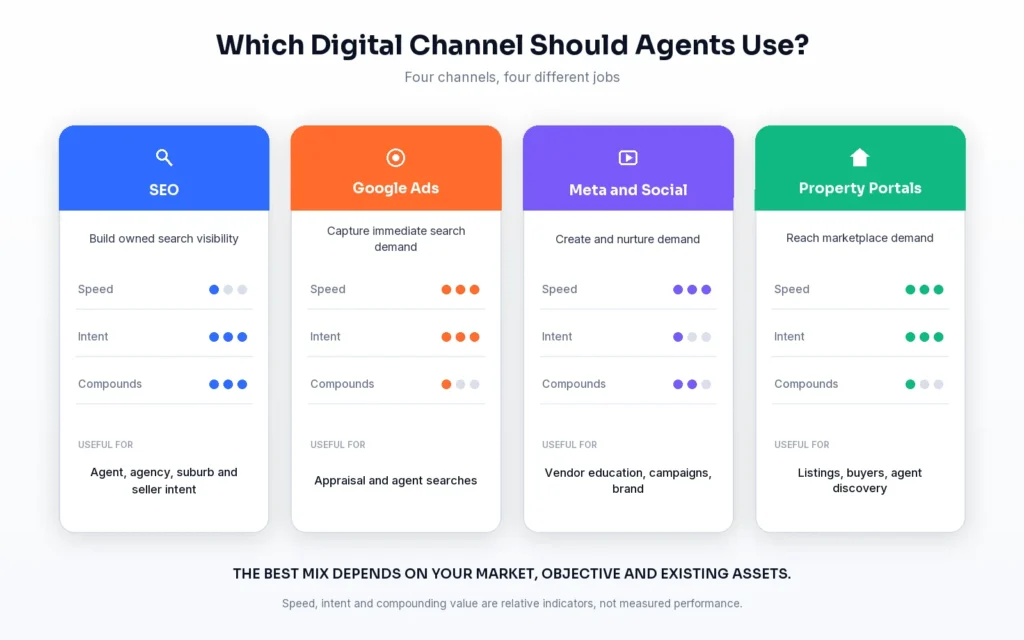
| Channel | Its job | Speed | Intent | Compounds | Best for | Main weakness |
|---|---|---|---|---|---|---|
| SEO | Builds owned search visibility | Slow | High | Yes | Agent, suburb and vendor searches | Needs sustained investment before it pays |
| Local SEO | Wins map and near-me searches | Medium | High | Yes | Any agency with a real office | Reviews and accuracy need constant attention |
| Google Ads | Buys active search demand | Fast | High | No | Appraisal and agent searches | Stops the day you stop paying |
| Meta and social | Creates awareness and familiarity | Fast | Low | Partly | Vendor education, campaigns, brand | Creative fatigue; easy to waste |
| Property portals | Reaches people already in property mode | Immediate | Very high | No | Listings, buyers, agent discovery | Dependency; the platform owns the relationship |
A reasonable sequence for most agencies: portals and paid media pay for this quarter, while local SEO, reviews, database and content lower what next year costs.
Counting the Right Things
Impressions, followers, sessions and raw enquiry counts describe activity. None of them pay a franchise fee.
A reporting framework worth having follows the business: visibility, then enquiry, then qualified vendor opportunity, then appraisal booked, then listing presentation, then listing won. For buyers it is shorter — enquiry, qualified buyer, inspection, active buyer relationship.
The measures that survive scrutiny are organic appraisal enquiries, cost per qualified vendor lead, appraisal bookings, appraisal-to-listing conversion, and listings won by source. Be realistic about what your systems can actually attribute — if appraisals mostly arrive by phone and nobody logs the source, no dashboard will fix that. Getting call tracking and CRM source fields right is usually the unglamorous first step.
One more, and it is the cheapest lever most agencies have: how quickly someone responds. An appraisal enquiry that sits until tomorrow afternoon has usually already been answered by a competitor. That is not a marketing failure, but marketing wears the blame for it, and no campaign fixes it.
A 90-Day Plan
Illustrative, not a promise. Priorities shift depending on the agency, the market and who you are competing with. But the sequence — find the leaks, fix the biggest ones, then put money behind what works — holds up almost everywhere.
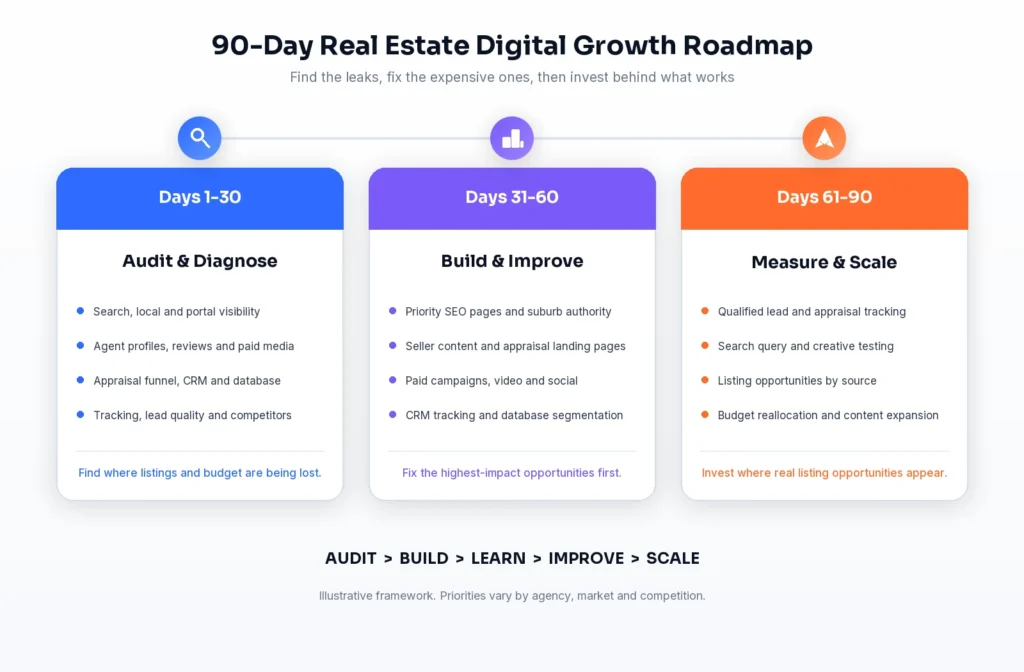
Days 1 to 30: work out where listings are being lost
Check that analytics and call tracking actually work, because a surprising number do not. Baseline your visibility for agent, suburb and appraisal searches. Audit the Google Business Profile and the review position properly. Look at how much of your enquiry depends on portals versus anything you own. Review agent profiles, the appraisal landing path, the CRM and how fast enquiries are really answered. Check database consent and unsubscribe handling against the Spam Act. And look honestly at the competitors taking the listings you want.
The question the whole month serves: where are appraisal opportunities and marketing budget leaking away?
Days 31 to 60: fix the expensive problems first
Rebuild the pages that earn appraisals — selling, appraisal, core suburbs, agent profiles. Ship the technical fixes. Get a real review process running rather than hoping. Restructure paid campaigns around vendor intent and fix the landing pages behind the highest-spend ones. Segment the database and start sending something worth opening. Set response-time standards and actually measure against them.
Days 61 to 90: put money behind what works
Look at which searches produced appraisal enquiries, which suburbs produced real opportunities, and which agents convert. Test the highest-traffic enquiry paths. Iterate creative on evidence rather than taste. Expand content into the suburbs showing traction. Then move budget toward whatever is producing appraisals, not whatever produces the most leads.
Choosing a Marketing Partner
Most pitches sound the same. These questions sort them out quickly, because they are hard to answer without genuine Australian experience.
- How would you measure whether our marketing is producing appraisals, not just enquiries?
- What is your view on how much we should rely on realestate.com.au and Domain?
- How would our plan differ for vendor acquisition versus buyer enquiry?
- Do Google’s housing ad targeting restrictions apply to us in Australia?
- How do you handle Spam Act consent in the database campaigns you build?
- How would you handle price advertising differences between the states we operate in?
- How do you measure appraisal enquiries that come in by phone?
- Who owns the ad accounts, analytics, CRM data and content if we part ways?
- What would you refuse to promise us?
The fourth question is a useful trap, and a fair one. The correct answer is no — those restrictions apply in the United States and Canada. An agency that says yes has not checked, and is probably reusing an overseas playbook on your account.
Red Flags
- Guaranteed rankings, guaranteed listings or guaranteed revenue
- Promises of placement or citations in ChatGPT or AI Overviews
- Cost per lead figures quoted before anyone has looked at your market
- Plans to generate a page for every suburb within fifty kilometres
- Any suggestion of buying reviews, or of incentivising them in ways that are not disclosed
- Advice built on United States housing ad rules that do not apply here
- Treating one state’s price advertising rules as national
- Email or SMS campaigns built on purchased or scraped lists
- Reporting that stops at traffic, impressions or raw enquiry count
- Ad accounts or CRM data held in the agency’s name
- Case studies with no named client and no verifiable numbers
How Apzom Digital Can Help
Apzom Digital is a digital marketing agency based in Ahmedabad, India, working with clients internationally. We do not have an Australian office, and we would rather say so plainly than imply a local presence we do not have. Australian property businesses work with us remotely, with scheduled reporting, shared dashboards and clear ownership of accounts and data.
The work relevant to agencies here is SEO, local SEO, answer engine optimisation, generative engine optimisation, content marketing, social media, Google Ads, Meta Ads, conversion rate optimisation and website development.
On compliance, we work alongside your licensed agency and its advisers rather than claiming to manage regulatory obligations for you. Licensing, price advertising and conduct obligations sit with the agency, and any marketing partner blurring that line is worth a second look.
Request a Real Estate Digital Growth Audit
If you want a clear read on where appraisals are being lost, start with a diagnostic rather than a proposal. A useful audit looks at your visibility for agent, suburb and appraisal searches, your local search and review position, how dependent you are on the portals, the appraisal enquiry path from click to booked appointment, paid campaign structure and wasted spend, agent profile visibility, database health and consent handling, call and CRM tracking, AI-search readiness, and the content gaps worth filling first.
Get in touch to talk it through, or request a quote if you already know the scope.
Frequently Asked Questions
What is digital marketing for real estate agents?
It is the combination of search visibility, local search, portal presence, paid advertising, content, social and database follow-up that puts an agent in front of people thinking about selling or buying. For Australian agencies the practical goal is usually appraisals and listings rather than raw enquiry volume, because listings are what the rest of the business runs on.
Is SEO worth it for Australian real estate agents?
For an agency planning to be in the same suburbs in three years, generally yes — it lowers how much of your pipeline you rent from portals and ad platforms. It is a poor fit if you need appraisals this month and have no existing foundation, in which case paid search and your database carry the load while SEO is built underneath.
How can agents get more appraisal enquiries?
Be visible for the searches vendors actually run, which are agent, suburb and selling-related rather than listing searches. Make sure your reviews, sold results and agent profile tell a consistent story, because vendors check all three. Give appraisals their own landing page and a clear way to book. Then answer enquiries fast, because most appraisal requests go to more than one agent.
Should agents use Google Ads or SEO?
They do different jobs. Google Ads buys visibility on vendor-intent searches immediately and stops when the budget does. SEO takes months, then compounds and reduces future cost. Most agencies want both, weighted toward paid early and shifting toward organic as it matures.
Is realestate.com.au enough on its own?
It works until it is the only thing you have. The portals deliver genuine scale — REA Group reported realestate.com.au averaging 146.4 million monthly visits in FY26 — but the platform owns the relationship, your competitors are on the same page, and you compete largely on spend and responsiveness. Most durable agencies use portals for reach while building owned visibility that lowers acquisition cost over time.
Do Google’s housing ad rules apply to Australian real estate ads?
No. Google’s restricted targeting policy for housing ads — which removes gender, age, parental status, marital status and postcode targeting — applies to the United States and Canada. It does not apply in Australia. Australian Consumer Law and Google’s general advertising policies still govern what you can claim, but those specific targeting restrictions are not an Australian constraint.
Does the Spam Act apply to real estate email and SMS marketing?
Yes. Database campaigns are commercial electronic messages. ACMA’s guidance sets out three obligations: consent, which can be express or inferred; identifying the sender using the correct legal name or name and ABN, kept accurate for at least 30 days; and a working unsubscribe that does not demand extra information, stays live for at least 30 days, and is actioned within five business days.
What is AEO and GEO for real estate?
Answer Engine Optimisation means structuring information so search features and assistants can lift a clear answer to a specific question. Generative Engine Optimisation is the broader work of being a source AI systems understand and trust. Neither can be guaranteed, and both still depend on ordinary SEO fundamentals being in place.
Are real estate advertising rules the same across Australia?
No. Australian Consumer Law applies federally and prohibits misleading conduct, but the ACCC states that real estate laws covering agent licensing, conduct, sales and rentals are state and territory based. Price advertising requirements in particular differ, and Victoria’s change on 1 October 2026 is a current example. Agencies operating across state lines need state-aware marketing processes.
How should an agency measure digital marketing performance?
By appraisals and listings, not traffic. Useful measures are organic appraisal enquiries, cost per qualified vendor lead, appraisal bookings, appraisal-to-listing conversion and listings won by source, reported separately for portal, paid and organic. Be honest about what your systems can attribute — if appraisals arrive by phone and nobody records the source, that is the first thing to fix.
Where to Start
If you do one thing after reading this, start counting appraisals by source instead of leads by channel. Almost every other decision gets easier once you can see which activity produces people who actually sit down with you.
After that the order is fairly boring, which is usually a good sign. Fix the Google Business Profile and get reviews moving. Make sure phone enquiries are tracked. Sort the appraisal landing path. Clean and segment the database. Then begin the slow work — suburb content, agent profiles, the pages that earn search visibility — because that is what lowers the cost of every listing you win next year.
For agencies working across other markets, we have companion guides covering real estate digital marketing in Canada and the United States, where the portal landscape and advertising rules work quite differently.