
Real estate digital marketing in Canada is the work of getting found by buyers and sellers online, then turning that attention into booked appointments. For most agents and brokerages it means a mix of search visibility, a Google Business Profile that actually ranks, presence on REALTOR.ca, paid campaigns on Google and Meta, useful local content, and a follow-up system that reaches people quickly and legally.
The last part is where Canada differs. Advertising rules come from your provincial regulator, not one national body. Email and text follow-up falls under CASL. Housing ads face targeting restrictions on both Google and Meta. And if you sell in Quebec, French isn’t a nice-to-have.
This guide walks through how those pieces fit together, what to measure, and how to tell a capable agency from a confident one.

Key Takeaways
- REALTOR.ca is the single biggest source of property search attention in Canada, but the audience it sends you is rented, not owned.
- Google and Meta both restrict how housing ads can be targeted in Canada. You cannot target full postal codes, and several demographic options are switched off.
- CASL governs marketing email and texts. Consent, identification and a working unsubscribe are not optional extras.
- Advertising rules are provincial. What satisfies RECO in Ontario is not automatically what BCFSA or the OACIQ expect.
- REALTOR® is a trademark controlled by CREA, not a generic word for an agent. Misusing it in ad copy is a genuine risk.
- Quebec is a different market, not a translation job.
- Appointments booked is a better measure of marketing than leads generated.
What Real Estate Digital Marketing Actually Means Here
Strip away the jargon and there are only three jobs. Get in front of people who are already looking. Stay in front of people who will look in six months. Make it easy for both groups to reach you and hard for them to forget you.
Everything else is detail. SEO is how you show up when someone searches. Local SEO is how you show up on the map when they search with a place attached. Paid ads buy that visibility now instead of earning it over time. Content answers the questions people ask before they are ready to call. A CRM makes sure nobody who did call gets forgotten.
What changes from market to market is the weight you put on each. In Canada, two things pull hard on that balance: an unusually dominant national listing portal, and a compliance layer that touches advertising, email and data.
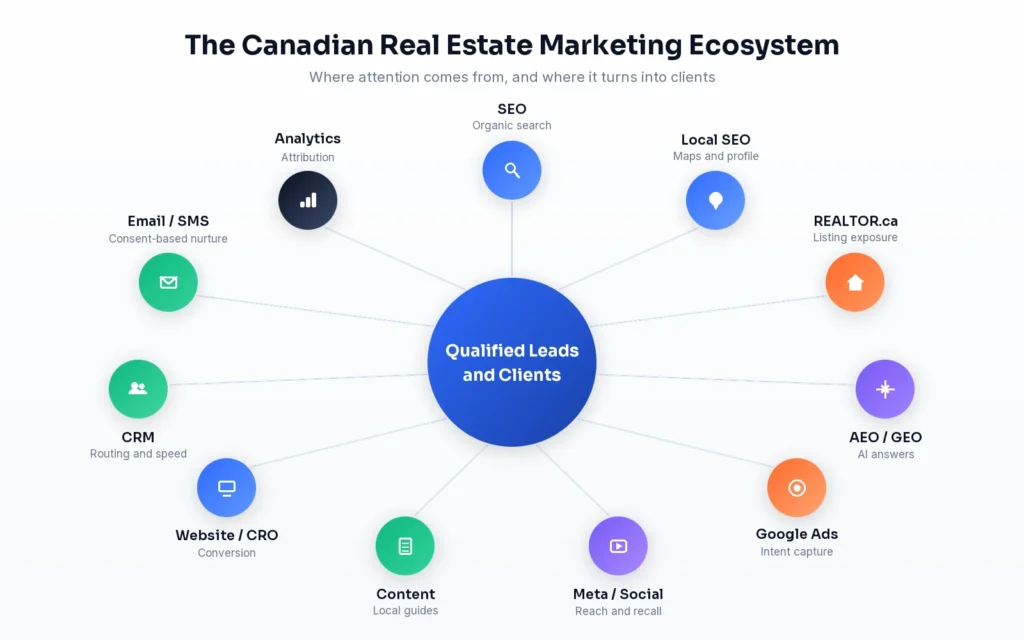
The Canadian Real Estate Discovery Stack
It helps to picture where attention actually comes from before deciding where to spend. A working stack for most Canadian agents and brokerages looks like this:
- Google Search — neighbourhood research, agent searches, market questions, brokerage brand searches.
- Google Maps and the Business Profile — proximity searches, calls, direction requests, reviews.
- REALTOR.ca — listing discovery and agent profile views at national scale.
- Paid media — Google Ads for active intent, Meta for reach and recall.
- Your website — where interest becomes a contactable person.
- Email and SMS — the long game with people who are not ready yet.
- Reviews, referrals and reputation — the quiet channel that closes more deals than most dashboards show.
Notice that only some of those are things you own. That distinction turns out to matter more than any individual tactic.
Marketplace, Paid and Owned Demand
Canadian real estate marketing draws on three different kinds of demand, and mixing them up is the most expensive mistake in the category.
Marketplace demand is REALTOR.ca. According to CREA, REALTOR.ca recorded 633 million visits from 113 million unique visitors in 2025, generating more than two billion listing page views and over 20 million REALTOR® profile views, with Similarweb data putting it at more than 60% of Canadian online market share (CREA, published May 2026). That is enormous reach you do not have to build. It is also reach you do not control. Your listing sits beside everyone else’s, and the relationship with that buyer belongs to the platform.
Paid demand is Google and Meta. You control targeting, message and budget, and it works the day you switch it on. It also stops the day you switch it off, and it gets more expensive as competitors bid on the same intent.
Owned demand is everything that keeps working without a media invoice: your organic rankings, your brand searches, your email list, your reviews, your reputation in a neighbourhood. It builds slowly and decays slowly.
Here is the part that matters commercially. An agent who gets every lead from the portal is renting their entire pipeline. They compete on response speed and nothing else, because the buyer never learned their name. The agents who compound are the ones who use marketplace and paid demand to fund the present while quietly building the owned layer that lowers next year’s cost.
None of this argues for abandoning REALTOR.ca. It argues for not letting it be your only front door.
How Canadian Property Search Narrows
Canadian property searches almost always carry a place inside them, and they get more specific as someone gets closer to acting. A useful way to think about it is a funnel of geography rather than a list of keywords:
Country → province → metro → municipality → neighbourhood → property type → buyer or seller intent.
Someone starting out might search a city. A week later they are searching a neighbourhood and a property type together. By the time they search for an agent, they usually attach a municipality to it. Each step down that ladder means fewer searches and far better leads.
This is why a single page targeting a whole province rarely earns anything, and why the opposite extreme fails too. Generating four hundred near-identical neighbourhood pages with the name swapped is doorway content. Google has been explicit about that pattern for years, and it does not hold rankings. A dozen genuinely researched community pages, each written by someone who knows the area, will outperform hundreds of templated ones.
The honest test for a local page: could someone who lives there read it and learn something? If not, it should not exist.
Real Estate SEO in Canada
SEO for a brokerage breaks into a few distinct jobs that tend to get lumped together.
The technical layer
Property sites break in predictable ways. Listing feeds spin up thousands of thin, near-duplicate pages. Filters and sort parameters create endless URL combinations that waste crawl budget. Sold listings linger as dead ends. Before anyone writes a word of content, someone needs to decide what gets indexed, how filtered views are canonicalised (that is, which version you tell Google is the real one), and what happens to a listing after it sells.
Commercial pages
These are the pages that actually earn enquiries: your services, the areas you work, buying, selling, valuations. They should be written for a decision, not a keyword. A seller wants to know what you will do, what it costs and what it is worth. A buyer wants to know the area, the process and whether you know your stuff.
Local and content pages
Neighbourhood guides, market updates, first-time buyer explainers, condo-specific content. These reach people months before they call. It is also the easiest thing to do badly, because generic advice ranks nowhere and helps nobody.
Entity clarity
Search engines and AI systems need to work out what your brokerage is, where it operates, who works there and what it is known for. Consistent naming, real contact details, proper agent bios and clear licensing information do more for durable visibility than most on-page tweaks. Our SEO methodology covers how we sequence this work, and the broader framework sits on our SEO services page.
Local SEO and Your Google Business Profile
For most agents this is the highest-return work available, and it is chronically neglected.
When someone searches with a place attached, Google leans heavily on proximity, relevance and prominence. A complete Business Profile with real photos, correct hours, a genuine address and a steady flow of reviews will out-perform a better-designed website with a neglected profile. Reviews in particular compound: they influence both ranking and whether someone chooses to call.
Two warnings. Do not create profiles or location pages for places where you have no real presence — fake locations violate Google’s guidelines and can get profiles suspended. And do not stuff keywords into your business name. It is against the rules, competitors report it, and the cleanup is painful. Our local SEO services page goes deeper on the mechanics.
AEO, GEO and Showing Up in AI Answers
A growing share of property research now starts with a generated answer rather than ten blue links. Google AI Overviews summarise a topic at the top of the page. ChatGPT, Perplexity and Copilot answer questions directly and cite a handful of sources.
Two bits of jargon worth knowing, briefly. Answer engine optimisation (AEO) means writing so that a specific question gets a clear, self-contained answer a machine can lift without mangling it. Generative engine optimisation (GEO) is the broader work of being a source these systems understand and trust enough to reference.
Neither can be guaranteed, and you should walk away from anyone who says otherwise. Nobody controls which sources an AI system picks, and no agency can promise you a citation. What you can influence is whether your content is clear, accurate, properly attributed and structured enough to be usable — and whether your brand is described consistently enough across the web that a model can work out who you are.
The unglamorous part: conventional SEO still decides whether you are eligible to be surfaced at all. If a page cannot be crawled or carries no authority, no amount of AI-era formatting rescues it. We cover this in more depth in our guide to answer engine optimisation for real estate, and across our AEO and GEO services.
Google Ads for Canadian Real Estate
Google Ads buys intent that already exists. Someone searching for a listing agent in a specific city is close to acting, and that is worth paying for. Seller-side campaigns often return more than buyer-side ones, simply because listings are the constrained resource in most brokerages.
There is a Canada-specific constraint you need to know before planning any of it. Google classifies housing as an area where it restricts personalised advertising, and the policy applies to the United States and Canada. Under that policy, housing advertisers cannot target by gender, age, parental status, marital status, or ZIP code.
For Canadian advertisers, the practical detail is the postal code rule. Google’s policy states that “For Canada, the first 3 letters of postal code (FSA), is acceptable for ad targeting.” So M5V is available to you; M5V 3A8 is not. Radius targeting is permitted with a minimum of one kilometre around a location, and city and country targeting remain available (Google Ads restricted targeting policy).
That single rule reshapes campaign structure. Agents used to carving up a city by postal walk have to rebuild around FSAs, radii and municipalities instead. It is not a loophole to engineer around, either — the restriction exists to keep housing opportunities equally visible, and attempts to work around it put the account at risk.
The other thing that decides whether Google Ads works is what happens after the click. Property enquiries frequently come by phone rather than form. If you only count form fills, you will undercount results and cut the wrong campaigns. Our Google Ads management page covers structure in general terms.
Meta and Social
Meta is a discovery channel, not a capture channel. Nobody opens Instagram to search for a semi-detached in Scarborough. Creative carries the campaign: listing walkthroughs, market updates, neighbourhood video, seller education, the occasional piece of genuinely useful explanation.
Meta operates a Housing Special Ad Category that applies to advertisers targeting Canada. Declaring it removes a large part of the targeting toolkit — age and gender selection, postal code targeting, and exclusion audiences among them — and imposes a minimum radius on location targeting. The specifics have shifted more than once, so confirm the current rules in Meta’s own documentation before building audiences rather than trusting a blog post, this one included.
On lead forms versus landing pages: forms convert at a higher rate and produce weaker leads, because filling one takes almost no effort. Landing pages produce fewer, better enquiries. Which you want depends on whether your team is short of pipeline or short of time. Our Meta Ads management page outlines the approach.
Buyer and Seller Marketing Are Not the Same Job
Most marketing plans treat these as one audience. They behave nothing alike.
| What differs | Buyer acquisition | Seller acquisition |
|---|---|---|
| What they search | Neighbourhoods, property types, affordability, process questions | Home values, agent comparisons, market timing, commission |
| Entry point | Listing pages, area guides, saved searches | Valuation tools, market reports, agent pages |
| Sales cycle | Often long and exploratory, with a sudden decision at the end | Slower to start, then compressed once they commit |
| What converts | Property fit, local knowledge, responsiveness | Trust, evidence of results, clarity on process and price |
| Commercial value | Lower per lead, higher volume | Higher per lead, harder to win |
The practical consequence is that a single generic contact form serving both audiences underperforms both. A seller landing on a page full of listings does not see anything relevant to them.
The Lead Journey, and Where It Leaks
This is illustrative rather than universal, but most Canadian property enquiries move roughly like this: discovery through search, maps, REALTOR.ca or social, then a visit to a website or listing, an enquiry, a qualification conversation, a booked appointment, an active opportunity, and finally a client.
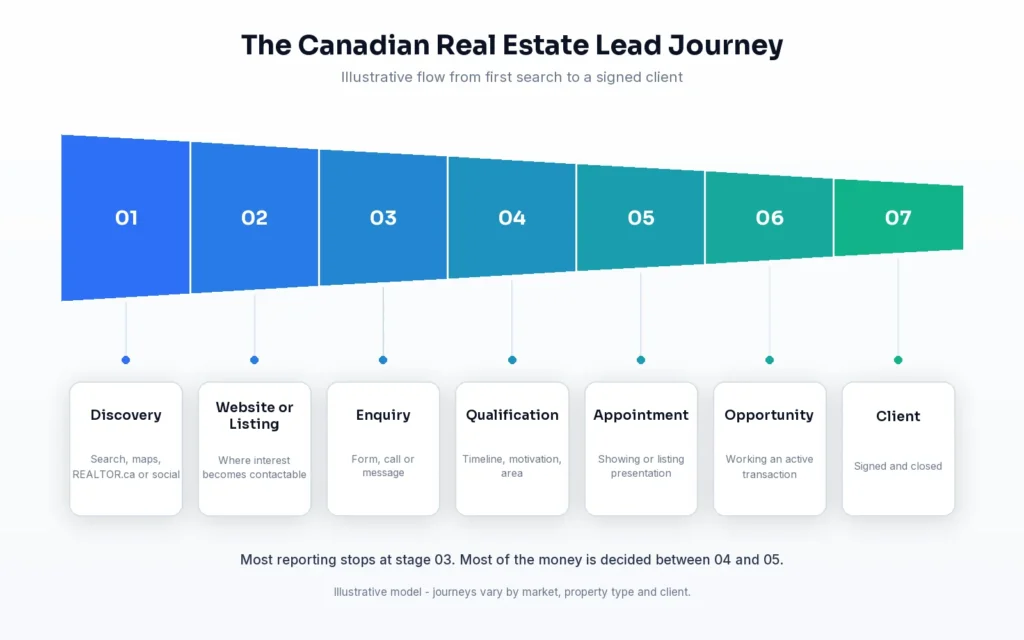
Most marketing reporting stops at the enquiry. Most of the money is made or lost in the two steps after it. A brokerage with average lead volume and a disciplined follow-up process will beat one with twice the leads and nobody minding them.
Speed matters more than almost anything else at that junction. If several agents hold similar inventory or appear in the same search, the one who replies first tends to get the appointment. Improving median response time usually produces a bigger commercial gain than an equivalent effort spent lowering cost per lead, because it changes the conversion rate on leads you have already paid for.
The Qualified Lead Ladder
Cheap leads are often the most expensive thing a brokerage buys, because they consume agent hours and produce nothing. Naming the stages makes the waste visible:
| Stage | What it means | What it tells you |
|---|---|---|
| Visitor | Someone reached your site or profile | Your visibility is working |
| Enquiry | A form, call or message arrived | Your message and offer are landing |
| Marketing-qualified | Real contact details, relevant area and property interest | Targeting is roughly correct |
| Sales-qualified | An agent has spoken to them and confirmed timeline and intent | The lead is genuinely commercial |
| Appointment | A listing presentation or showing is booked | The strongest early predictor of revenue |
| Active opportunity | Working with them on a specific transaction | Forecastable pipeline |
| Client | Signed representation or a completed deal | The only number that pays anyone |
If an agency reports only the first two rows, they are reporting their own activity rather than your outcome. Ask for the ladder.
CASL, Consent and Follow-Up That Does Not Get You Fined
Here is where Canadian real estate marketing genuinely diverges from the American playbook, and where a lot of imported advice becomes dangerous.
Canada’s Anti-Spam Legislation governs commercial electronic messages — broadly, messages that encourage participation in a commercial activity. Marketing email and text messages to prospects sit squarely inside that. According to CRTC guidance, sending a commercial electronic message requires three things: consent, identification information, and an unsubscribe mechanism.
Consent can be express or implied, and the distinction matters because implied consent generally expires. Identification means naming your business, naming anyone else on whose behalf you are sending, and including a mailing address. The unsubscribe mechanism has to work, be easy to find and use, and requests must be honoured without delay and in all cases within ten business days.
What that rules out is the tactic imported agencies still recommend: buying lists, scraping addresses, or dropping every business card from an open house into an automated drip. What it rewards is a properly built consent flow at the point of enquiry, clear records of when and how consent was given, and follow-up sequences that identify you correctly and let people leave.
This is a practical summary for marketing planning, not legal advice. Penalties under CASL are significant and the rules have nuances this article does not cover, so get proper guidance before building a nurture programme.
Privacy and the Data You Collect
Every valuation tool, property alert, chat widget and lead form collects personal information, and a brokerage is responsible for what happens to it afterwards.
Federal private-sector privacy law generally requires organisations to be clear about what they collect and why, to obtain meaningful consent, to use the information only for the stated purpose, and to protect it. Some provinces have their own private-sector privacy legislation that applies instead of or alongside the federal regime, and Quebec’s framework in particular has moved substantially in recent years.
The marketing-side implications are concrete. Know what your forms actually collect and whether you need all of it. Have a privacy policy that describes reality rather than a template. Understand where lead data flows once it leaves your site — CRM, ad platforms, email tools, chat providers are all third parties. And do not retain everything forever because storage is cheap. Again: verify your obligations with a qualified adviser rather than relying on a marketing article.
Advertising Rules Are Provincial, Not National
There is no single Canadian rulebook for real estate advertising. Registration and conduct are regulated province by province, which means the requirements that govern your ad copy depend on where you are licensed.
In Ontario that is the Real Estate Council of Ontario. In British Columbia it is the BC Financial Services Authority. In Quebec it is the Organisme d’autoréglementation du courtage immobilier du Québec. Other provinces have their own regulators, and the details differ.
The recurring themes across regulators tend to involve identifying the brokerage properly in advertising, representing your own registration accurately, and not making claims you cannot support. Social media is advertising too, which catches people out — an Instagram post promoting a listing is subject to the same expectations as a newspaper ad.
What you should not do is assume one province’s guidance covers the country, or take an agency’s word for what your regulator requires. Check your own regulator’s current advertising guidance, and treat this section as a prompt to do that rather than as the answer.
Separately, marketing claims are subject to federal competition law. Unsupportable superlatives — the “number one agent” badge with nothing behind it, invented awards, manufactured scarcity — carry real risk beyond simply looking unserious.
REALTOR® and MLS® Are Trademarks, Not Generic Words
This one catches almost every marketing agency that has not worked in Canada, and it shows up directly in ad copy.
The REALTOR® trademark is controlled by the Canadian Real Estate Association. Only CREA members are licensed to use it. As CREA puts it, not every real estate agent is a REALTOR® — and the mark must not be used as a synonym for real estate agent. CREA’s guidance on advertising requires the mark to appear in capitals with the registered symbol, and asks that advertising carrying it include a trademark statement where space allows, such as “Not every real estate agent is a REALTOR®. Only REALTORS® are members of CREA.”
CREA also illustrates the distinction with job titles. Writing that your job is a REALTOR® is misuse; the correct framing separates the occupation from the membership — you are a salesperson, and you are also a REALTOR®.
MLS® carries similar constraints. It identifies a co-operative service provided by REALTORS®, and CREA is explicit that it must never be used as a synonym for a database, nor appear in a business name, trade name or corporate branding.
Why this belongs in a marketing article rather than a legal one: these words appear in page titles, meta descriptions, ad headlines, image alt text and domain names. An agency that sprinkles “realtor” through your site as a keyword is creating exposure for you, not visibility. If you are not a CREA member, the correct words are real estate agent, broker, brokerage or real estate professional — and those terms carry search demand of their own.
Quebec Is a Market, Not a Translation
If you sell in Montreal or Quebec City, French is not an SEO opportunity you can take or leave.
Quebec’s Charter of the French language, substantially reformed by Bill 96, sets French-language requirements for commercial communications. The broad principle relevant to marketers is that commercial content directed at Quebec consumers needs a French version that is at least as complete and as prominent as any other language, and the Office québécois de la langue française oversees compliance. Provisions covering commercial advertising and signage came into force in 2025. Obligations vary by business size and circumstance, so confirm what applies to you before acting.
The marketing consequence is bigger than a translation invoice. A machine-translated mirror of your English site is both a compliance risk and an SEO liability — thin, awkward pages that rank for nothing and read badly to the people you are trying to win. Doing Quebec properly means native-quality French, French keyword research (the terms people actually use are not literal translations), French metadata and internal linking, and enough local knowledge to write about a Montreal borough credibly.
It also means being honest about capacity. If nobody in the brokerage can handle a French enquiry, publishing French pages generates conversations you cannot serve. That is worse than staying English-only and focusing elsewhere.
Agent, Team or Brokerage
These three are routinely handed the same marketing plan, which is why it fails for at least two of them.
| Area | Individual agent | Team | Brokerage |
|---|---|---|---|
| Brand | Personal name and face | Team identity, agent faces underneath | Corporate brand plus individual agents |
| SEO focus | One or two neighbourhoods, done properly | Several local niches | Multi-market architecture and internal linking |
| Content | First-hand local knowledge | Shared production, distinct voices | Editorial system with governance |
| Local SEO | One profile, reviews are everything | Profile plus agent visibility | Office locations and agent profiles at scale |
| Paid media | Tight targeting, modest budget | Segmented by area and intent | Multiple campaigns, brand plus performance |
| CRM | A pipeline one person can hold in their head | Routing and accountability | Attribution across offices and channels |
| What to measure | Appointments booked | Appointments per agent | Cost per client by channel and office |
A brokerage running an agent’s playbook underinvests in structure. An agent running a brokerage’s playbook spends money on infrastructure they will never use.
Not Every Canadian Market Wants the Same Thing
Treating Canada as one market produces bland campaigns that work nowhere in particular. A few honest generalisations, offered as prompts to research rather than facts to copy:
Toronto and the GTA are dense, competitive and condo-heavy, with search behaviour that fragments quickly into neighbourhoods and buildings. Vancouver shares the density and competition, with municipality distinctions that locals take seriously and outsiders get wrong. Calgary has seen meaningful relocation interest, which changes the questions newcomers ask and the content that answers them. Montreal adds a language dimension on top of everything else, and a distinct professional framework.
The point is not the specifics, which move. It is that a campaign built for one of these and reused in another will misjudge the vocabulary, the property mix and the competitive intensity all at once.
Choosing Between SEO, Ads, Meta and REALTOR.ca
There is no universal winner. Each does a different job, and the right mix depends on how quickly you need pipeline and how long you can invest.
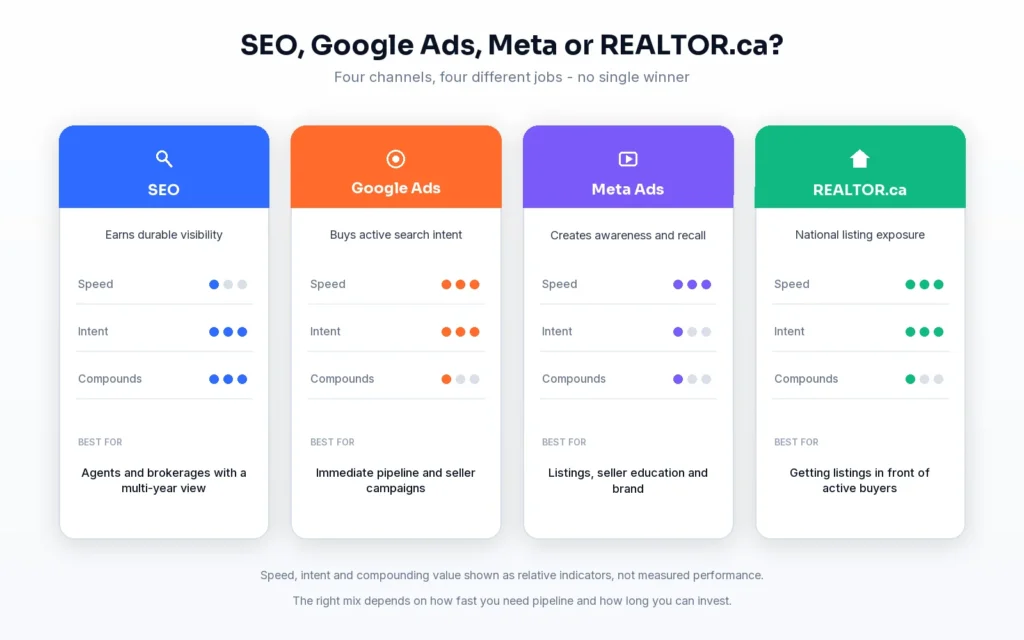
| Channel | What it does | Speed | Intent | Compounds | Best for | Main risk |
|---|---|---|---|---|---|---|
| SEO | Earns durable visibility | Slow | High | Yes | Brokerages and agents with a multi-year view | Needs sustained investment before returns |
| Local SEO | Wins proximity and map searches | Medium | High | Yes | Anyone with a real office or defined service area | Reviews and accuracy need ongoing attention |
| Google Ads | Buys active search intent | Fast | High | No | Immediate pipeline, seller campaigns | Stops with the budget; targeting is restricted |
| Meta Ads | Creates awareness and recall | Fast | Low | No | Listings, seller education, brand | Creative fatigue; restricted targeting |
| REALTOR.ca | Puts listings in front of national demand | Immediate | Very high | No | Listing exposure and agent profile views | Dependency; the platform owns the relationship |
A workable sequence for most: use the portal and paid media to fund this quarter, and build local SEO, reviews and content so next year costs less.
Measuring What Actually Matters
Traffic, impressions, clicks and followers describe activity. None of them pay anyone. A reporting framework worth having follows the money:
Impression → click → visitor → enquiry → qualified lead → appointment → opportunity → client → revenue.
The metrics that survive scrutiny are cost per qualified lead, appointment rate, lead-to-opportunity rate, close rate and customer acquisition cost, reported separately for portal, paid and organic sources. Blending them hides which part of the machine is improving.
Two are worth watching more closely than the rest. Median response time, because it is usually the cheapest thing to fix and the most expensive thing to ignore. And appointment rate, because it is the earliest honest signal of lead quality — available weeks before anything closes.
A 90-Day Growth Framework
Illustrative only — actual priorities and timelines vary by business, market and competition. But the sequence matters more than the dates, and it is nearly always diagnose, build, then scale.
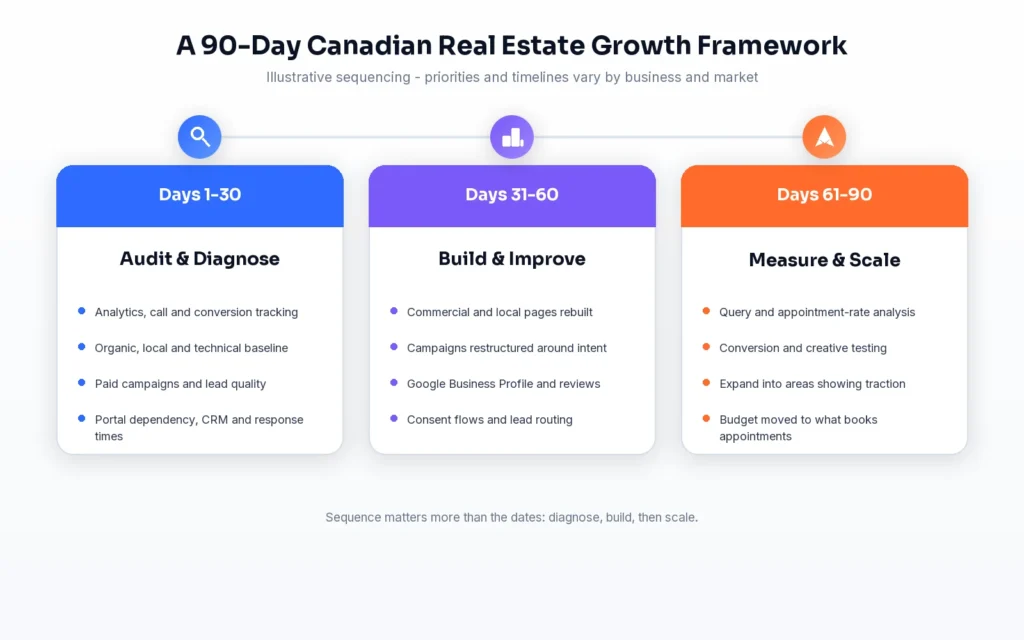
Days 1 to 30 — audit and diagnose
Find out what is actually happening before changing anything. That means verifying analytics and conversion tracking including calls, reviewing Search Console and technical health, baselining organic and local visibility, auditing paid campaigns for wasted spend and lead quality, checking the Google Business Profile properly, looking honestly at how dependent the pipeline is on REALTOR.ca, reviewing the CRM and measuring real response times, examining consent and unsubscribe flows against CASL, and reading the competitors who are beating you.
Days 31 to 60 — build and improve
Now fix things in priority order. Rewrite or build the commercial pages that earn enquiries. Ship the technical fixes. Restructure campaigns around intent and rebuild landing pages for the highest-spend ones. Complete conversion tracking end to end. Sort out the Business Profile and start a genuine review process. Get lead routing, qualification and response-time standards in place. Begin the content that will not pay off for months, because starting late is the only guaranteed mistake.
Days 61 to 90 — measure and scale
Look at search queries and landing pages, qualified leads and appointment rates by channel and area, and which content is assisting conversions. Test the highest-traffic enquiry paths. Iterate creative on evidence rather than taste. Expand into the neighbourhoods showing early traction, and move budget toward whatever is producing appointments rather than whatever is producing the most leads.
How to Choose an Agency
Most pitches sound identical. These questions separate them quickly, because they are hard to answer convincingly without real Canadian experience.
- How do you define a qualified lead for our business, and what will you report?
- How do the Google and Meta housing targeting restrictions change what you can do for us in Canada?
- How would our plan differ if we were a single agent rather than a twenty-agent brokerage?
- How do you handle CASL consent in the follow-up sequences you build?
- What is your position on REALTOR® and MLS® trademark usage in our copy?
- How do you measure enquiries that arrive by phone rather than a form?
- How do you report portal leads separately from organic and paid?
- Who owns the ad accounts, analytics, CRM data and content if we part ways?
- What would you refuse to promise us?
That last one is the most useful question in the conversation. An agency that will not name its limits has not thought about them.
Red Flags
- Guaranteed rankings, guaranteed lead volumes or guaranteed sales
- Promises of placement or citations in ChatGPT or AI Overviews
- Cost per lead figures quoted before anyone has looked at your market
- Using REALTOR® as a generic word for agent, or MLS® as a word for a database
- Plans to generate dozens of near-identical city or neighbourhood pages
- Advice that treats one province’s advertising rules as national
- Email programmes built on purchased or scraped lists
- Reporting that stops at traffic, impressions or raw lead count
- Ad accounts or CRM data held in the agency’s name
- Unsupported “number one” or “best in Canada” claims, including about themselves
How Apzom Digital Can Help
Apzom Digital is a digital marketing agency based in Ahmedabad, India, working with clients internationally. We do not have a Canadian office, and we would rather say that plainly than imply a local presence we do not have. Canadian real estate businesses work with us remotely, with scheduled reporting, shared dashboards and clear ownership of accounts and data.
The services relevant here are SEO, local SEO, answer engine optimisation, generative engine optimisation, content marketing, social media marketing, Google Ads, Meta Ads, conversion rate optimisation and website development.
On the compliance side we work alongside your brokerage and its advisers rather than claiming to manage regulatory obligations for you. Provincial advertising rules, CASL and privacy obligations sit with the licensed business, and any agency blurring that line is worth questioning.
Request a Real Estate Digital Growth Audit
If you want a clear read on where your marketing is leaking, start with a diagnostic rather than a proposal. A useful audit should look at organic and local visibility across the areas you actually serve, competitor visibility, paid campaign structure and wasted spend, lead quality measured against the ladder above, website and landing page conversion on mobile, enquiry paths including phone, response times and CRM routing, portal dependency versus owned demand, consent and follow-up flows, AI-search readiness, and the content gaps worth filling first.
Get in touch to talk it through, or request a quote if you already know the scope you need.
Frequently Asked Questions
What is real estate digital marketing in Canada?
It is the combination of search visibility, local search, listing exposure on REALTOR.ca, paid campaigns on Google and Meta, content and follow-up that turns online attention into booked appointments. What makes it distinctly Canadian is the compliance layer around it: provincial advertising rules, CASL for email and texts, housing targeting restrictions on the ad platforms, and French-language requirements in Quebec.
Is SEO worth it for Canadian real estate agents?
For anyone planning to still be in the business in three years, usually yes, because organic and local visibility reduce how much of your pipeline you rent. It is a poor fit if you need appointments this month and have no existing foundation — in that case paid search and the portal carry the pipeline while SEO is built underneath.
What is the difference between a real estate agent and a REALTOR® in Canada?
REALTOR® is a trademark controlled by the Canadian Real Estate Association and may only be used by CREA members. Not every real estate agent is a REALTOR®. In marketing copy, use real estate agent, broker or brokerage as the general terms, and reserve REALTOR® for CREA members, written in capitals with the registered symbol.
How can Canadian real estate agents generate leads online?
By combining intent capture with fast, disciplined follow-up. The channels matter less than the operational layer: an agent who replies within minutes, qualifies on timeline and motivation, and books an appointment will out-earn one with better ads and slower responses.
SEO or Google Ads — which is better for real estate?
They solve different problems. Google Ads buys visibility on high-intent searches immediately and stops when the budget does. SEO takes months, then compounds and lowers future acquisition cost. Most businesses need both, with the balance shifting toward organic as it matures.
What is local SEO for real estate agents?
It is the work of showing up when someone searches with a place attached — in the map results, on Google Maps and in the local pack. The main levers are a complete and accurate Google Business Profile, genuine reviews, consistent business information, and pages that demonstrate real knowledge of the areas you serve.
Does CASL affect real estate email marketing?
Yes. Marketing emails and texts are commercial electronic messages under CASL, which means you need consent, proper identification including a mailing address, and a working unsubscribe honoured within ten business days. Purchased and scraped lists are exactly what the legislation targets.
Can Canadian real estate businesses rely only on REALTOR.ca?
It works, until it is the only thing you have. REALTOR.ca delivers genuine national demand, but the platform owns the relationship with that buyer and you compete on responsiveness rather than brand. Most durable businesses use it for exposure while building owned visibility that lowers acquisition cost over time.
Can we target specific postal codes in Google Ads for real estate?
Not full postal codes. Google restricts personalised advertising for housing in Canada and the United States, which rules out ZIP and full postal code targeting along with gender, age, parental status and marital status. In Canada the first three characters of a postal code, the FSA, remain acceptable for targeting, as do radius targeting of at least one kilometre, city and country.
Do we need a French version of our website for Quebec?
If you market commercially to Quebec consumers, French obligations under the Charter of the French language are likely to apply, and the French version generally needs to be at least as complete and prominent as the other language. Beyond compliance, a machine-translated mirror performs badly in French search and reads poorly. Confirm your specific obligations with a qualified adviser.
How do I choose a real estate digital marketing agency in Canada?
Ask how they define and report a qualified lead, how the housing targeting restrictions change their approach, how they handle CASL consent, what they know about REALTOR® trademark usage, and who owns the accounts and data if you leave. Specific answers indicate real experience. Vague ones indicate a template.
Where to Start
If you take one thing from this: stop measuring leads and start measuring appointments. Almost every other decision gets easier once you can see which channel produces people who actually show up.
After that, the order is usually unglamorous. Fix the Google Business Profile. Get the tracking right so you know what is working. Build consent properly into the follow-up. Then start the slow work — local content, reviews, the pages that earn search visibility — because that is the part that lowers what you pay for a client next year.
If your market is the United States rather than Canada, the channel mix is similar but the rules are not. Our guide for US agents and brokerages covers that version of the problem.