
Case study
ARKS Infinity Logistics: a 51-page platform, built from a blank page.
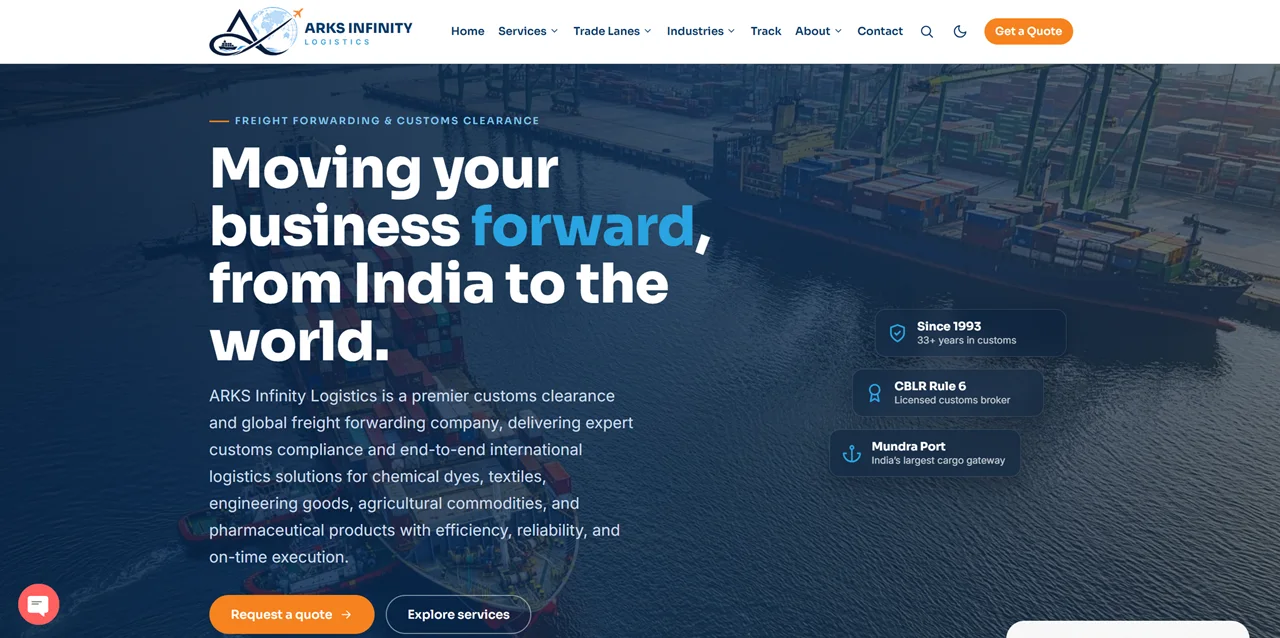
Custom WordPress theme and companion plugin — no template. Six services, nine international trade corridors and seven commodity verticals, structured so a visitor reaches their exact case in two clicks.
Case study
Project overview
ARKS Infinity Logistics Pvt. Ltd. is an international freight forwarding and customs advisory company based in Ahmedabad, Gujarat, operating in the Mundra Port ecosystem. Its founder has worked in Indian customs since 1993 and has qualified the customs broker examination under Regulation 6 of the Customs Brokers Licensing Regulations, 2018 — a personal qualification, not a company licence.
The company needed its first full digital presence: a website that could explain a genuinely complicated service, stand up to scrutiny from corporate procurement teams, and generate qualified enquiries.
I planned, designed, built, tested and deployed the entire website. It was built from scratch — a custom theme and a custom companion plugin, not a purchased template with the colours changed.
| Client | ARKS Infinity Logistics Pvt. Ltd. |
| Industry | Freight forwarding, customs advisory, international shipping |
| Website | arksinfinity.com |
| Platform | WordPress · custom child theme · custom plugin · GeneratePress framework |
| Scale delivered | 51 indexable URLs — 44 pages, 4 articles, 3 category archives |
| Project type | Complete design and development, strategy through launch |
| Launched | July 2026 |
The starting point
There was no previous website to improve. ARKS Infinity was a newly incorporated company with deep operational expertise and no digital footprint at all — no site, no content architecture, no search presence, no enquiry channel.
That is a harder brief than a redesign. A redesign inherits decisions. This one required every decision to be made from nothing: what the business actually sells, how buyers search for it, how to structure it, and how to make a first-year company credible to buyers who verify their suppliers.
Project objectives
- Explain a multi-layered service offering without overwhelming a first-time visitor.
- Establish credibility for a new company in a trust-critical industry.
- Create an architecture that could rank for commercial searches across services, destinations and commodities.
- Build clear paths from arrival to enquiry.
- Hand over a platform the client could extend themselves, without a developer.
My role
Sole strategist, designer, developer and QA on the project. End to end, that covered:
- Strategy and research — business discovery, competitor review, logistics-sector research, requirements analysis.
- Architecture — sitemap, URL structure, navigation design, internal linking model.
- Design — UI/UX planning, visual design system, typography, component design, responsive layouts.
- Development — custom WordPress child theme, custom companion plugin, block-based page construction, reusable components, custom forms.
- Conversion — CTA strategy, quote journey, enquiry handling, lead storage.
- SEO — technical SEO, on-page optimisation, semantic and entity structure, metadata, structured data, crawlability.
- Performance and security — asset optimisation, image conversion, caching, security headers, hardening.
- Launch — cross-device and cross-browser testing, full pre-launch audit, deployment, post-launch fixes.
The core challenge: three dimensions, one navigation bar
A freight forwarder does not sell one thing. It sells a service, applied to a commodity, moving along a corridor. A customer might need customs clearance for pharmaceuticals going to Canada, or door-to-door delivery of chemical dyes to the UAE.
Most logistics websites collapse that into a single flat services list, which fails two audiences at once. The exporter who knows exactly what they need cannot find their specific case. And search engines see one thin page trying to rank for hundreds of distinct queries.
The architecture had to hold all three dimensions without turning the navigation into a maze.
The solution: three parallel content systems
I built three independent but interlinked page families, each answering a different question a buyer arrives with.
| System | Answers | Pages |
|---|---|---|
| Services | “What can you do for me?” | 6 — Freight Forwarding, Customs Advisory & Clearance Facilitation, Door-to-Door Delivery, Documentation & Compliance, Warehousing, Cargo Insurance |
| Trade Lanes | “Do you ship where I need to go?” | 9 — USA, UAE, Canada, Vietnam, Thailand, Europe, Australia, New Zealand, Latin America |
| Industries | “Do you understand my cargo?” | 7 — Chemical Dyes & Intermediates, Textile & Garments, Engineering Goods, FIBC / Jumbo Bags, Agro Products, Pharma Machinery, Pharmaceuticals |
Each family has its own hub page (/our-services/, /trade-lanes/, /commodities/) and its own dropdown. A visitor never has to understand the whole business — only the dimension they arrived thinking about.
Why this matters commercially
Real logistics searches are compound. Somebody types “customs clearance for pharmaceuticals to Canada”, not “logistics company”. A single services page cannot answer that. Three intersecting systems can, because any two dimensions combine into a specific, low-competition, high-intent query.
It also creates room to grow. A new corridor or commodity is a new page inside an existing pattern, not a redesign. The architecture was built to be extended.
UI/UX strategy
The design brief was not “make it look good”. It was: make a visitor understand five things fast — what ARKS does, where it ships, which cargo it handles, why it can be trusted, and how to ask for a price.
Trust-first hierarchy
In freight forwarding the buyer is handing over high-value cargo and regulatory liability. Trust has to be established before capability is even read. The homepage therefore leads with a credentials strip immediately below the hero — company registration, the founder’s customs qualification, systems capability, years in the trade — before any sales copy.
The eleven-section homepage
The homepage runs a deliberate sequence: positioning hero → credentials → the founder’s customs background → services → a commercial value section on duty recovery and penalty exposure → the nine-corridor network with an animated route map → process → a commodity-by-corridor table → shipment status → FAQs → closing call to action.
Each section answers the question the previous one raises. Interest, then proof, then capability, then specificity, then action.
Design decisions
- Navigation: seven top-level items with icon mega-dropdowns, kept to a single row so the header stays compact.
- Scannability: long compliance content broken into cards, checklists and tables rather than paragraphs, so a specialist can skim to the clause they care about.
- Typography: Sora for headings, Inter for body — a geometric/neutral pairing that reads as corporate rather than consumer.
- Persistent conversion: a “Get a Quote” button pinned in the header on every page, plus contextual calls to action at the end of each service, lane and commodity page.
WordPress development
This is a custom build on WordPress, not a theme install. The work splits across two pieces of code I wrote for this client.
Custom child theme
Holds the design system — the full stylesheet, the JavaScript, and the PHP that controls layout, the footer, blog templates and the site’s structural behaviour. Built on GeneratePress as a lightweight framework rather than a page-builder, which is why the front end ships without the DOM bloat a builder introduces.
Custom companion plugin
Holds the functionality that must survive a theme change: custom content types, the enquiry system, security hardening, block patterns and structured-data output. Separating theme from function is deliberate — the client can restyle in future without losing their data or their forms.
Built to be handed over
Pages are Gutenberg blocks with a shared component vocabulary — hero, section, card grid, feature, checklist, steps, call to action. The client edits content in the normal WordPress editor. No page builder licence, no developer dependency for routine changes, no rebuild required to add a page.
One thing I had to solve during handover: the client’s editor account was silently stripping inline SVG icons on every save, because WordPress filters unfiltered HTML for non-administrator roles. I added a filter to the plugin whitelisting the specific SVG elements and attributes the design uses. The client can now edit any page without breaking the iconography.
Lead generation and the quote journey
Two distinct paths, because two different visitors need two different things.
The quote form
A nine-field form built for shipment scoping rather than generic contact: name, company, email, phone, origin, destination, commodity, service required (ocean freight, air freight, customs advisory, end-to-end orchestration, project and heavy cargo) and shipment details. Origin and destination are the fields that let the operations team price a lane instead of replying with “what are you shipping?”.
The enquiry form
A separate contact form capturing commodity and destination alongside the usual details — again, structured so the first reply can be substantive.
A submission system that cannot lose a lead
I wrote a custom handler rather than installing a form plugin. Every submission is stored as a record in the WordPress admin and emailed to the team. If mail delivery fails — a genuine risk on shared hosting — the enquiry is still saved and visible. Spam is filtered with a honeypot field rather than a CAPTCHA, so there is no friction for real users.
Shipment status requests
The homepage carries a short status-request form — reference number and email — that routes to the operations desk. The dedicated tracking page explains the milestone communication process and states plainly that a self-service portal is still in development. The site does not claim live tracking software it does not have, which was a deliberate decision.
SEO strategy
Architecture as the primary SEO asset
The three-system structure is the SEO strategy. Twenty-two commercial landing pages exist because there are twenty-two distinct commercial intents, each with its own URL, heading structure and internal links.
That lets the site address compound queries — service plus destination, commodity plus destination, service plus commodity — that a flat brochure site cannot reach. These are lower-volume searches with far higher intent and far lower competition than head terms like “freight forwarder”.
Verified on-page foundations
Audited across all 51 indexable URLs:
- Exactly one H1 per page across the entire site.
- Unique title and meta description on every page. Titles run 30–65 characters, descriptions 111–163 — inside display limits rather than truncated.
- Clean, readable URLs that describe the page:
/india-to-usa/,/chemical-dyes-intermediates/,/custom-clearance-cha/. - Structured data — Organization, WebSite, WebPage, Article and CollectionPage output across the site.
- Hub-and-spoke internal linking — hubs distribute to their children; children link back and across to related services.
- Crawlable and indexable — clean robots.txt, live XML sitemap index, all 51 URLs returning 200.
Entity and topical signals
The compliance depth doubles as semantic SEO. Pages use the vocabulary the industry actually searches with — IMDG classes, REACH registration, ISPM-15, preferential origin documentation, duty drawback, RoDTEP — which builds topical authority no amount of generic copy can substitute for. The founder’s customs qualification and the company registration number provide the entity signals that support E-E-A-T in a regulated field.
Performance and technical delivery
Methodology: three anonymous, cache-busted requests per page, median reported. Cache-busting forces a full origin render, so these figures represent the slowest realistic case — a cached response to a normal visitor is faster. These are server response and payload measurements, not Lighthouse scores, and I have not published a PageSpeed number because I did not run one.
| Page | Median response | HTML payload |
|---|---|---|
| Homepage | 171 ms | 115 KB |
| Customs Advisory & Clearance Facilitation | 141 ms | 90 KB |
| India → USA | 205 ms | 79 KB |
| Chemical Dyes & Intermediates | 207 ms | 84 KB |
| Contact | 157 ms | 79 KB |
Supporting measurements: 5 stylesheets, 6 scripts, 603 DOM nodes on a representative page, served over HTTP/2 with Brotli compression and LiteSpeed page caching. Those are lean numbers for a site of this size, and they are a direct consequence of not using a page builder.
Asset and rendering work
- Every content image converted to WebP.
- The route map built as inline SVG over a 49 KB raster basemap rather than a heavy JavaScript mapping library.
- Explicit
widthandheighton inline SVG icons — without them an icon renders full-container-width if the stylesheet is slow or stale, which is a genuine layout-shift risk I hit and fixed during QA. - Server-side page caching enabled at launch.
Security configuration
Verified live on the production site:
- Content-Security-Policy, Strict-Transport-Security, X-Content-Type-Options: nosniff, X-Frame-Options: SAMEORIGIN, Referrer-Policy and Permissions-Policy all present.
- X-Powered-By removed — no PHP version disclosure.
- XML-RPC disabled at both application and server level.
- REST user enumeration blocked. This was the most important find of the pre-launch audit: the default WordPress REST endpoint was exposing the administrator account name, which is half of a brute-force attempt. Closed before the site was public.
Responsive delivery and quality assurance
The site was built and tested across desktop, laptop, tablet and mobile. Navigation collapses to a mobile menu, multi-column grids stack, the commodity-by-corridor table reflows, and forms remain usable on narrow screens with touch targets sized for thumbs rather than cursors.
Pre-launch audit
I crawled and audited the full site before go-live. The audit closed with zero outstanding issues across 51 pages:
- 0 errors or fatals · 0 broken internal links across 47 checked
- 1 correct H1 per page · 0 missing image alt text
- 0 missing or out-of-range titles and descriptions
- Canonicals and structured data present sitewide
- Responsive verified from 320 px to 1920 px
- Security endpoints confirmed blocked
Bugs found and fixed during QA
Two worth recording, because both were invisible in normal testing:
- Unsized inline SVGs. Icons authored with only a
viewBoxrender at full container width whenever CSS is stale or slow — the page appears to explode. My own checks passed because my browser had fresh CSS. Fixed by adding explicit dimensions to every icon and re-testing with the stylesheet disabled. - A broken scroll behaviour. A CSS performance property I had added broke scroll anchoring on long pages, and the framework’s back-to-top control never activated. Both replaced with a custom implementation and verified.
Building credibility for a first-year company
Early drafts of the content carried the numbers logistics templates ship with: millions of shipments delivered, a 99.6% on-time rate, a row of client logos, a fleet of owned warehouses.
None of it was true. The logos were invented company names. The warehouses did not exist. The company was in its first year.
I stripped all of it out before the site went live, and it was a commercial decision rather than a moral one. ARKS sells to procurement and compliance teams who run supplier due diligence. A claim that fails a background check does not merely fail to persuade — it ends the relationship silently, and you never learn why.
What replaced it
Credentials that survive verification:
- Corporate Identification Number, published in the footer — independently checkable on the MCA register, and legally required on an Indian company website.
- CBLR-qualified leadership — the founder’s customs broker examination under Regulation 6 of CBLR 2018, presented as a personal qualification, never as a company licence.
- Founder’s record in customs since 1993, stated consistently everywhere rather than inflated on one page and contradicted on another.
- ICEGATE and E-Sanchit familiarity — the customs documentation systems Indian shipments run through, with filing carried out by licensed customs broker partners.
- A real corporate address plus the Mundra operational hub, both published.
The badges I refused to add
The client could have displayed FIATA and ISO marks. I left them off, because their own accreditations page lists both as planned rather than held. A certification mark you have not earned is not decoration — it is a claim, and in this sector the wrong reader checks it.
I also repositioned the company as asset-light — corridor specialisation and vetted bonded partners — because that is what it is. The earlier “owned fleet” framing would have collapsed under the first serious question.
Challenges and solutions
| Challenge | Solution |
|---|---|
| A service defined by three variables at once — service, commodity, corridor | Three parallel page families with their own hubs and dropdowns, cross-linked |
| No prior website, no brand presence, no search footprint | Complete architecture, design system and content ecosystem built from zero |
| A first-year company selling to buyers who run due diligence | Verifiable credentials only; every unprovable claim removed |
| Technical audience and non-technical audience on the same page | Plain-language summaries up top, specialist detail in scannable cards and checklists below |
| Enquiries lost to unreliable shared-hosting email | Custom handler storing every submission in the admin as well as emailing it |
| Client edits breaking the design after handover | SVG whitelist filter so non-admin editors cannot strip iconography |
| Nine corridors and seven commodities to add without a rebuild | Reusable block components and a repeatable page pattern |
Development process
The project ran in four stages across roughly three weeks of build, plus a pre-launch audit and post-launch fixes.
- 1 · Discovery and architecture. Business and competitor research, requirements analysis against the client brief, sitemap and URL planning, navigation design.
- 2 · Design system and homepage. Visual language, typography, colour tokens, component library, then the homepage as the reference implementation every later page inherits.
- 3 · Content systems, in three phases. Phase one delivered the core services and first corridors; phase two the remaining lanes and commodities; phase three the network, credentials and company pages. Building in phases meant each pattern was proven before it was repeated twenty times.
- 4 · Conversion, SEO, hardening and launch. Forms and lead storage, metadata and structured data across all pages, image conversion, security headers, responsive and cross-browser QA, full audit, then deployment.
Post-launch I ran a further round of fixes on client feedback — corrected statistics, the credibility purge described above, accessibility labelling on third-party widgets, and the scroll and SVG bugs found in QA.
Starting point vs delivered solution
| Starting point | Delivered |
|---|---|
| No website | 51 indexable URLs on a custom WordPress platform |
| No way to explain the offering | Three interlinked systems: 6 services, 9 corridors, 7 commodities |
| No enquiry channel | Quote form, enquiry form and status requests, all stored in-admin |
| No search presence | 22 commercial landing pages, unique metadata, structured data, live sitemap |
| No credibility signals | Verifiable registration, licensing and operational credentials |
| No content capability | Blog infrastructure and reusable components the client manages alone |
Results and strategic impact
Verified outcomes
Directly observable on the live site today:
- 51 indexable URLs, every one returning 200.
- Zero broken internal links across 47 checked.
- One H1 per page and unique, in-range metadata sitewide.
- Median server response 141–207 ms on cache-busted requests, with 79–115 KB HTML payloads.
- Six security headers live, version disclosure removed, user enumeration blocked.
- Pre-launch audit closed at zero outstanding issues.
Strategic outcomes
Built into the architecture, not yet measurable:
- A structure that can target compound commercial queries head-on rather than competing for generic head terms.
- A credibility position that survives procurement due diligence — increasingly the deciding factor for corporate freight buyers.
- Content infrastructure the client extends without a developer.
- A lead system where no enquiry is lost to email failure.
What is not claimed
No traffic, ranking, lead-volume or revenue figures appear in this case study. Analytics were still being configured at launch, so no meaningful measurement window exists yet. Publishing an estimate would contradict the entire premise of the project. When real data exists and the client has approved it, it will be added here.
Key takeaways
- Architecture is strategy. The three-system structure is simultaneously the UX solution, the SEO solution and the scalability solution. Getting it right made everything downstream easier.
- In regulated industries, subtraction beats addition. Removing unverifiable claims made the site more persuasive to the buyers who matter, not less.
- Domain vocabulary is a moat. Content using the terms the industry actually searches with cannot be replicated quickly by a competitor without the operational knowledge behind it.
- Build for the handover. Anticipating how a non-technical client would break things — and preventing it in code — was as important as the build itself.
Services provided on this project
Every part of this engagement was delivered in-house by the same team:
- Website development — custom WordPress child theme and companion plugin, built from scratch rather than from a template.
- SEO services — information architecture, on-page foundations and topical structure across 51 pages.
- AEO services — entity signals and answer-ready structure so the business can be described accurately by search and AI systems.
- Conversion rate optimisation — the quote and enquiry journeys, and a submission system designed not to lose a lead.
- Branding and creative design — visual identity and the trust-first hierarchy used across the site.
More context on how this work is scoped and sequenced: our process and SEO methodology. Other engagements are listed under case studies and portfolio.
Project snapshot
| Client | ARKS Infinity Logistics Pvt. Ltd. |
| Industry | Logistics, freight forwarding, customs clearance |
| Website | arksinfinity.com |
| Platform | WordPress — custom child theme + custom plugin, GeneratePress framework |
| Project type | Complete website design and development |
| Development | Built from scratch |
| Scale | 51 indexable URLs · 22 commercial landing pages |
| Services | Strategy · Information architecture · UI/UX · WordPress development · Custom plugin development · Responsive development · Technical SEO · Conversion optimisation · Performance · Security · QA · Deployment |
| Launched | July 2026 |